

Top UEFA officials under more scrutiny by media, prosecutors
Advertisement
Read this article for free:
or
Already have an account? Log in here »
To continue reading, please subscribe:

Digital Subscription
One year of digital access for only $205*
- Enjoy unlimited reading on winnipegfreepress.com
- Read the E-Edition, our digital replica newspaper
- Access News Break, our award-winning app
- Play interactive puzzles
*First annual payment billed as $205.00 + GST for one year. This annual subscription will automatically renew at $233.00 + GST every 52 weeks (10% off the regular annual price of $259.35). Offer available to new and qualified returning subscribers only. Cancel any time.
To continue reading, please subscribe:
Add Free Press access to your Brandon Sun subscription for only an additional
$1 for the first 4 weeks*
- Enjoy unlimited reading on winnipegfreepress.com
- Read the E-Edition, our digital replica newspaper
- Access News Break, our award-winning app
- Play interactive puzzles
*Your next Brandon Sun subscription payment will increase by $1.00 and you will be charged $17.95 plus GST for four weeks. After four weeks, your payment will increase to $24.95 plus GST every four weeks.
Read unlimited articles for free today:
or
Already have an account? Log in here »
Hey there, time traveller!
This article was published 02/04/2019 (2693 days ago), so information in it may no longer be current.
GENEVA – An international soccer body has several top elected officials under scrutiny by media at home and under investigation internationally.
A vice-president resigns from his domestic soccer job on Tuesday, undermined by newly revealed details of personal earnings after missteps with an under-performing national team.
A second top official’s job switch last month does not stem a swathe of questions, including from lawmakers, about his personal finances and leadership.
Two more officials are recently elected despite being subject in Switzerland to, respectively, a criminal proceeding for bribery and a criminal complaint for alleged death threats to a reporter.
Business as usual for soccer’s scandal-hit world body FIFA? Not this time.
The image of European soccer body UEFA is being tested by some of its 20-member executive committee at a sensitive time.
UEFA typically occupies the moral high ground in soccer, yet some of its ruling class has provoked negative headlines during hardball negotiations with FIFA, clubs, and European leagues about the next World Cup and future Champions League changes.
Here’s a look at some UEFA officials in a tough run of form:
REINHARD GRINDEL (GERMANY)
When Germany’s second-string team won the 2017 Confederations Cup, soccer federation president Reinhard Grindel was riding high.
Grindel carried a glass of Champagne through the players’ interview zone after the final in St. Petersburg, Russia. He oversaw the undisputed No. 1 team weeks after being elected by European colleagues to join the ruling committees at FIFA and UEFA.
Much has gone wrong since a troubled lead-in to Germany’s embarrassing World Cup title defence last June.
Grindel admitted to errors, and was accused of racism, in alienating Mesut Ozil and Ilkay Gundogan after they posed for photos with Turkish President Recep Tayyip Erdogan. Ozil felt he was made a scapegoat for the failure, quit the team, and criticized Grindel.
Though Germany later beat Turkey in a UEFA hosting vote for the 2024 European Championship, Grindel’s reputation was hit. Pressure was added by revelations last week of 78,000 euros ($87,000) in undeclared income from a media subsidiary.
Grindel resigned on Tuesday and apologized for accepting a luxury watch from a Ukrainian colleague at UEFA.
Still, he can continue getting more than $400,000 plus expenses annually from his UEFA and FIFA positions, maybe until March when European federations are next scheduled to meet for a possible election.
Until then, he risks being a lame duck at FIFA meetings. Few at Zurich will feel sorry for one of their regular critics.
JOHN DELANEY (IRELAND)
Grindel’s exit sets an uncomfortable precedent for John Delaney, his UEFA colleague since both were elected in April 2017.
Delaney has similar problems at home fueled by a series of Sunday newspaper stories about his finances, including a 100,000 euros loan to his employer.
He ended an often turbulent 14-year stint as Irish soccer federation CEO last month, though by switching to a new executive vice presidency. That complies with UEFA’s rule that candidates for executive committee (ExCo) elections must actively run domestic soccer.
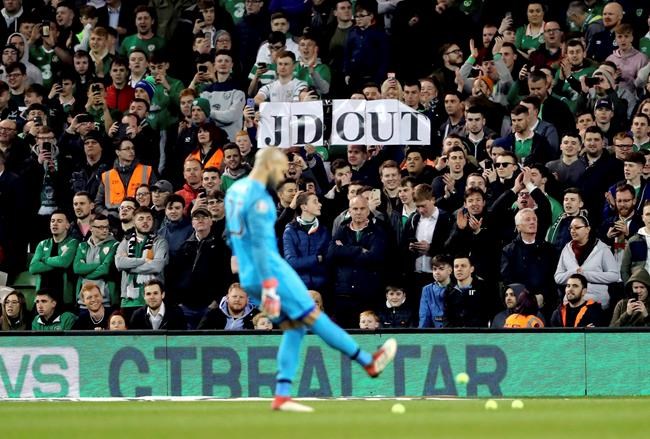
Fans were not buying that. An anti-Delaney protest last week saw a hail of tennis balls thrown on the field to interrupt a Euro 2020 qualifying game in Dublin.
NASSER AL-KHELAIFI (QATAR, PARIS SAINT-GERMAIN)
Two weeks ago, Grindel, Delaney and other UEFA leaders met in Nyon, Switzerland, to open talks with the European Club Association (ECA) about proposed Champions League changes taking effect in 2024. Tricky negotiations should take at least one year.
Paris Saint-Germain president Nasser Al Khelaifi plays on both sides. In February, the Qatari television boss joined UEFA’s ExCo as one of two ECA nominees despite being a criminal suspect in the broad Swiss federal investigation of FIFA.
Al Khelaifi denies the allegation he bribed a senior FIFA official with use of an Italian vacation villa to help secure World Cup TV rights for Qatar-owned BeIN Sports.
UEFA is also investigating if PSG deceived its club finance experts with false details of overvalued Qatari sponsorship deals.
UEFA President Aleksander Ceferin said at the election meeting he saw no reason to block Al Khelaifi.
ANDRIY PAVELKO (UKRAINE)
Ceferin also defended the process that let Ukraine federation president Andriy Pavelko join the ExCo in February — effectively replacing longtime senior UEFA official Grigoriy Surkis, who gifted the watch to Grindel.
Letters UEFA received from former lawmakers and NGOs in Ukraine alleging financial wrongdoing by Pavelko were “without any concrete proof” or evidence of court proceedings, Ceferin said in Rome two months ago.
Pavelko is also subject to a criminal complaint to prosecutors in Neuchatel, Switzerland. A journalist alleges he received death threats by telephone after writing about Pavelko in a Swiss magazine. Prosecutors are examining the complaint.
ARMAND DUKA (ALBANIA)
Duka, the head of Albania’s soccer federation for 17 years, was elected to UEFA’s ExCo on his latest attempt in February.

Last year, UEFA imposed its biggest club ban for match-fixing — 10 years’ exile from UEFA club competitions — on perennial Albanian champion Skenderbeu.
The club’s appeal at the Court of Arbitration for Sport is due this year against a UEFA investigation which tied the club to politicians and corrupt gambling.
Though not publicly linked by UEFA to match-fixing, Duka’s name did appear in internal case documents, a person familiar with the case told The Associated Press. The person spoke on the condition of anonymity because the case is confidential.
___
More AP soccer: https://apnews.com/apf-Soccer and https://twitter.com/AP_Sports
Related Articles
Jimenez finally delivering on promise at Wolves
Advertisement Advertise With Us
Advertisement Advertise With Us