New Jersey enacts law on assisted suicide for terminally ill

Advertisement

Advertise with us

TRENTON, N.J. - Gov. Phil Murphy on Friday signed legislation making New Jersey the seventh state to enact a law permitting terminally ill patients to seek life-ending medication.

Read this article for free:


or

Already have an account? Log in here »

To continue reading, please subscribe:

Subscribe and receive a limited-edition Free Press branded hat or tote.

Digital Subscription

One year of digital access for only $205*

  • Enjoy unlimited reading on winnipegfreepress.com
  • Read the E-Edition, our digital replica newspaper
  • Access News Break, our award-winning app
  • Play interactive puzzles

*First annual payment billed as $205.00 + GST for one year. This annual subscription will automatically renew at $233.00 + GST every 52 weeks (10% off the regular annual price of $259.35). Offer available to new and qualified returning subscribers only. Cancel any time.

To continue reading, please subscribe:

Add Free Press access to your Brandon Sun subscription for only an additional

$1 for the first 4 weeks*

  • Enjoy unlimited reading on winnipegfreepress.com
  • Read the E-Edition, our digital replica newspaper
  • Access News Break, our award-winning app
  • Play interactive puzzles
Start now

*Your next Brandon Sun subscription payment will increase by $1.00 and you will be charged $17.95 plus GST for four weeks. After four weeks, your payment will increase to $24.95 plus GST every four weeks.

Hey there, time traveller!
This article was published 12/04/2019 (2680 days ago), so information in it may no longer be current.

TRENTON, N.J. – Gov. Phil Murphy on Friday signed legislation making New Jersey the seventh state to enact a law permitting terminally ill patients to seek life-ending medication.

New Jersey will join six other states and the District of Columbia that have similar laws once it goes into effect in August.

Murphy, a Democrat, signed the Medical Aid in Dying for the Terminally Ill Act in private. His office would not answer why the signing was not public.
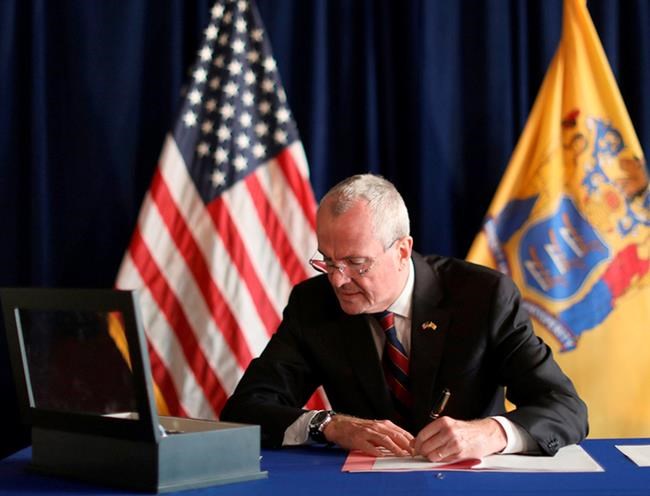
In this photo provided by the New Jersey Office of the Governor, N.J. Gov. Phil Murphy signs the Medical Aid in Dying for the Terminally Ill Act Friday, April 12, 2019 at the New Jersey Statehouse in Trenton, N.J. New Jersey is the seventh state to enact a law permitting terminally ill patients to seek life ending medication. (New Jersey Office of the Governor via AP)

He earlier indicated he would support the bill, but in a personal statement, Murphy — a lifelong Catholic — revealed that he wrestled with whether to sign the legislation. The state’s Catholic Conference testified against the measure.

“I have concluded that, while my faith may lead me to a particular decision for myself, as a public official I cannot deny this alternative to those who may reach a different conclusion,” Murphy wrote. “I believe this choice is a personal one and, therefore, signing this legislation is the decision that best respects the freedom and humanity of all New Jersey residents.”

Under New Jersey’s law, only patients who are irreversibly terminally ill and have a prognosis of six months or less to live could acquire the medication to end their lives.

Lawmakers have tried since at least 2012 to advance the legislation.

The effort got some attention in New Jersey in 2014 when a 29-year-old California woman drew news coverage after she and her husband moved to Portland, Oregon, so she could use that state’s law to end her life on her own terms. Brittany Maynard, 29, was terminally ill with brain cancer.

Her husband, Dan Diaz, praised New Jersey on Friday, saying residents wouldn’t have to leave their homes “to secure the option of a gentle dying process.”

Oregon in 1997 was the first state to provide an end-of-life option. California’s law went into effect in 2016.

The New Jersey legislation includes measures that legislators called “safeguards.”

The law requires that two doctors sign off on the request, that the patient be deemed an adult resident of New Jersey, who can make such a decision and who voluntarily expresses a wish to die.

It requires patients to request the medication twice and says they must be given a chance to rescind the decision. At least one of the requests must be in writing and signed by two witnesses.

At least one witness cannot be a relative, entitled to any portion of the person’s estate, the owner of the health care facility where the patient is getting treatment or a worker there, or the patient’s doctor.

The New Jersey law lets only patients administer the drug to themselves, and his or her attending physician would be required to offer other treatment options, including palliative care.

Supporters say the new law lets qualified patients decide to end their own lives in a dignified manner.

Opponents, including the state’s Catholic Conference, argue that the measure hurts the most vulnerable in society and that the state should instead work to improve its health care system.

“With the signing of this bill to legalize assisted suicide, many vulnerable New Jerseyans are now at risk of deadly harm through mistakes, coercion, and abuse,” said Matt Valliere, executive director of the Patients Rights Action Fund, an advocacy group opposed to such legislation.

The measure passed the Democrat-led Assembly 41-33, with four abstentions. It cleared the Democrat-controlled Senate 21-16.

In addition to California and Oregon, Colorado, Hawaii, Vermont, Washington and the District of Columbia all have similar legislation. Montana does not have a law permitting medically assisted suicide for the terminally ill, but a 2009 state Supreme Court ruling determined that nothing in state law prevented a physician from prescribing such a drug to terminally ill person.


Report Error Submit a Tip

More Stories

It’s one thing to climb aboard rail-relocation train, quite another to pay for the ride

Dan Lett 5 minute read Preview

It’s one thing to climb aboard rail-relocation train, quite another to pay for the ride

Dan Lett 5 minute read Yesterday at 3:57 PM CDT

Anyone who wants a brighter, safer, healthier future for the city of Winnipeg should really want the renewed hopes of rail relocation to finally become reality. And the sooner, the better.

Premier Wab Kinew announced Wednesday the province was going to forge a plan to relocate the Canadian Pacific Kansas City central yards and many of other the lines that run through Winnipeg to a bypass that runs around the city.

This “plan to design a plan” strategy was devised by a task force headed up by former federal MP and cabinet minister Lloyd Axworthy, who in 2024 was given a two-year mandate to find the best way to rid the city of some or all of its rail infrastructure.

For the record, Kinew and Axworthy said a relocation would likely take 20 years to complete, which makes this week’s announcement an important statement of intent, but little more. The sobering reality is that this promising idea has been proposed by political leaders, and then abandoned, for decades.

Read
Yesterday at 3:57 PM CDT

Signs the Carney approach is working

Editorial 4 minute read Preview

Signs the Carney approach is working

Editorial 4 minute read Yesterday at 2:00 AM CDT

It was, if nothing else, a glowing review in trying times.

Matt Winkler, the editor in chief emeritus of Bloomberg News, spoke last week on Bloomberg Business News Daily about a recent Bloomberg analysis of the performance of the Canadian economy, and this country as a target for investment

“This is one of the greatest periods for overseas investment in Canada that we’ve seen in the century, and it may be unprecedented, because we have to wait for the rest of the year. … Money is pouring into Canada like we have not seen from everywhere. Stocks and bonds are the obvious beneficiaries,” Winkler said. He argued that Canada is both liked and seen as reasonable.

“The point is… Canada since Mark Carney became prime minister in 2025, has outperformed everyone in America and also the Eurozone and anywhere in the world. The 10 largest stock markets in the world, Canada appreciated the most, more than 40 per cent. … Its bond market is also doing great, partially because the inflation rate in Canada, unlike the Eurozone or America, is actually trending lower, and is outperforming both the Eurozone and the U.S.”

Read
Yesterday at 2:00 AM CDT

Psychologist sentenced to house arrest after affair with patient

Dean Pritchard 5 minute read Updated: 5:31 PM CDT

A psychologist who didn’t disclose her sexual affair with a mental-health patient under her care when she testified on his behalf before the Criminal Code Review Board has been sentenced to 18 months house arrest.

“The offence represents a significant affront to the administration of justice,” provincial court Judge Kusham Sharma said at a sentencing hearing for woman earlier this week.

A court-order bars the publication of details that could identify those involved in the case, after the patient pleaded guilty in 2024 to criminally harassing the psychologist’s husband. The patient has anti-social and borderline personality disorders with psychopathic traits.

Sharma convicted the woman last March of one count each of breach of trust by a public official and attempting to obstruct justice.

Puzzles Palace

1 minute read Monday, Jul. 27, 2026

To solve our puzzles, please subscribe with this special offer: |

Poilievre’s simplistic bluster a desperate bid for attention in a serious moment for nation

Tom Brodbeck 6 minute read Preview

Poilievre’s simplistic bluster a desperate bid for attention in a serious moment for nation

Tom Brodbeck 6 minute read Tuesday, Aug. 11, 2026

Conservative Leader Pierre Poilievre’s suggestion that Mark Carney needs more “backbone” to negotiate with Donald Trump would be easier to take seriously if anyone had actually figured out how to negotiate with the U.S. president.

Read
Tuesday, Aug. 11, 2026

Mom grieves loss of daughter, 4, on Long Plain First Nation

Morgan Modjeski 4 minute read Preview

Mom grieves loss of daughter, 4, on Long Plain First Nation

Morgan Modjeski 4 minute read Tuesday, Aug. 11, 2026

The mother of a four-year-old girl killed and two other children injured on Long Plain First Nation said she raised concerns about their care months before her daughter’s death.

Read
Tuesday, Aug. 11, 2026