B.C. overdose prevention sites should be template for others: report

Advertisement

Advertise with us

VANCOUVER - It was a day Heather Hobbs recalls vividly: the staff at AIDS Vancouver Island had pulled another overdose victim from the washroom, his body was blue from a lack of oxygen.

Read this article for free:

or

Already have an account? Log in here »

To continue reading, please subscribe:

Subscribe and receive a limited-edition Free Press branded hat or tote.

Digital Subscription

One year of digital access for only $205*

  • Enjoy unlimited reading on winnipegfreepress.com
  • Read the E-Edition, our digital replica newspaper
  • Access News Break, our award-winning app
  • Play interactive puzzles

*First annual payment billed as $205.00 + GST for one year. This annual subscription will automatically renew at $233.00 + GST every 52 weeks (10% off the regular annual price of $259.35). Offer available to new and qualified returning subscribers only. Cancel any time.

To continue reading, please subscribe:

Add Free Press access to your Brandon Sun subscription for only an additional

$1 for the first 4 weeks*

  • Enjoy unlimited reading on winnipegfreepress.com
  • Read the E-Edition, our digital replica newspaper
  • Access News Break, our award-winning app
  • Play interactive puzzles
Start now

*Your next Brandon Sun subscription payment will increase by $1.00 and you will be charged $17.95 plus GST for four weeks. After four weeks, your payment will increase to $24.95 plus GST every four weeks.

Hey there, time traveller!
This article was published 14/04/2019 (2669 days ago), so information in it may no longer be current.

VANCOUVER – It was a day Heather Hobbs recalls vividly: the staff at AIDS Vancouver Island had pulled another overdose victim from the washroom, his body was blue from a lack of oxygen.

The man was revived and they closed the office in Victoria to allow staff to regroup. At the same time, in an alley just a half a block away, another of their clients was dying from an overdose.

Hobbs said she remembers seeing the man leave the facility as they began cleaning up from the overdose. His death was the tipping point for the implementation of an overdose prevention site at their facility, even though they weren’t yet legal, she said.
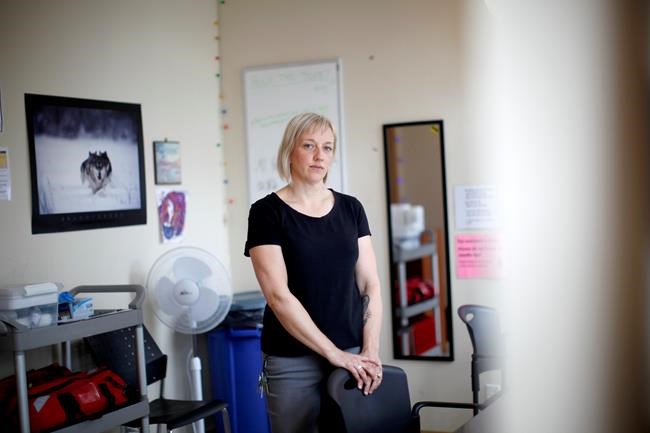
Manager of Harm Reduction Services Heather Hobbs is photographed in the safe injection room at AIDS Vancouver Island in Victoria, B.C., on Friday, April 12, 2019. THE CANADIAN PRESS/Chad Hipolito

“I feel like it’s possible, had we not had to have closed, that he would still be alive. So it’s those moments that stick with me and really drive it home that these spaces are essential in terms of keeping people alive,” said Hobbs, who is the manager of harm reduction services for AIDS Vancouver Island.

In April 2016, the B.C. government declared a public health emergency in the overdose crisis, allowing for the unprecedented implementation of the prevention facilities. Within weeks, 20 sites had mushroomed around the province.

A new study by researchers at the Canadian Institute for Substance Use Research concludes the rapid implementation of the sites should be used as a template for other governments to save lives.

The study says the quick response of the provincial government and community groups is an “international example of an alternative to the lengthy and cumbersome sanctioning processes for (supervised consumption sites.)”

The report, published this month in the International Journal of Drug Policy, says other government demands for public consultations and an intensive application process “are highly questionable in the context of legal drug poisonings and evidence-based alternatives such as (overdose prevention sites.)”

Health Canada approves the supervised consumption sites, which require an exemption from federal drug laws, while the overdose prevention sites in B.C. are sanctioned under the provincial health minister’s declaration of a public health emergency.

Bruce Wallace, co-author of the report, a scientist at the institute and an associate professor at the University of Victoria, said the study demonstrates how unnecessary the approval process is elsewhere.

“Our research is showing that the benefits of being able to have overdose prevention sites at so many different locations and really integrated with housing, health and social support is a model to go for, rather than going back to the federal processes, which are more onerous to set up and more limited in scope.”

The BC Coroners Service said 991 people died of illicit drug overdoses in 2016, 1,486 died the next year and 1,510 were killed by illicit drugs in 2018. The dramatic rise in deaths coincides with emergence of the powerful opioid fentanyl, which the coroner says is responsible for the majority of illicit drug deaths.

In the province, drug poisoning deaths this year equate to about 2.9 deaths a day, said the City of Vancouver in a statement Sunday as it marked the three-year anniversary of the province’s public health emergency. The city flew its flag at half-mast to recognize the lives lost and said it would continue to do so on each subsequent anniversary until the provincial health officer rescinds the current state of public health emergency.

Canada’s Public Health Agency said last week that 3,286 people died of apparent opioid-related deaths between January and September last year.

The report draws on interviews from staff at three of the prevention sites in Victoria to determine their impact.

Wallace said he’s frustrated that other jurisdictions in Canada aren’t adopting the same innovate practices to save lives, especially because they’ve been warned that dangerous opioids are moving into their provinces.

“So to have that level of warning of the potential harm and not act, it’s really tragic that people would not take these lessons and adopt them as fast as they can in other jurisdictions.”

The Ontario government announced in late March that while 15 overdose prevention sites had been approved, six others would close, including three in Toronto.

Judy Darcy, B.C.’s mental health and addictions minister, said there are about 40 overdose prevention sites across B.C. with over one million visits. Thousands of overdoses have been reversed and there have been no deaths at the sites, she added.

Darcy said it’s estimated the government’s actions, including the prevention sites, take-home naloxone kits and other prevention measures, have saved about 4,700 lives.

She said the prevention sites are a critical tool that also connect visitors to other supports, such as housing or treatment. But the stigma remains, Darcy said, and that is the next barrier to knock down.

“For too long we have treated mental health, mental illness as a sign of weakness and addiction as a character failure and as a sign of moral failure,” she said. “These centres don’t judge people. They’re there to save lives, they’re there to connect people to the social supports they need.”

Report Error Submit a Tip

More Stories

Letters, Aug. 4

7 minute read 2:01 AM CDT

Charge highlights need for action

The recent reporting regarding a Winnipeg Fire Paramedic Service employee accused of violating a protection order, following previous convictions related to criminal harassment and breaches of court orders against former partners, raises concerns that extend beyond a single individual.

I believe this case highlights important questions about how public institutions assess and respond to risks associated with intimate partner violence, stalking, coercive control and repeated violations of court-imposed conditions.

Gender-based violence is a public safety issue. Survivors are encouraged to seek protection orders and to call emergency services for safety and support. When those orders are breached, organizations have a responsibility to carefully consider workplace safety, public safety and survivor safety in their decision-making. Manitobans deserve confidence that public institutions have clear, consistent processes to assess risk and respond appropriately.

Today’s horoscope

Georgia Nicols 4 minute read Preview

Today’s horoscope

Georgia Nicols 4 minute read 2:01 AM CDT

MOON ALERT: Caution. Avoid shopping (except food and gas) and important decisions from 1:15 p.m. until 10 p.m. After that, the moon moves from Aries into Taurus.

ARIES (March 21-April 19)

You have lots of mental energy because the moon is in your sign dancing with your ruler fiery Mars, which pushes you into a leadership role. It makes you feel independent and ready to challenge anyone who challenges you.

TAURUS (April 20-May 20)

Read
2:01 AM CDT

Give parents space to work out the details

Maureen Scurfield 4 minute read 2:01 AM CDT

DEAR MISS LONELYHEARTS: My mom has shocked me and my brother (we’re both teenagers) by getting a new boyfriend so soon after breaking up with our dad — a really nice guy.

I just told my dad about her new boyfriend, and he said, “Oh, I think that guy’s been on the scene a while.”

I went back to my mom and asked if her new “friend” (that’s what she calls him) had been on the scene a while, like dad told me.

She said, “Just a very little while.” What is that supposed to mean?”

Downtown Keg closes… to reopen nearby

Free Press staff 2 minute read Preview

Downtown Keg closes… to reopen nearby

Free Press staff 2 minute read Friday, Jul. 31, 2026

Downtown Winnipeg is without a Keg restaurant — for a couple of months, anyways.

The Keg Steakhouse and Bar vacated 115 Garry St. on Wednesday, after more than five decades at the location. It will open in a new Donald Street apartment tower this fall.

Its move comes after years of waiting. The DSM, at 185 Donald St., sat as a partially started apartment block after its developer stopped operating and sought creditor protection in April 2023. The developer began the project in 2019.

Carrington Real Estate took over in 2024. Part of the 14-storey site’s initial plans — pre-Carrington — was for the Keg to occupy the main floor.

Read
Friday, Jul. 31, 2026

Travellers in Winnipeg scramble to rebook flights as WestJet attendants reach tentative deal

By Melissa Martin 4 minute read Preview

Travellers in Winnipeg scramble to rebook flights as WestJet attendants reach tentative deal

By Melissa Martin 4 minute read Yesterday at 4:21 PM CDT

WestJet flights were back in the skies Monday after a brief flight-attendant strike grounded planes across the country. But even as their cancelled flights were rebooked, many travellers spent the holiday scrambling to adapt to new, altered plans.

By 11:30 a.m. about 200 people were queued up in front of WestJet’s check-in booths at Winnipeg Richardson International Airport. Many were there to check in for an afternoon flight to Toronto, which, along with most other WestJet flights for the day, was now listed on the departure board as proceeding as planned.

Others, unable to reach someone on WestJet’s apparently overburdened customer service hotline, were hoping to find a solution to altered travel plans that had delayed their travel by days, or in some cases rerouted them through other cities.

Dan Schenkeveld was among them. The Kamloops resident spent most of the past month on a deep wilderness canoe trip in Nunavut. When he got back in cellular service range, he learned that a WestJet flight attendant strike was looming: “We’re aware of the issues around unpaid work, and we’re compassionate to that,” he said.

Read
Yesterday at 4:21 PM CDT

Meeting the needs of disabled Indigenous children

Sherry Gott 5 minute read 2:00 AM CDT

Navigating Manitoba’s disability services is difficult under the best circumstances. For Indigenous families, access is further constrained by geography, poverty, jurisdictional confusion, and culturally-inappropriate systems that do not reflect Indigenous approaches to raising and supporting children. Culturally-insensitive intakes, assessments, and treatments in Manitoba also contribute to misunderstanding, misdiagnosis, and inappropriate service responses across the province.

The consequences for Indigenous children with disabilities and their families are profound — they are forced into a system that does not recognize who they are, how they are understood in their communities or what they need to thrive.

Many First Nations families, particularly in remote and northern communities, are faced with the choice of living in their home community with limited or no resources for their child with a disability or relocating to an urban centre to access necessary supports. This further disconnects families from family and community support, connectedness to shared values and teachings and a child’s right to a sense of belonging.

Additionally, First Nations families living with a disabled child experience significant over-involvement with the child welfare system compared to non-Indigenous Manitobans. This is due to a couple of key factors, namely the differing perspectives regarding disabilities between the Western clinical and many First Nations world views and the prevailing systemic default that families be pressured to surrender their disabled child to child and family services care in order to access resources that are otherwise unavailable.