Senior’s weakness for scams may be warning sign of dementia

Advertisement

Advertise with us

WASHINGTON - Does an older friend or relative have a hard time hanging up on telemarketers? Or get excited about a "You've won a prize" voicemail? New research suggests seniors who aren't on guard against scams also might be at risk for eventually developing Alzheimer's disease.

Read this article for free:


or

Already have an account? Log in here »

To continue reading, please subscribe:

Subscribe and receive a limited-edition Free Press branded hat or tote.

Digital Subscription

One year of digital access for only $205*

  • Enjoy unlimited reading on winnipegfreepress.com
  • Read the E-Edition, our digital replica newspaper
  • Access News Break, our award-winning app
  • Play interactive puzzles

*First annual payment billed as $205.00 + GST for one year. This annual subscription will automatically renew at $233.00 + GST every 52 weeks (10% off the regular annual price of $259.35). Offer available to new and qualified returning subscribers only. Cancel any time.

To continue reading, please subscribe:

Add Free Press access to your Brandon Sun subscription for only an additional

$1 for the first 4 weeks*

  • Enjoy unlimited reading on winnipegfreepress.com
  • Read the E-Edition, our digital replica newspaper
  • Access News Break, our award-winning app
  • Play interactive puzzles
Start now

*Your next Brandon Sun subscription payment will increase by $1.00 and you will be charged $17.95 plus GST for four weeks. After four weeks, your payment will increase to $24.95 plus GST every four weeks.

Hey there, time traveller!
This article was published 15/04/2019 (2680 days ago), so information in it may no longer be current.

WASHINGTON – Does an older friend or relative have a hard time hanging up on telemarketers? Or get excited about a “You’ve won a prize” voicemail? New research suggests seniors who aren’t on guard against scams also might be at risk for eventually developing Alzheimer’s disease.

Elder fraud is a huge problem, and Monday’s study doesn’t mean that people who fall prey to a con artist have some sort of dementia brewing.

But scientists know that long before the memory problems of Alzheimer’s become obvious, people experience more subtle changes in their thinking and judgment. Neuropsychologist Patricia Boyle of Rush University’s Alzheimer’s disease centre wondered if one of the warning signs might be the type of judgment missteps that can leave someone susceptible to scams.
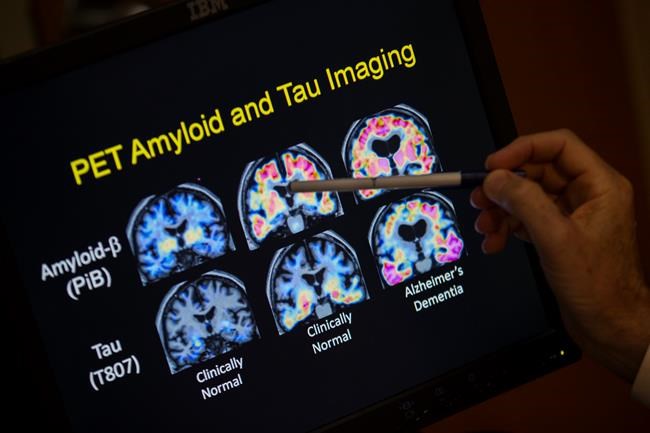
FILE - In this May 19, 2015, file photo, a doctor points to PET scan results that are part of a study on Alzheimer's disease at a hospital in Washington. Scientists know that long before the memory problems of Alzheimer's become obvious, people experience more subtle changes in their thinking and judgment. (AP Photo/Evan Vucci, File)

“When a con artist approaches an older person, they’re looking for a social vulnerability — someone who is open to having a conversation with a complete stranger,” said Boyle. Then the older person must interpret that stranger’s intentions and emotions, with little else to go on, in deciding whether to believe what they’re peddling, she explained.

Boyle turned to data from the Financial Industry Regulatory Authority, which operates a fraud “risk meter,” to determine behaviours that could signal scam vulnerability — things such as answering the phone when you don’t recognize the number, listening to telemarketers, finding it difficult to end unsolicited calls, being open to potentially risky investments and not realizing that seniors often face financial exploitation.

Boyle studied 935 seniors, mostly in their 70s and 80s, with no known brain problems who were enrolled in a long-running memory and aging project in Chicago. They took a scam awareness questionnaire and then took yearly brain tests for an average of six years.

During the study, 151 seniors were diagnosed with Alzheimer’s and another 255 with mild cognitive impairment, sometimes a precursor for Alzheimer’s. The participants who’d had what Boyle calls low scam awareness at the study’s start were more likely to have developed each of those conditions than seniors who were more aware of scam vulnerability.

For a closer look, the 264 participants who died during the study underwent brain autopsies. Sure enough, the lower the scam awareness at the study’s start, the more people had a buildup of sticky plaque in their brains that is a hallmark of Alzheimer’s, Boyle reported in Annals of Internal Medicine.

The study can’t prove a link between low scam awareness and impending decline in thinking and memory, cautioned Dr. Jason Karlawish of the University of Pennsylvania in an accompanying editorial.

Karlawish described one of his own patients who confessed to a grandson, “I think I’ve been had” by a lottery scam that persuaded him to pay taxes up-front so he could receive his purported winnings. It was just too hard to hang up on the polite caller. Three years later, that patient shows no sign of cognitive impairment, said Karlawish, who said he’s flummoxed by how the clever crooks managed to rob the man.

Still, the study results “should be a call to action to health care systems, the financial services industry and their regulators,” Karlawish wrote, urging further research into what he called “notable findings.”

The possible scam link isn’t surprising, agreed Alzheimer’s Association vice-president Beth Kallmyer, who also said it needs more research. In fact, she said seniors may be reluctant to report fraud for fear family members might suspect they were sucked in because of health problems.

Dementia concerns or not, she advises seniors simply to not answer unsolicited calls or emails from people they don’t recognize, making it harder for them to be targeted.

Previous research has suggested that seniors can begin to have trouble managing their finances even with aging’s normal cognitive slowing.

And the rise in elder fraud has reached such a level that investment firms now are supposed to ask customers for the contact information of a “trusted person” they can alert if they suspect a case of financial exploitation. Just last week, federal agents broke up a Medicare scam that sold unneeded orthopedic braces to hundreds of thousands of seniors. And every tax season the government warns people not to fall for phone calls from IRS impostors — that agency won’t call for payment.

“As older people start making mistakes in financial, health care and other types of complex decisions, we do need to raise awareness and start asking, ‘Do they need some help?'” Boyle said. “It doesn’t necessarily mean someone is going to go on to develop dementia. But we should become more aware.”

___

The Associated Press Health and Science Department receives support from the Howard Hughes Medical Institute’s Department of Science Education. The AP is solely responsible for all content.

Report Error Submit a Tip

More Stories

Rainbow Stage’s Legally Blonde a lovely legal musical

Holly Harris 6 minute read Preview

Rainbow Stage’s Legally Blonde a lovely legal musical

Holly Harris 6 minute read Friday, Aug. 14, 2026

Omigod, you guys! Rainbow Stage kicked off its penultimate summer production Thursday with a high-octane joy machine bathed in a sea of pink.

Inspired by the 2001 Hollywood film starring Reese Witherspoon, and Amanda Brown’s same-titled novel, the award-winning Legally Blonde: The Musical — featuring a book by Heather Hach, with music/lyrics by Laurence O’Keefe and Nell Benjamin — opened on Broadway in April 2007, followed by a subsequent West End run.

The tale — equal parts cheesy rom-com and potent siren call for female autonomy and empowerment — focuses on quintessential Cali-girl Elle Woods (a pitch-perfect Claire Mac Master). A proud daughter and president of Delta Nu sorority house, she enrols at Harvard Law School to win back her upwardly mobile ex-boyfriend, Warner Huntington III (Duncan Cox).

Laser-focused on marrying a “Jackie, not a Marilyn,” Warner dreams of becoming an American senator, latching onto uber-preppy fellow pupil Vivienne Kensington (Julie Davis), who becomes Elle’s arch nemesis.

Read
Friday, Aug. 14, 2026

Men’s recovery home dedicated to ‘homeless hero’ Faron Hall’s memory

Scott Billeck 14 minute read Preview

Men’s recovery home dedicated to ‘homeless hero’ Faron Hall’s memory

Scott Billeck 14 minute read Friday, Aug. 14, 2026

Faron Hall never got the chance to begin recovery. Once heralded as Winnipeg’s “homeless hero” after twice plunging into the Red River to save strangers from drowning, Hall told St. Boniface Street Links executive director Marion Willis shortly before his death in 2014 that he wanted help for his alcoholism.

Read
Friday, Aug. 14, 2026

Don’t be a big loser — check out Real Love Summer Fest ReunionBig Loser takes the stage at 8:20 p.m. tonight as part of the Real Love Summer Fest Reunion, a one-day event put on by the indie promotion company, which ran the festival in the Interlake area for a decade until last summer’s final edition near Teulon.

Bookers Gil Carroll and Adam Soloway have programmed a full day of music at Blue Note Park (220 Main St.), the outdoor venue adjacent to Times Change(d) High and Lonesome Club.

First up at 4 p.m. is folk-rock songwriter tofusmell, followed at 5 p.m. with a rare performance by indie-songwriting darlings Animal Teeth, a group with several summer fest bills under its belt. Up-and-coming pop-rockers Synthetic Friend take the stage at 6, followed at 7 by the fun electronic dance pop of French Class.

After playing with his full band at last month’s Winnipeg Folk Festival, Amos the Kid will perform a solo set at 8 p.m. Sans band, the performer shows off his affable roots as a Gord Downie acolyte with catchy earworms to match.

RCMP searching for missing 34-year-old woman

1 minute read Yesterday at 6:29 PM CDT

Police are asking for the public’s help locating a 34-year-old woman last heard from almost a week ago.

Tamara Stevens, who also goes by Tammy, was last heard from on Sunday last weekend and was reported missing Tuesday morning, said a Thompson RCMP news release Saturday.

RCMP and family are worried for her well-being.

Stevens is believed to be in Thompson and is described as 5'7, with a slender build and long red hair, said RCMP. She also has a piercing on her lip and was last seen wearing black T-Shirt featuring the Twilight character Jacob, pants and work boots.

Proposed Transcona development — which could add 20,000 people — gets thumbs down from residents

Joyanne Pursaga 5 minute read Preview

Proposed Transcona development — which could add 20,000 people — gets thumbs down from residents

Joyanne Pursaga 5 minute read Friday, Aug. 14, 2026

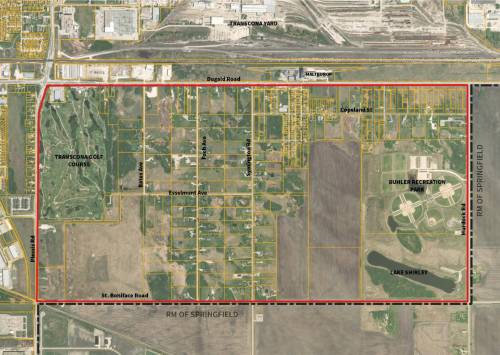
Dozens of Winnipeggers fear plans to make way for up to 20,000 more people to live in south Transcona would dramatically alter their neighbourhood and tie hefty fees for new services to their property titles.

If city council adopts the proposed South Transcona secondary plan, all future development applications would need to conform to its goals. The affected area is located south of Dugald Road, north of St. Boniface Road, east of Plessis Road and west of Murdock Road.

Homeowner Virginia Page Jähne fears the plan could add a massive tab to the title of her 4.3-acre property to cover services required for the development.

“My main concern is that they are wanting to put $1.4 million onto my title to pay for this. Now, they say that I will not have to pay it unless I subdivide. But if a person comes by and wants to buy from me … and they see that $1.4 million … what’s the first thing (they’re) going to do?” said Page Jähne, in an interview.

Read
Friday, Aug. 14, 2026

Rise of social media reflects rise of self-promotion — to the detriment of genuine storytelling

Reviewed by Matt Henderson 4 minute read Preview

Rise of social media reflects rise of self-promotion — to the detriment of genuine storytelling

Reviewed by Matt Henderson 4 minute read Yesterday at 3:00 AM CDT

A conversation is overheard between two people; one congratulates the other on their success, evident through countless posts on LinkedIn, but the other confesses the prolific aggrandizement is due to slumping success.

A young man on an airplane spends three hours poring over selfies taken on a vacation, zooming in on his biceps and using AI to retouch photos before posting on Instagram.

Anonymous and cowardly trolls on Reddit attempt to end another person’s career.

All this “storytelling” was observed in one day by this reviewer.

Read
Yesterday at 3:00 AM CDT