High-end hostels offer ‘flashpackers’ affordable luxuries, social connection
Advertisement
Read this article for free:
or
Already have an account? Log in here »
To continue reading, please subscribe:

Digital Subscription
One year of digital access for only $205*
- Enjoy unlimited reading on winnipegfreepress.com
- Read the E-Edition, our digital replica newspaper
- Access News Break, our award-winning app
- Play interactive puzzles
*First annual payment billed as $205.00 + GST for one year. This annual subscription will automatically renew at $233.00 + GST every 52 weeks (10% off the regular annual price of $259.35). Offer available to new and qualified returning subscribers only. Cancel any time.
To continue reading, please subscribe:
Add Free Press access to your Brandon Sun subscription for only an additional
$1 for the first 4 weeks*
- Enjoy unlimited reading on winnipegfreepress.com
- Read the E-Edition, our digital replica newspaper
- Access News Break, our award-winning app
- Play interactive puzzles
*Your next Brandon Sun subscription payment will increase by $1.00 and you will be charged $17.95 plus GST for four weeks. After four weeks, your payment will increase to $24.95 plus GST every four weeks.
Read unlimited articles for free today:
or
Already have an account? Log in here »
Hey there, time traveller!
This article was published 15/04/2019 (2661 days ago), so information in it may no longer be current.
Back in the day, the best backpackers could expect from a hostel was a rock-hard bunk bed, a grimy shared bathroom, and with luck, checking out with all their belongings in tact.
But now, a burgeoning cohort of young travellers dubbed “flashpackers” — backpackers with a slightly larger budget — has given rise to a form of lodging that at one time would have been considered an oxymoron: the high-end hostel.
Unlike the dingy dormitories of decades past, hostels in Canada have been revamped to cater to millennial wanderlust, offering affordable luxuries such as free breakfast, private rooms, digital amenities and modern-day security features.
Look at the M Montreal’s Instagram feed, and you’ll find photos of guests lounging in the hostel’s two rooftop Jacuzzis, partying in the neon-lit bar, taking in musical and comedy acts or chowing down at the cafe, which offers free or pay-what-you-can dinners several nights a week.
Located in Montreal’s Gay Village, the hostel’s most lavish accommodations — a 700-square-foot private room with a kitchen, living room and large-screen TV — can run for up to $250 per night during peak summer months.
Owner Andreas Zacharakis said the M Montreal is designed to facilitate connections among tourists and locals alike, which he sees as the hostel’s competitive advantage over five-star hotels and shared-economy accommodations such as Airbnb.
“The customers are smart. They’re smarter than ever before,” said Zacharakis. “They don’t mind paying. They just want to be assured that they’re going to have a good experience and a good service.”
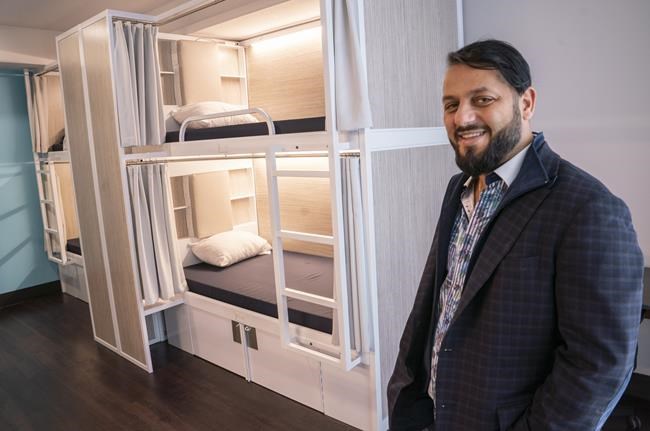
In low season, budget-conscious guests can still pick up a key card to a 10-person room for roughly $30 per night, which includes a bunk bed with a back pillow to lean on while web surfing, outlets for charging devices, storage spaces, a curtain for privacy and access to a shared ensuite bathroom.
Zacharakis compared today’s tech-savvy consumers to “cyborgs” who are pushing hostels to provide upscale amenities on par with hotels through reviews on social media and sites such as hostelworld.com, where the M Montreal globally ranks as the best extra-large hostel of 2019.
“There’s a communal spirit going on,” said Zacharakis. “When you’re checked in, you’re introduced to everyone in your room… By the time you’re leaving, you feel like you’re about to cry, because you’re leaving your family.”
The Two Peas Pod Hostel in Toronto bills itself as a “new travel concept” straddling the hotel-hostel divide. Guests can book a spot in one of the Chinatown hostel’s four-pod rooms — each bunk equipped with a memory-foam mattress, bamboo pillow, a personal fan, flat-screen TV and headphones — for as low as $49 per night this spring, its website boasts amenities such as luxury showers, a quiet lounge, cafe, hair dryers and a home theatre.
Gabor Forgacs, an associate professor in Ryerson University’s hospitality and tourism management department, said hostels comprise only a small share of Canada’s commercial lodging industry, and there’s a wide variation in quality.
But as hotel prices have increased year after year, Forgacs said an influential segment of tourists — millennials who are looking for a good deal, but would pay a premium for purportedly authentic experiences — are turning to alternatives like hostels and Airbnb over “cookie-cutter” accommodations.
“It’s an age cohort specifically that is more interested in gathering experiences than objects, and they place higher value on seeing the world,” he said. “The traveller is more socially interactive. They want to at least have the illusion of being part of a community.”
Even hostel chains are upping their offerings to stay competitive.
Hostelling International has updated many of its 54 locations to serve these plugged-in, community-oriented travellers, said Shelbey Sy, marketing director for the Pacific/Mountain region.
“It’s not just offering a place to crash, but a wide experiences within the property, and also outside that takes them closer to the community they’re visiting,” said Sy.
“Travellers nowadays not only want to be able travel comfortably, but they also want to stay connected and to be able to share their experiences with their networks.”
The HI Vancouver provides local-guided pub crawls and walking tours for tourists who want to go off the beaten path and explore the city, while the HI Ottawa Jail offers one-of-a-kind stays in converted prison cells, some of which are rumoured to be haunted, Sy said.
The HI Toronto maintains some of the hostel’s ramshackle charms, with one hallway strewn with debris from guests, and a basement bar and cafe dubbed “The Cavern” with exposed vents and tangle of wires in the ceiling.
But manager Desmond Tibby said the HI Toronto has come a long way since he came on board in 2003, offering free breakfasts, live performances and private accommodation costing up to $200 per night that are fully booked during high season.
“(Guests) have a bigger disposable income now. They expect better furnishings; they expect better service; they expect breakfast included,” said Tibby. “The way we could be going is having a concierge. If they demand that, that’s what will happen.”