

In Venezuela, Guaidó’s patience runs out
Advertisement
Read this article for free:
or
Already have an account? Log in here »
To continue reading, please subscribe:

Digital Subscription
One year of digital access for only $205*
- Enjoy unlimited reading on winnipegfreepress.com
- Read the E-Edition, our digital replica newspaper
- Access News Break, our award-winning app
- Play interactive puzzles
*First annual payment billed as $205.00 + GST for one year. This annual subscription will automatically renew at $233.00 + GST every 52 weeks (10% off the regular annual price of $259.35). Offer available to new and qualified returning subscribers only. Cancel any time.
To continue reading, please subscribe:
Add Free Press access to your Brandon Sun subscription for only an additional
$1 for the first 4 weeks*
- Enjoy unlimited reading on winnipegfreepress.com
- Read the E-Edition, our digital replica newspaper
- Access News Break, our award-winning app
- Play interactive puzzles
*Your next Brandon Sun subscription payment will increase by $1.00 and you will be charged $17.95 plus GST for four weeks. After four weeks, your payment will increase to $24.95 plus GST every four weeks.
Read unlimited articles for free today:
or
Already have an account? Log in here »
Hey there, time traveller!
This article was published 03/05/2019 (2695 days ago), so information in it may no longer be current.
Back in early March, it seemed that both sides in Venezuela had decided a long drawn-out crisis was better than a civil war. It appears that the leader of one side has now changed his mind.
Almost four months ago, Juan Guaidó challenged President Nicolás Maduro on the grounds that his re-election last year had been fraudulent. Guaidó claimed to be the legitimate president himself, and Maduro did not arrest him, presumably because he feared it would cause a civil war he might lose. Since Guaidó wasn’t sure he would win it either, he also held his fire.
The political operation to remove Maduro was clearly co-ordinated with Washington. Guaidó was doubtlessly told that if he declared himself president, the United States and 50 of its friends and allies would recognize him — which they promptly did. But he still avoided a showdown with Maduro, and restricted himself to making speeches (which Maduro did not interfere with).
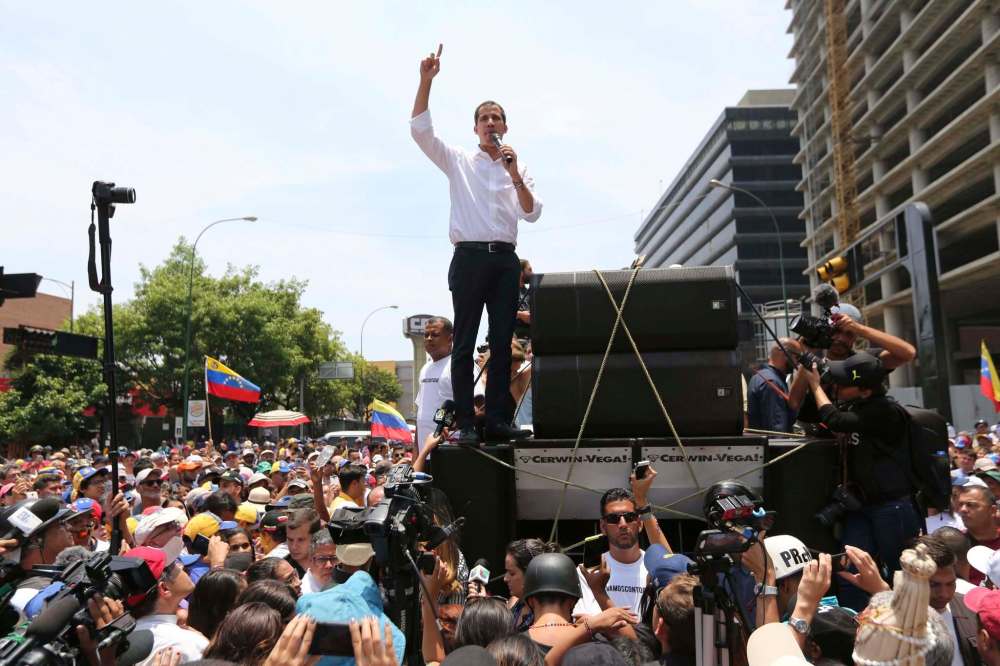
Both men knew they were on shaky ground legally. Maduro won a rigged election, but Guaidó didn’t even run in it.
As president of the National Assembly, Guaidó is in the line of succession if the president dies or goes crazy, but whether or not he has the right to replace a sitting president just because he believes the president cheated in the election is the sort of question that makes lawyers rich. Most non-lawyers would say he doesn’t have that right.
That’s beside the point. This is a power struggle, in which Maduro still controls the army, but Guaidó has powerful foreigners and a large but unknown portion of the Venezuelan population on his side. Both men decided to play a waiting game, in the hope that the tide would turn in their direction. It was the right choice.
However, for reasons best known to himself, Guaidó has changed his mind. Maybe he thinks the tide is running in his direction, or maybe he fears that Maduro will win by default if he doesn’t act now, but he has clearly decided that the showdown should happen now.
On Monday, he released a three-minute video showing him together with men in Venezuelan military uniforms, claiming that the armed forces have come over to his side. “The moment is now,” he says.
Some of the ordinary soldiers may be on his side, but there is little evidence for it except Guaidó’s video. The officers, and especially the generals, are not ready to change sides, partly because they are dedicated Chavistas, but also because few of the generals have managed to hide their loot somewhere safe abroad. They only get to keep it if Maduro stays in power.
By going onto a military base and trying to turn the military against the government, Guaidó has committed high treason, and Maduro has to respond. Yet it is not at all certain that Guaidó’s supporters, numerous though they may be, will win the battle in the streets.
He summoned them to come out on the streets of Caracas on Tuesday, and called on the army to support them. They did come, but so did Maduro’s supporters (or more precisely, people who still support Hugo Chávez’s original revolution, though not many of them have the same deep affection for Maduro). More than 100 people were injured during the day.

And yes, some dozens of National Guardsmen did switch sides on Tuesday, but thousands did not. More importantly, the regular army has remained loyal to Maduro. Guaidó called his supporters out again on Wednesday, but at the time of writing (Wednesday morning), there is no sign that Maduro is about to flee the country, or that his army is going to defect.
It’s too early to be sure, but it looks like Guaidó moved too soon. He will probably soon be in jail if he does not flee the country. His political mentor and party leader, Leopoldo López, has already sought refuge with his family in the Spanish Embassy. Maduro has already claimed on television that he has defeated the “attempted military coup.”
What persuaded Guaidó to abandon the slow and cautious strategy he has pursued for the past four months and go for broke instead? The suspicion must be that he did it under pressure from Washington, where U.S. President Donald Trump is impatient, Secretary of State Mike Pompeo is compliant and nobody understands Venezuela very well.
Nobody except the U.S. armed forces, which have made it quietly clear from the start that they do not want to end up giving military support to Venezuelan rebels. But nobody in Trump’s Washington listens to the army.
Gwynne Dyer’s latest book is Growing Pains: The Future of Democracy (and Work).
Related Articles
Trump threatens Cuba as US supports Venezuela uprising

Advertisement Advertise With Us
Advertisement Advertise With Us