‘Tortilla movement’ seeks to restore Mexico’s iconic food

Advertisement

Advertise with us

MEXICO CITY - As Mexico City's 9 million residents sleep in the pre-dawn darkness, busy hands are already preparing the day's corn tortillas in the small kitchen of Molino El Pujol, a tortilla shop that is part of a famed chef's bid to help recover Mexico's iconic food.

Read this article for free:


or

Already have an account? Log in here »

To continue reading, please subscribe:

Subscribe and receive a limited-edition Free Press branded hat or tote.

Digital Subscription

One year of digital access for only $205*

  • Enjoy unlimited reading on winnipegfreepress.com
  • Read the E-Edition, our digital replica newspaper
  • Access News Break, our award-winning app
  • Play interactive puzzles

*First annual payment billed as $205.00 + GST for one year. This annual subscription will automatically renew at $233.00 + GST every 52 weeks (10% off the regular annual price of $259.35). Offer available to new and qualified returning subscribers only. Cancel any time.

To continue reading, please subscribe:

Add Free Press access to your Brandon Sun subscription for only an additional

$1 for the first 4 weeks*

  • Enjoy unlimited reading on winnipegfreepress.com
  • Read the E-Edition, our digital replica newspaper
  • Access News Break, our award-winning app
  • Play interactive puzzles
Start now

*Your next Brandon Sun subscription payment will increase by $1.00 and you will be charged $17.95 plus GST for four weeks. After four weeks, your payment will increase to $24.95 plus GST every four weeks.

Hey there, time traveller!
This article was published 20/05/2019 (2638 days ago), so information in it may no longer be current.

MEXICO CITY – As Mexico City’s 9 million residents sleep in the pre-dawn darkness, busy hands are already preparing the day’s corn tortillas in the small kitchen of Molino El Pujol, a tortilla shop that is part of a famed chef’s bid to help recover Mexico’s iconic food.

As the old tortilla machine roars to life at 5 a.m., a steaming hot mass of lime-treated corn mash is loaded into one end, where it is divided into small portions, flattened and baked. Fresh tortillas come out the other end, letting customers taste a bit of Mexican history that chefs say is being eroded by modern production techniques and modern corns.

If the “Pujol” in the shop’s name sounds familiar, it’s because its creator is chef Enrique Olvera, whose Mexico City restaurant Pujol is rated among the world’s best restaurants.
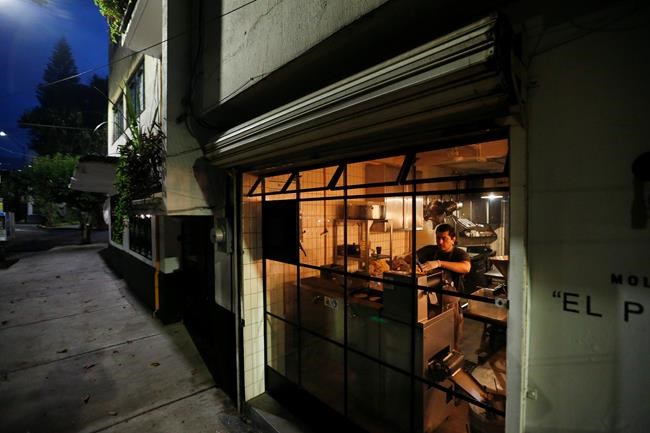
Chef Jesus Saldivar feeds ground corn through the tortilla making machine at El Pujol Mill in the Condesa neighborhood of Mexico City, Tuesday, April 9, 2019. The shop is part of a new tortilla movement launched by a handful of chefs, restaurants and organizations to restore and popularize authentic tortillas, made of only corn, water and lime or calcium carbonate. (AP Photo/Rebecca Blackwell)

Why would the star of Mexico’s culinary world open a simple tortilla shop, or tortilleria, which conjures up images here of working class homemakers lining up for their tortillas with cloths that save them a peso on paper wrapping?

For the 43-year-old Olvera, it was a logical step, given that he had already started supporting the local farmers who supply his restaurants. His shop is part of a new tortilla movement launched by a handful of chefs, restaurants and organizations to restore and popularize authentic tortillas.

And Amado Ramírez, an agronomist who helped Olvera select the native corn varieties in the southern state of Oaxaca, often viewed as Mexico’s culinary cradle, said starting a tortilleria was also an act of nostalgia.

“For him, a tortilla shop is about recovering his past,” said Ramírez. “It was stepping back into the time when he would be sent to the street to get tortillas and bring them home for supper.”

That memory is part of the childhood of millions of Mexicans. Children would go hand-in-hand with their grandmothers to wait at the local tortilleria for the steaming hot discs of corn. Such scenes are still common in Mexico, but the practice has been eroded by the spread of pre-packaged tortillas, and many chefs say the raw materials are no longer the same.

Corn was domesticated — hybridized from the tiny ears of wild teozintle — in Mexico thousands of years ago.

Like the French baguette, the list of ingredients for a true tortilla is short: corn, water and lime or calcium carbonate. The corn is slowly cooked or soaked in the lime in process called “nixtamalization.”

Many experts say the quality of modern tortillas suffers from excessive processing and industrialization. The culprits include techniques that bypass the nixtamal process, GMO corn and the addition of preservatives.

In big cities many Mexicans have lost sight — or memory — of the taste of authentic tortillas, or the differences between the vast varieties of native corn, which vary in colour, consistency and taste.

“Mexico took its corn for granted,” says Rafael Mier, director of the Tortilla Foundation, which focuses its efforts on promoting quality tortilla production and informing people of its benefits.

Historically, tortillas have been Mexico’s greatest source of energy, though wheat bread has made inroads.

“A poor quality tortilla yields poor performance,” said Mier. “Tortillas are a part of Mexico’s culture, national identity, economy and gastronomy.”

Other Mexico City “authentic tortilla” shops like Maizajo and Cal y Maíz (Lime and Corn) can appear to be specialty stores catering to Mexico’s upper classes, in part because their distribution is limited to a few shops and restaurants. And they are a drop in the bucket compared to the mass production of giants like Maseca, which uses a dry corn flour tortilla recipe that differs from nixtamal.

But tortilla advocates aren’t deterred, even though the costs — and prices — are higher than Maseca, bakery giant Bimbo, or grocery chains that sell packaged tortillas as “loss leaders” to get people inside their stores.

The Alliance for Our Tortilla has published a list of 10 commandments for good tortillas, including that they be made by the nixtamal process because cooking with lime breaks down the indigestible outer layer of a corn kernel and releases nutrients.

Another factor is the use of locally sourced corn varieties: blue, red or white. Yellow corn in Mexico is generally used for animal feed.

Still, many Mexicans find the prices at places like Molino El Pujol prohibitive.

Concepción Reyes, 84, buys her tortillas at a local shop in Mexico City’s San Rafael neighbourhood, and says she would never pay the 60 pesos ($3) per kilogram charged at Molino El Pujol.

Reyes says she pays 13 pesos per kilogram at her shop, and won’t pay more.

Still some people are willing to pay the higher prices — often foreigners who want to taste an “authentic” Mexican tortilla.

Molino El Pujol, where the air is scented with the doughy aroma of corn, was opened a year ago in Mexico City’s trendy Condesa district. Customers can order at a wooden counter or sit at benches.

The shop offers more than just tortillas, though everything is corn-based. There is a blackboard menu listing a dozen items, including a sweet, thick, corn-dough drink known as atole. Customers can also try the cooked corn tamales with local herbs and beans.

But, true to tradition, sometimes the tortillas are just so good that locals will shun the fancy dishes, grab the salt shaker always present at the counter of tortillerias and have a “taco de sal” — a hot tortilla with a dash of salt.

Report Error Submit a Tip

More Stories

'Tortilla movement' seeks to restore Mexico's iconic food

MaríA Teresa HernáNdez, The Associated Press 6 minute read Preview

'Tortilla movement' seeks to restore Mexico's iconic food

MaríA Teresa HernáNdez, The Associated Press 6 minute read Monday, May. 20, 2019

MEXICO CITY - As Mexico City's 9 million residents sleep in the pre-dawn darkness, busy hands are already preparing the day's corn tortillas in the small kitchen of Molino El Pujol, a tortilla shop that is part of a famed chef's bid to help recover Mexico's iconic food.

As the old tortilla machine roars to life at 5 a.m., a steaming hot mass of lime-treated corn mash is loaded into one end, where it is divided into small portions, flattened and baked. Fresh tortillas come out the other end, letting customers taste a bit of Mexican history that chefs say is being eroded by modern production techniques and modern corns.

If the "Pujol" in the shop's name sounds familiar, it's because its creator is chef Enrique Olvera, whose Mexico City restaurant Pujol is rated among the world's best restaurants.

Why would the star of Mexico's culinary world open a simple tortilla shop, or tortilleria, which conjures up images here of working class homemakers lining up for their tortillas with cloths that save them a peso on paper wrapping?

Read
Monday, May. 20, 2019

Luxury and livability

Todd Lewys 5 minute read Preview

Luxury and livability

Todd Lewys 5 minute read Yesterday at 2:00 AM CDT

Those in the market for a new luxury home tend to be looking for two things.

First, the home must be unique — which is to say it possesses defining design characteristics that set it apart from other homes. Second, while the home must be different, it also must be livable.

Problem is, many home builders get too focused on fashion, which often makes for a visually arresting home that, sadly, isn’t as functional as it could be.

Fortunately, that’s not the case in Maric Homes’ stunning bungalow show home at 2 Woodland Lane in Headingley’s Forest Grove Estates.

Read
Yesterday at 2:00 AM CDT

The view from here: Phyllis Green. Boob Tree, 1975

2 minute read Preview

The view from here: Phyllis Green. Boob Tree, 1975

2 minute read Yesterday at 2:01 AM CDT

Staycation: The Art of Being Here feautres more than 100 Manitoba-related artworks from the Winnipeg Art Gallery-Qaumajuq collection, spanning the past 50 years. These pieces reveal how the places around us are layered with memory, story and lived experience. Over the coming weeks, the Free Press will spotlight works from this eclectic exhibition, each one offering a new way of seeing home. Experience it in person and enjoy some staycation time at the gallery, on view until December.

Phyllis Green. Boob Tree, 1975

(Yarn, wood. Collection of the Winnipeg Art Gallery; Acquired with funds from the Estate of Mr. and Mrs. Bernard Naylor, funds administered by The Winnipeg Foundation, 2014-128. Photo: Ernest Mayer.)

The year 1975 was designated International Women’s Year by the United Nations, and in celebration, the WAG staged the show Images of Women, which explored how women had historically been depicted, an impressive selection but by mostly male artists. Amid pushback from the community, Sharron Zenith Corne and Marian Yeo organized a second exhibition, Woman as Viewer, which challenged those portrayals by only featuring works by women. It was called the first Canadian exhibition of feminist art. American artist Phyllis Green’s Boob Tree, a four-foot-tall crochet sculpture of a cluster of breasts, adorned the exhibit posters, which were so popular they were snatched by passersby! The sculpture is playful and unsettling, re-appropriating the objectification of women’s bodies.

Read
Yesterday at 2:01 AM CDT

Main Street restaurant Boujee burns for the second time in one week

Aaron Epp 2 minute read Preview

Main Street restaurant Boujee burns for the second time in one week

Aaron Epp 2 minute read Yesterday at 3:15 PM CDT

A former restaurant on Main Street is set to be demolished after a fire broke out for the second time in less than a week.

Winnipeg Fire Paramedic Service crews responded to reports of a fire at Boujee Restaurant and Bar, a vacant, single-storey building on the 100 block of Main Street shortly before 6 a.m. Saturday. The same building was most recently damaged in a fire last Sunday.

At the scene, crews found heavy smoke coming from the building. After attacking the fire using aerial ladders that sprayed water from above, firefighters arranged an emergency demolition of the building. Demolition is expected to be completed today, the WFPS said in a news release.

No injuries were reported and the fire is under investigation.

Read
Yesterday at 3:15 PM CDT

Livestreamed mental-health meltdown underscores medium’s disturbing decline

Melissa Martin 7 minute read Preview

Livestreamed mental-health meltdown underscores medium’s disturbing decline

Melissa Martin 7 minute read Friday, Aug. 7, 2026

On Tuesday evening, a well-known celebrity blogger, best known by the nom de plume Perez Hilton, opened up his TikTok account and began a livestream from his Miami home. What unfolded over the next 30 minutes horrified all who witnessed it — and should force the rest of us to take a very sober look at the ways social media can harm.

Read
Friday, Aug. 7, 2026

A measure of hope a decade after senseless death, injustice

Niigaan Sinclair 5 minute read Preview

A measure of hope a decade after senseless death, injustice

Niigaan Sinclair 5 minute read Friday, Aug. 7, 2026

I’m a few hundred kilometres from the farm near Biggar, Sask. — the place where 22-year old Colten Boushie from Cree Red Pheasant First Nation was shot and killed by farmer Gerald Stanley precisely 10 years ago.

“You need to remind people about the 10-year anniversary,” a nearby, rural school principal tells me at the education conference I just finished speaking at.

“That death is a wound that continues to bleed in all of us,” a principal from Regina adds. “I hear about it from our students all the time.”

On Aug. 9, 2016, Boushie’s death entered the Canadian consciousness, representing what then-Saskatoon mayor Charlie Clark declared “a defining moment for this community and this country.”

Read
Friday, Aug. 7, 2026