Exhibit highlights cartoonists’ focus on First Amendment

Advertisement

Advertise with us

COLUMBUS, Ohio - The First Amendment right to free speech is no laughing matter, as illustrated by a new exhibit at the world's largest cartoon library.

Read this article for free:


or

Already have an account? Log in here »

To continue reading, please subscribe:

Subscribe and receive a limited-edition Free Press branded hat or tote.

Digital Subscription

One year of digital access for only $205*

  • Enjoy unlimited reading on winnipegfreepress.com
  • Read the E-Edition, our digital replica newspaper
  • Access News Break, our award-winning app
  • Play interactive puzzles

*First annual payment billed as $205.00 + GST for one year. This annual subscription will automatically renew at $233.00 + GST every 52 weeks (10% off the regular annual price of $259.35). Offer available to new and qualified returning subscribers only. Cancel any time.

To continue reading, please subscribe:

Add Free Press access to your Brandon Sun subscription for only an additional

$1 for the first 4 weeks*

  • Enjoy unlimited reading on winnipegfreepress.com
  • Read the E-Edition, our digital replica newspaper
  • Access News Break, our award-winning app
  • Play interactive puzzles
Start now

*Your next Brandon Sun subscription payment will increase by $1.00 and you will be charged $17.95 plus GST for four weeks. After four weeks, your payment will increase to $24.95 plus GST every four weeks.

Hey there, time traveller!
This article was published 27/05/2019 (2652 days ago), so information in it may no longer be current.

COLUMBUS, Ohio – The First Amendment right to free speech is no laughing matter, as illustrated by a new exhibit at the world’s largest cartoon library.

The political cartooning display runs the gamut from a 1774 etching by Paul Revere criticizing Britain’s use of tea as a political weapon to a 2018 cartoon lampooning the blocking of online conservative commentary.

Other cartoons take on political correctness, flag desecration, fake news, campus conduct codes, and the role of Twitter in public discourse.
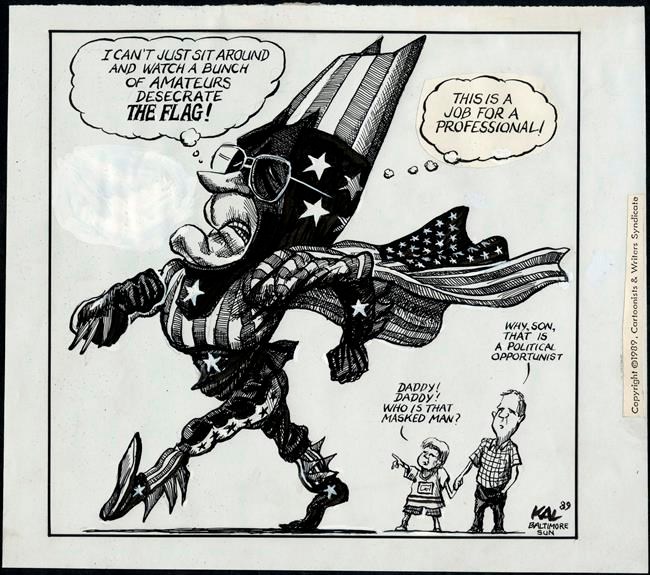
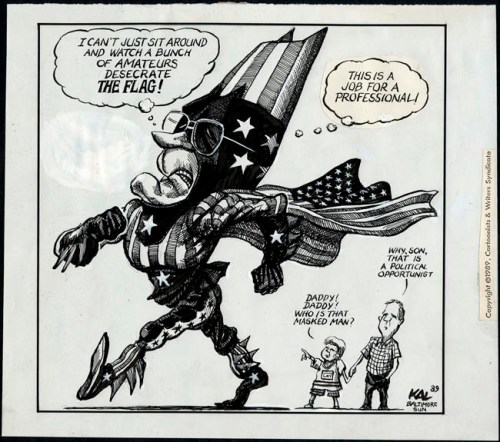
This image provided by Kevin Kallaugher shows “I Can’t Just Sit Around...,” by editorial cartoonist Kevin Kallaugher, that is one of dozens of political cartoons focusing on the First Amendment in a new exhibit, “Front Line: Editorial Cartoonists and the First Amendment” at Ohio State University’s Billy Ireland Cartoon Library & Museum in Columbus, Ohio. The display runs the gamut from a 1774 cartoon by Paul Revere criticizing Britain’s use of tea as a political weapon to a 2018 cartoon lampooning the blocking of online conservative commentary. (Kevin Kallaugher via AP)

The exhibit combines drawings contributed by several dozen cartoonists with material from the library’s own collection. Many are from newspapers, but offerings include cartoons from The New Yorker magazine and even ones that first appeared online, on websites such as Politico.

“We focused on editorial cartoonists and the First Amendment partly because American editorial cartoonists are the only ones in the world whose work is protected by an amendment to the federal constitution of the country,” said museum founder Lucy Caswell, who co-curated the exhibit with Pulitzer Prize-winning cartoonist Ann Telnaes.

Among cartoons on display:

— “Get up Kaepernick!! Men died for your right to stand!” protesters shout at former NFL quarterback Colin Kaepernick, highlighting his decision to kneel during the national anthem to protest racial injustice, in a 2016 cartoon by Ed Hall for Artizans Syndicate.

“Actually, we died for his right to sit or stand,” say two soldiers observing the scene in Hall’s drawing.

— Angelo Lopez sums up the trend of people walling themselves off from alternative viewpoints in a 2017 cartoon that appeared on the site Cartoon Movement, in which a bound and gagged Uncle Sam listens as protesters shout, “My opinions only!” and “Free speech for those I agree with!”

— A 1989 Baltimore Sun cartoon by Kevin Kallaugher featuring a superhero decked out in American flag-themed clothing from head to toe. “I can’t just sit around and watch a bunch of amateurs desecrate the flag!” he says.

President Donald Trump’s scorn for traditional media inspired several Trump-related cartoons at the exhibit. Those include a 2017 drawing by Jimmy Margulies of King Features Syndicate that portrays the iconic Twitter bird logo with a Trump hairstyle, sitting in a birdcage lined with newspapers.

Margulies said in an email that it’s a challenge not to draw about the president every day, “though he probably does or says several things each day that are worthy of a cartoon.”

Telnaes noted that editorial cartoons have been an integral part of American political discourse for more than 250 years, since “Join, or Die” appeared in Benjamin Franklin’s Pennsylvania Gazette in 1754. Worldwide, they’re an indicator of a nation’s freedom of expression.

“If there aren’t cartoonists creating tough, pointed satire against their politicians and policies, you can bet that country and its government doesn’t tolerate an individual’s right to free speech,” Telnaes said in an email.

In a 1971 cartoon by Karl Hubenthal in the now defunct-Los Angeles Examiner, a smug Supreme Court justice examines the decision upholding the printing of the Pentagon Papers. Far below, a woman tugs at his robe and questions “the moral question” of printing stolen government documents.

The headline: “Totally ignored.”
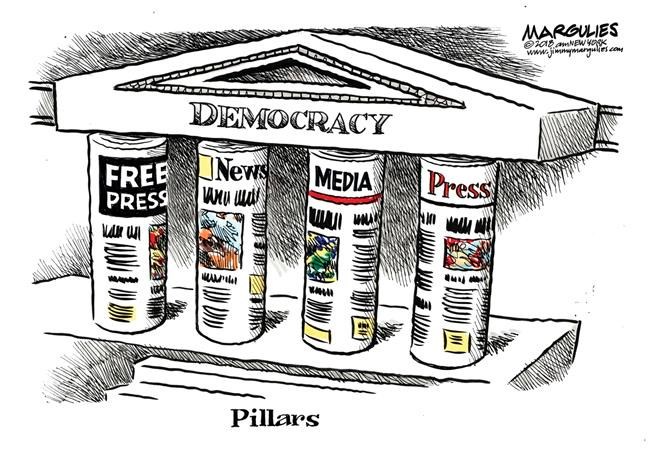
This image provided by Jimmy Margulies shows “Pillars,” by King Features editorial cartoonist Jimmy Margulies, that is one of dozens of political cartoons focusing on the First Amendment in a new exhibit, “Front Line: Editorial Cartoonists and the First Amendment” at Ohio State University’s Billy Ireland Cartoon Library & Museum in Columbus, Ohio. The display runs the gamut from a 1774 cartoon by Paul Revere criticizing Britain’s use of tea as a political weapon to a 2018 cartoon lampooning the blocking of online conservative commentary. (Jimmy Margulies via AP)

The inclusion of a cartoon from a long-gone paper underscores one of the biggest challenges for cartoonists: the decline of print newspapers and the elimination of many full-time cartooning jobs.

Twenty years ago, the country had about 150 full-time editorial cartoonists, according to Telnaes. Today it’s down to about 40.

Just last week, longtime Columbus Dispatch editorial cartoonist Nate Beeler lost his job amid a series of nationwide layoffs by GateHouse Media. Beeler has a cartoon in the Ohio State exhibit that satirizes campus free speech “safe spaces.”

Concluding a series of Friday tweets about his layoff, Beeler said, “Lastly, my heart goes out to the other cartoonists and journalists across the nation caught up in these layoffs. It’s a devastating trend in the news business.”

While the digital age has created new opportunities, it’s still tough for cartoonists to make a living, Telnaes said. Meanwhile, social media has been both a blessing and a curse.

“Social media is both positive in that readers are more engaged and appreciative of cartoons but also enables special interest groups to target cartoonists and their publications when a cartoon challenges their beliefs and agenda,” she said.

In 1988, the U.S. Supreme Court upheld political cartoons as protected speech in a case involving a Hustler Magazine parody ad that lampooned the Rev. Jerry Falwell, founder of the Moral Majority, an ad that’s on display at the Ohio State exhibit.

Writing the court’s unanimous decision, Justice William Rehnquist noted that cartoonists have portrayed public figures through the ages in a manner unavailable to a photographer or portrait artist, sketching Abraham Lincoln’s “tall, gangling posture, Teddy Roosevelt’s glasses and teeth, and Franklin D. Roosevelt’s jutting jaw and cigarette holder.”

“From the viewpoint of history, it is clear that our political discourse would have been considerably poorer without them,” Rehnquist wrote.

“Front Line: Editorial Cartoonists and the First Amendment” runs through October at Ohio State University’s Billy Ireland Cartoon Library & Museum.
Report Error Submit a Tip

More Stories

Jets’ Hellebuyck trade request marks pivotal moment for the franchise

Ken Wiebe 6 minute read Preview

Jets’ Hellebuyck trade request marks pivotal moment for the franchise

Ken Wiebe 6 minute read Thursday, Aug. 27, 2026

Connor Hellebuyck has broken his silence in an effort to expedite his departure from the Winnipeg Jets.

In a statement released by agent Ray Petkau on Thursday afternoon, Hellebuyck confirmed he has asked to be moved by the team that chose him in the fifth round of the 2012 NHL draft.

“I have never forgotten June 23, 2012. That’s the day the Winnipeg Jets took a chance on a goalie playing in Odessa, Texas. I gave everything I had from that moment to prove the Jets made the right decision,” Hellebuyck said in the statement.

“Several months ago, I privately requested a trade. I have tried to handle the situation quietly and respectfully, while giving the organization time to explore its options. With training camp approaching, I felt it was important to publicly confirm my request. My position has not changed and I believe moving on is the best path forward for me and my family.”

Read
Thursday, Aug. 27, 2026

Exhibit highlights cartoonists' focus on First Amendment

Andrew Welsh-Huggins, The Associated Press 6 minute read Preview

Exhibit highlights cartoonists' focus on First Amendment

Andrew Welsh-Huggins, The Associated Press 6 minute read Monday, May. 27, 2019

COLUMBUS, Ohio - The First Amendment right to free speech is no laughing matter, as illustrated by a new exhibit at the world's largest cartoon library.

The political cartooning display runs the gamut from a 1774 etching by Paul Revere criticizing Britain's use of tea as a political weapon to a 2018 cartoon lampooning the blocking of online conservative commentary.

Other cartoons take on political correctness, flag desecration, fake news, campus conduct codes, and the role of Twitter in public discourse.

The exhibit combines drawings contributed by several dozen cartoonists with material from the library's own collection. Many are from newspapers, but offerings include cartoons from The New Yorker magazine and even ones that first appeared online, on websites such as Politico.

Read
Monday, May. 27, 2019

Puzzles Palace

1 minute read Monday, Jul. 27, 2026

To solve our puzzles, please subscribe with this special offer: |

Looking back on Bombers shocking, and convincing, win over CFL’s top team

Taylor Allen 7 minute read Preview

Looking back on Bombers shocking, and convincing, win over CFL’s top team

Taylor Allen 7 minute read 4:52 PM CDT

It was getting harder and harder to believe in the 2026 edition of the Winnipeg Blue Bombers.

If anyone outside their locker room picked them to beat the Montreal Alouettes, they must’ve kept it to themselves, as pundits — this one included — and armchair quarterbacks across the nation doubted their chances heading into Friday night.

And honestly, rightfully so. The Bombers had left a lot to be desired through their opening 10 games.

But no matter what the stats say or what outsiders think, they play the games for a reason.

Read
4:52 PM CDT

Carney’s defence of Lake Ontario carries enormous weight

Niigaan Sinclair 5 minute read Preview

Carney’s defence of Lake Ontario carries enormous weight

Niigaan Sinclair 5 minute read Yesterday at 4:28 PM CDT

For centuries on Turtle Island (North America), explorers, map makers, and political leaders have erased Indigenous place names and substituted them — more often than not — with political, ethnocentric, and self-aggrandizing names.

In recent years, a few places on the continent have had Indigenous names re-established, but as of today, few of the original names are “official.”

So, it was no surprise when U.S. President Donald Trump on Thursday signed an executive order directing the U.S. Department of the Interior and Board on Geographic Names to take steps within 30 days to officially rename Lake Ontario as “Lake America.”

The move may have been a result of the Canada-U.S. trade war and Trump’s pettiness and ego, but it also fits in perfectly with his career.

Read
Yesterday at 4:28 PM CDT

Council candidates call out vandalism after campaign signs defaced in Waverley West

Scott Billeck 5 minute read Preview

Council candidates call out vandalism after campaign signs defaced in Waverley West

Scott Billeck 5 minute read Updated: 3:15 PM CDT

A council candidate in Waverley West said she will not be intimidated after 16 of her campaign signs were vandalized this week — some with apparent gang symbols.

Nafiya Naso is the second candidate in the ward whose signs were defaced this month. Jasmine Brar, who is also running for the council seat, had some of her signs broken on Friday along Kenaston Boulevard and signs near Naso’s that were also defaced on Saturday.

Earlier this month, Eaglewood Park in the nearby Prairie Pointe neighbourhood was also vandalized with graffiti that included homophobic slurs, anti-India messages and repeated references to “3LK” — a symbol Naso believes is associated with a gang.

Naso’s signs, located along Waverley Street near Tim Sale Drive and across from École South Pointe School in southwest Winnipeg, were spray-painted with apparent gang signs, crude drawings and other messages, including “loser” and “Ur not winning” written across her name and photograph.

Read
Updated: 3:15 PM CDT