

Carney’s defence of Lake Ontario carries enormous weight

Advertisement
Read this article for free:
or
Already have an account? Log in here »
To continue reading, please subscribe:

Digital Subscription
One year of digital access for only $205*
- Enjoy unlimited reading on winnipegfreepress.com
- Read the E-Edition, our digital replica newspaper
- Access News Break, our award-winning app
- Play interactive puzzles
*First annual payment billed as $205.00 + GST for one year. This annual subscription will automatically renew at $233.00 + GST every 52 weeks (10% off the regular annual price of $259.35). Offer available to new and qualified returning subscribers only. Cancel any time.
To continue reading, please subscribe:
Add Free Press access to your Brandon Sun subscription for only an additional
$1 for the first 4 weeks*
- Enjoy unlimited reading on winnipegfreepress.com
- Read the E-Edition, our digital replica newspaper
- Access News Break, our award-winning app
- Play interactive puzzles
*Your next Brandon Sun subscription payment will increase by $1.00 and you will be charged $17.95 plus GST for four weeks. After four weeks, your payment will increase to $24.95 plus GST every four weeks.
Read unlimited articles for free today:
or
Already have an account? Log in here »
For centuries on Turtle Island (North America), explorers, map makers, and political leaders have erased Indigenous place names and substituted them — more often than not — with political, ethnocentric, and self-aggrandizing names.
In recent years, a few places on the continent have had Indigenous names re-established, but as of today, few of the original names are “official.”
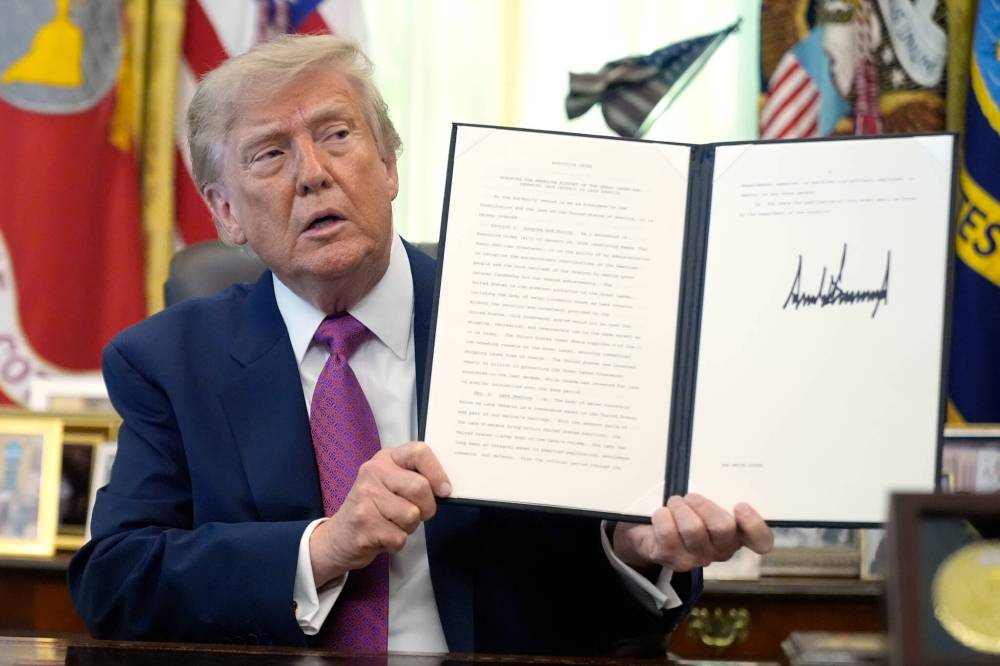
So, it was no surprise when U.S. President Donald Trump on Thursday signed an executive order directing the U.S. Department of the Interior and Board on Geographic Names to take steps within 30 days to officially rename Lake Ontario as “Lake America.”
The Associated Press
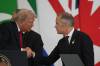
U.S. President Donald Trump holds up a signed executive order renaming Lake Ontario as “Lake America” in the Oval Office of the White House on Thursday. Erasing the Indigenous name for a lake is just another step in Trump’s attacks on Indigenous Peoples, Niigaan Sinclair writes.
The move may have been a result of the Canada-U.S. trade war and Trump’s pettiness and ego, but it also fits in perfectly with his career.
Whether it be Trump’s longtime fights with tribes over casinos, his affection for the Lumbee (considered by many Native Americans not to be Indigenous), his celebration of genocidal former president Andrew Jackson, or more recent moves, such as cutting funding for Native American hospitals and schools, reviving Columbus Day, forcibly opening up of millions of acres of Indigenous land for resource development, whitewashing the National Museum of the American Indian, or trying to end U.S. birthright citizenship and the rights of some Native Americans to be Americans, Trump has made a lifetime out of harassing, undermining, and complicating the lives of Indigenous Americans.
Erasing the Indigenous name for a lake is just another step in Trump’s attacks on Indigenous Peoples.
Chief Margaret Sault of the Mississaugas of the Credit First Nation rejected his renaming, telling media: “Lake Ontario is shared by Canada and the United States, but it is also part of a much older Indigenous landscape. I hope this moment encourages people to look beyond the political rhetoric and learn whose lands and waters these have always been.”
Sault added: “For the Mississaugas of the Credit, it will remain Lake Ontario and, more importantly, it will remain a living part of our homeland and our responsibilities to future generations.”
If this had happened a few decades ago, this story would have stopped here.
People may have even started using “Lake America” — such as when the National Oceanic and Atmospheric Administration, the U.S. Geological Survey, and the Army Corps of Engineers immediately used “Gulf of America” after Trump issued an executive order, on the first day of his second presidential term, to rename the Gulf of Mexico.
Or, media and politicians might have complained but just let the change happen.
This time, the response to Trump’s anti-Indigenous move is different — with a somewhat unexpected champion.
“The name Lake Ontario comes from the Wendat word Ontari’io, which, appropriately, means ‘the lake is beautiful, the lake is big,’” Prime Minister Mark Carney posted on social media. “The name is more than 400 years old, predating both the Confederation of Canada and the Declaration of Independence of the United States of America.”
Carney ended his post by saying: “We know that America is changing. Their trading relationships, their foreign policies, their national monuments, their hydronyms. Canadians also know that naming reality means calling it Lake Ontario — then, now and always.”
Notably, Carney posted it in French, too.
I’m not sure about Carney’s use of “then” (French explorers, for example, called Lake Ontario “Lake Frontenac” for a time) but his use of “now” and “always” was clear and emphatic.
It also suggests something kind of new in the fight against the United States and Trump in this escalating trade war: pride in Canada’s Indigenity.
The problem, of course, is that Carney can’t just cherry-pick one name or culture to defend — he needs to respect them all.

While he says he does, this has come into question during his time as prime minister, especially when it comes to including Indigenous Peoples in consultations and resource development.
Whether he knew it or not, by arguing for the original Indigenous name of Lake Ontario, Carney made an argument for Indigenous rights.
Trump’s move to rename Lake Ontario may be forgotten by Monday and is more evidence of a dying presidency, but the fact Carney used an Indigenous name to argue for Canadian sovereignty carries far more weight than most may know.
I just wonder if the prime minister knows what he did.
niigaan.sinclair@freepress.mb.ca
Niigaan Sinclair is Anishinaabe from Peguis First Nation and a professor in the Department of Indigenous Studies at the University of Manitoba. He’s been a columnist for the Free Press since 2018. Read more about Niigaan.
Every piece of writing Niigaan produces is reviewed by an editing team before it is posted online or published in print — part of the Free Press‘s tradition, since 1872, of producing reliable independent journalism. Read more about Free Press’s history and mandate, and learn how our newsroom operates.
Our newsroom depends on a growing audience of readers to power our journalism. If you are not a paid reader, please consider becoming a subscriber.
Our newsroom depends on its audience of readers to power our journalism. Thank you for your support.
Niigaan Sinclair is Anishinaabe from Peguis First Nation and a professor in the Department of Indigenous Studies at the University of Manitoba. He’s been a columnist for the Free Press since 2018. Read more about Niigaan.
Every piece of writing Niigaan produces is reviewed by an editing team before it is posted online or published in print — part of the Free Press‘s tradition, since 1872, of producing reliable independent journalism. Read more about Free Press’s history and mandate, and learn how our newsroom operates.
Our newsroom depends on a growing audience of readers to power our journalism. If you are not a paid reader, please consider becoming a subscriber.
Our newsroom depends on its audience of readers to power our journalism. Thank you for your support.
Related Articles
Trump signs order renaming Lake Ontario as 'Lake America' in the United States

Advertisement Advertise With Us
Advertisement Advertise With Us