Save the bees (and time and money) by creating a bee lawn

Advertisement

Advertise with us

Flowering "bee lawns" that attract pollinators are a compromise between fastidious turf management and the more casual yard approach. They add biodiversity to the landscape and need less maintenance. That makes them cost-effective, too.

Read this article for free:

or

Already have an account? Log in here »

To continue reading, please subscribe:

Subscribe and receive a limited-edition Free Press branded hat or tote.

Digital Subscription

One year of digital access for only $205*

  • Enjoy unlimited reading on winnipegfreepress.com
  • Read the E-Edition, our digital replica newspaper
  • Access News Break, our award-winning app
  • Play interactive puzzles

*First annual payment billed as $205.00 + GST for one year. This annual subscription will automatically renew at $233.00 + GST every 52 weeks (10% off the regular annual price of $259.35). Offer available to new and qualified returning subscribers only. Cancel any time.

To continue reading, please subscribe:

Add Free Press access to your Brandon Sun subscription for only an additional

$1 for the first 4 weeks*

  • Enjoy unlimited reading on winnipegfreepress.com
  • Read the E-Edition, our digital replica newspaper
  • Access News Break, our award-winning app
  • Play interactive puzzles
Start now

*Your next Brandon Sun subscription payment will increase by $1.00 and you will be charged $17.95 plus GST for four weeks. After four weeks, your payment will increase to $24.95 plus GST every four weeks.

Hey there, time traveller!
This article was published 28/05/2019 (2622 days ago), so information in it may no longer be current.

Flowering “bee lawns” that attract pollinators are a compromise between fastidious turf management and the more casual yard approach. They add biodiversity to the landscape and need less maintenance. That makes them cost-effective, too.

Bee lawns are turf grasses blended with low-growing perennials that bloom again after mowing. They’re cared for like typical lawns, making them comfortable for playing and lounging. But they also contain protein-rich ingredients providing vital nutrients for foraging pollinators.

Their natural diversity — they might contain fine fescues mixed with such spontaneous plants as white clover, dandelions (that bloom early when little else is flowering), creeping thyme, daisies and shade-tolerant lamium — make them less demanding and more resilient than Kentucky bluegrass. Bee lawns require minimal watering and little fertilizing, encourage deeper roots and build healthier soil — especially when their clippings are returned to the turf.
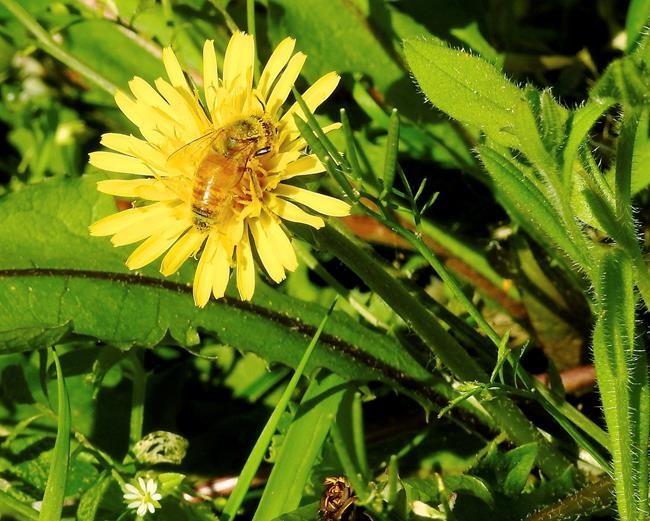
This May 2, 2019 photo shows a pollen-laden Italian honeybee in a bee lawn near Langley, Wash. Bee lawns are turf grasses blended with low-growing perennials that bloom again after mowing. This is a spontaneous ground cover that is a great pollen source for beneficial insects. Dandelions may be considered weeds by fastidious lawn managers but they bloom early in spring when little else is flowering and are favored by foraging pollinators. (Dean Fosdick via AP)

James Wolfin, a graduate research assistant working on the University of Minnesota’s bee lawn project, suggests using the fescue Festuca brevipila.

“This grass has a thin leaf blade and a slow rate of growth,” Wolfin said. “The slow rate of growth is essential in making sure the grass blades do not create a canopy over the flowers.”

Hand weeding is recommended.

For people who feel they don’t have the time, money or talent for gardening, bee lawns mean “we can mow our lawns less frequently, let the lawn flowers grow and provide habitat for bees,” said Susannah Lerman, a research ecologist with the U.S. Forest Service Northern Research Station in Amherst, Massachusetts. “Everyone can contribute to this simple solution for advancing bee conservation.”

Bee populations have been crashing for the past couple of decades because of habitat loss, chemical use and parasitic mites. These collapses are particularly worrisome since pollinators are instrumental in the growth of more than a third of the food making it to our tables.

Every pollinator plant helps rebuild those insect stocks, even if it’s just part of a colorful arrangement on a corner of the property.

Sunny slopes, rocky ground, boulevards, athletic fields and golf courses are optimal locations. “Also, office parks could benefit from bee lawns, particularly since they have very low human traffic,” Lerman said.

Check, though, with your neighbours and city hall before doing any lawn-alternative landscaping.

“It shouldn’t be too much of a hassle to get your community on board with bee lawns,” Wolfin said. “In terms of dealing with neighbours, sometimes it can be useful to install a row or strip of rocks or wood chips along your fence line to hinder the ability of flowers to spread to your neighbour’s lawn.”

Signage also helps, he said.

Monitor growth regularly to ensure you’re not introducing invasive weeds or creating a tall, unsightly yard. Mowing to about 3 inches is a good rule to follow.
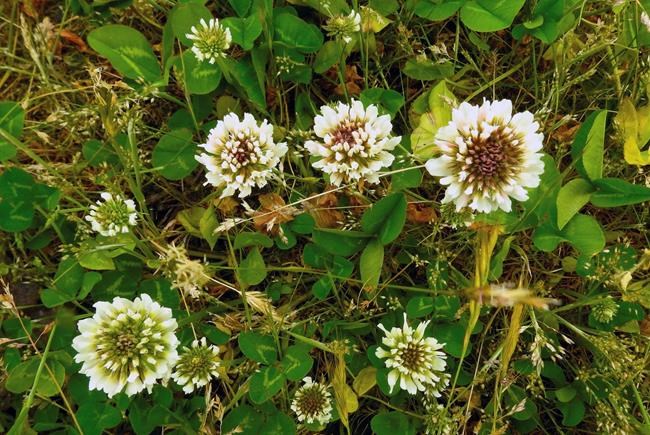
This May 12, 2019 photo shows a white clover in a bee lawn near Langley, Wash. Bee lawns are turf grasses blended with low-growing perennials that bloom again after mowing. This is a spontaneous ground cover that is a great pollen source for beneficial insects. (Dean Fosdick via AP)

“The two-week mowing regime supported the highest abundance of bees,” Lerman said, citing data from a recent turf study in Springfield, Massachusetts.

“We documented 111 species of bee (mostly native species and the majority wild bees) using the lawn flowers in western Massachusetts suburban yards,” she said.

Bee lawns are compatible with family activities unless you run into aggressive colonies of ground-dwelling yellow jackets. Honeybees, wild bees and bumblebees usually are docile unless provoked.

___

Online:

For more about managing lawns for pollinators, see this fact sheet from the University of Minnesota Extension’s Bee Lab:

http://www.beelab.umn.edu/sites/beelab.umn.edu/files/bee-lawns-2018-mg.pdf

You can contact Dean Fosdick at deanfosdick@netscape.net

Report Error Submit a Tip

More Stories

‘Good deal of synergy’ brewing in South Osborne

Gabrielle Piché 5 minute read Preview

‘Good deal of synergy’ brewing in South Osborne

Gabrielle Piché 5 minute read Yesterday at 6:56 PM CDT

Pub crawls could become the next South Osborne draw.

At least, that’s the hope of entrepreneurs in the area as three breweries build out locations in the Winnipeg neighbourhood.

Nonsuch Brewing Co. and Good Neighbour Brewing Co. have opened storefronts along the strip in the past three months. Dastardly Villain is creating a taproom and nanobrewery.

“I’m really excited to have these pubs and taprooms,” said Ben Shantz, board chair of the South Osborne Business Improvement Zone.

Read
Yesterday at 6:56 PM CDT

Downtown Keg closes… to reopen nearby

Free Press staff 2 minute read Preview

Downtown Keg closes… to reopen nearby

Free Press staff 2 minute read Yesterday at 7:28 PM CDT

Downtown Winnipeg is without a Keg restaurant — for a couple of months, anyways.

The Keg Steakhouse and Bar vacated 115 Garry St. on Wednesday, after more than five decades at the location. It will open in a new Donald Street apartment tower this fall.

Its move comes after years of waiting. The DSM, at 185 Donald St., sat as a partially started apartment block after its developer stopped operating and sought creditor protection in April 2023. The developer began the project in 2019.

Carrington Real Estate took over in 2024. Part of the 14-storey site’s initial plans — pre-Carrington — was for the Keg to occupy the main floor.

Read
Yesterday at 7:28 PM CDT

The bountiful harvest: Thousands of visitors flock to St. Norbert Farmers’ Market every Saturday

Melissa Martin 17 minute read Preview

The bountiful harvest: Thousands of visitors flock to St. Norbert Farmers’ Market every Saturday

Melissa Martin 17 minute read Yesterday at 6:00 AM CDT

While most of Winnipeg is still sleeping, or perhaps just starting to think about making the morning coffee, a patch of shade and sun just south of the Perimeter Highway is already humming with life.

Read
Yesterday at 6:00 AM CDT

We’re giving, they’re taking — where’s the win?

Editorial 4 minute read Preview

We’re giving, they’re taking — where’s the win?

Editorial 4 minute read Yesterday at 2:00 AM CDT

In the give-and-take of negotiations so far, Canada seems to be doing all the giving, while the United States does all the taking.

In the last few days, the Canadian government said it was backing away from a five per cent levy to be paid by American streaming services such as Amazon and Netflix after, earlier, dropping the three per cent digital services tax. Then, there was what now appears to be succumbing to American President Donald Trump over the Gordie Howe International Bridge, where Canada agreed to let the U.S. share the net revenues from the bridge, even though Canada paid for the entire construction.

Now, Prime Minister Mark Carney is signalling he won’t use energy exports to the United States as a bargaining chip in the current talks on the Canada-U.S.-Mexico free trade agreement, saying he didn’t “see the value” of using Canada’s energy exports to the U.S. as a trade bargaining chip.

“Canadians are reliable,” Carney said Wednesday in Red Deer, Alta. “One of the biggest commodities, arguably the best, is trust. People trust us, and so, when you’re a supplier of a key commodity, key service, you’ve got to think really hard about not supplying.”

Read
Yesterday at 2:00 AM CDT

Climate change threatens events we wait for all year

Jen Zoratti 5 minute read Preview

Climate change threatens events we wait for all year

Jen Zoratti 5 minute read 2:01 AM CDT

This week, owing to extreme heat and a wild storm with tree-snapping winds, the Royal Winnipeg Ballet had to cancel its full run of Ballet in the Park, a much-loved annual tradition at which people from all over Manitoba can enjoy world-class art in the verdant Assiniboine Park.

Two weeks prior, Rainbow Stage, another jewel of a Winnipeg summer, had to cancel the closing matinee of Jesus Christ Superstar owing to heat and humidity.

And at the beginning of July, Winnipeg Folk Festival attendees baked under scorching temperatures — 47 C with the humidex — to enjoy not just the discovery of music, but the community that has formed in Birds Hill Park on the second weekend of July for over 50 years.

This doesn’t feel great. I do not begrudge cancellations — they are absolutely the correct call for the health and safety of performers and patrons — but I can’t be the only one feeling some existential dread about our summers, and the things that make them special, in the face of a changing climate.

Read
2:01 AM CDT

Giant Tiger to close downtown, area residents bemoan dwindling grocery options

Nicole Buffie 4 minute read Preview

Giant Tiger to close downtown, area residents bemoan dwindling grocery options

Nicole Buffie 4 minute read Thursday, Jul. 30, 2026

One of the only remaining grocery-store options for people living downtown and in the Exchange District is closing its doors.

Red notices on the windows at Giant Tiger’s Donald Street and Ellice Avenue location advised passersby the store will close on Nov. 7.

Chain spokesperson Jessica Charbonneau said in an email the decision to shutter stores is “not taken lightly and is made with careful consideration and thorough analysis.”

The store was busy Thursday afternoon.

Read
Thursday, Jul. 30, 2026