

The MLA’s role (a short primer)
Advertisement
Read this article for free:
or
Already have an account? Log in here »
To continue reading, please subscribe:
Digital Subscription
One year of digital access for only $1.44 a week*
- Enjoy unlimited reading on winnipegfreepress.com
- Read the E-Edition, our digital replica newspaper
- Access News Break, our award-winning app
- Play interactive puzzles
*Billed as $5.77 plus GST every four weeks. After 52 weeks, price increases to the regular rate of $19.95 plus GST every four weeks. Offer available to new and qualified returning subscribers only. Cancel any time.
To continue reading, please subscribe:
Add Free Press access to your Brandon Sun subscription for only an additional
$1 for the first 4 weeks*
- Enjoy unlimited reading on winnipegfreepress.com
- Read the E-Edition, our digital replica newspaper
- Access News Break, our award-winning app
- Play interactive puzzles
*Your next Brandon Sun subscription payment will increase by $1.00 and you will be charged $17.95 plus GST for four weeks. After four weeks, your payment will increase to $24.95 plus GST every four weeks.
Read unlimited articles for free today:
or
Already have an account? Log in here »
Hey there, time traveller!
This article was published 18/07/2019 (2514 days ago), so information in it may no longer be current.
Have you ever thought of running to become one of the 57 members of the Manitoba Legislative Assembly? As of July 12, 2019, 102 individuals were nominated to run for Manitoba’s four main parties in the election scheduled for Sept. 10. This number will grow; in the 2016 election, 221 Manitobans put their names on a ballot.
Given the strong anti-politics public mood that exists today, we should be grateful to citizens prepared to campaign in the hope of representing their communities.
MLAs are often described as provincial lawmakers, but there is an illusionary aspect to such a description. Realism requires a recognition that the key decisions in the governing process are made by the premier and cabinet. The government proposes and the legislature disposes is an apt description of the relationship. Backbench MLAs have only limited opportunities to influence the policy process.
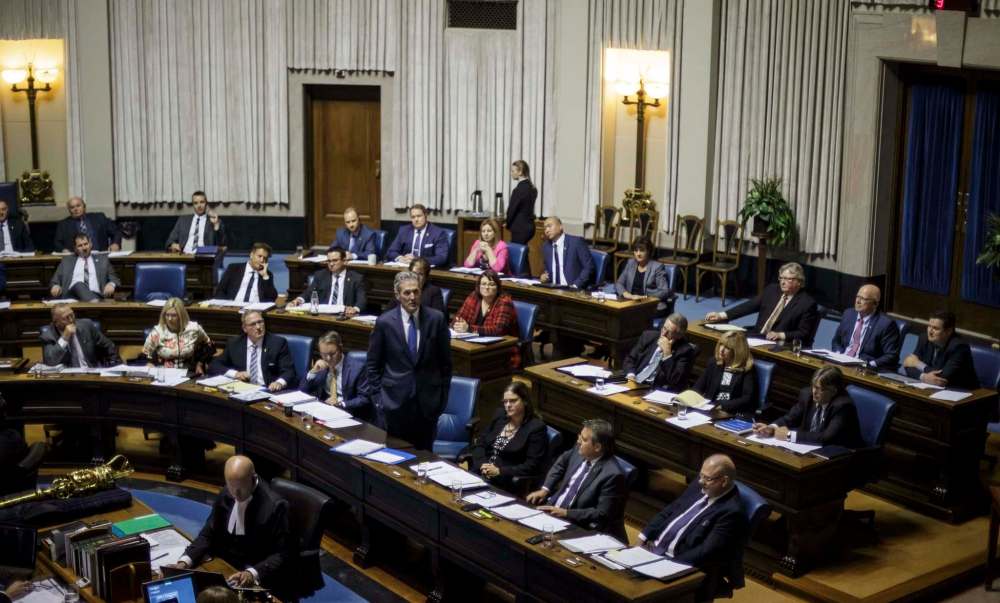
Once a part-time job, the role of MLA has become full time for most members. On average over the past decade, the legislature has sat for 81 days during each calendar year. The annual number of sitting days fluctuates, depending on factors such as election timing and transition periods when new governments are settling in.
Interestingly, a 2018 study found a majority of provincial and territorial legislatures, including Manitoba’s, had sat for fewer days over this last decade compared to the past. Manitoba had 3.2 per cent fewer sitting days.
There are several possible explanations for the shorter legislative sessions. MLAs argue that in order to gain greater public trust, they need to spend more time in their constituencies listening to citizens. The move toward more “family friendly” legislatures with shorter sessions, calendar dates for opening and closing and no evening sittings is another factor.
Most importantly, there is the centralization of power in the premier’s office and the rise of the permanent campaign that inclines governments to limit the time when they are forced to boast and confess daily in question period.
MLAs participate in debates on government bills, but party loyalty and discipline mean they normally follow the policy positions of their leaders and their party caucuses. With ministerial reputations on the line, substantive amendments to bills are rarely successful. MLAs can propose legislation but, for several reasons, such bills seldom go beyond the introductory stage in the legislative process.
Another function of the legislature is to review the annual spending plans of government. The forecasts of spending are called estimates, and the documents are notoriously difficult to comprehend for non-specialists. This contributes to little actual examination in the committee of supply; instead, debates over broad budgetary policy and fights over controversial expenditures take place along party lines.
Standing committees could be important forums for MLAs to have greater input, but unfortunately, Manitoba’s committee system is not very robust compared to other jurisdictions. Ministers serve on committees and government MLAs preside as chairs, so executive control of proceedings is virtually complete. In many cases, partisan clashes featured in the full chamber spill over into the committees.

Participation in the meetings of party caucuses is another avenue for input by regular MLAs. In the case of the government caucus, MLAs may help set limits on executive actions, but caucus seldom initiates.
An important part of the job of an MLA is to interact with constituents, including acting on their behalf to resolve grievances with the bureaucracy. Service to constituents is often the most satisfying activity for MLAs. Better MLAs use their constituency work to gather intelligence that can be used to evaluate bills and the overall performance of government.
By Manitoba standards, MLAs are well-paid. Until October 2020, the basic annual salary for an MLA is frozen at $94,513. MLAs in leadership roles are paid extra, such as $79,201 for the premier, $51,745 for a cabinet minister and the leader of the official Opposition and $43,614 for the leader of a recognized opposition party. In 2015, the provincial median income was $68,000, so MLAs are generally better off financially than most of the people they represent.
Currently, the talents of too many MLAs are underutilized. All parties should commit to giving them a more meaningful role. On less controversial topics, all-party task forces should provide advice on potential legislation. Committees should be more active, meeting between sessions, and autonomous, without ministers on them. More private members’ bills, sponsored by backbench MLAs, should be referred to committees for study and an eventual vote.
Paul G. Thomas is professor emeritus of political studies at the University of Manitoba. He was the founding academic director of the Manitoba Legislative Internship Programme that provides recent university graduates with first-hand exposure to the legislative process.