Topiary tips: When you want shrubs to double as sculpture

Advertisement

Advertise with us

Topiary is the art of growing trees and shrubs as living sculptures — cubes, spheres, obelisks, animal shapes or combinations of these.

Read this article for free:


or

Already have an account? Log in here »

To continue reading, please subscribe:

Subscribe and receive a limited-edition Free Press branded hat or tote.

Digital Subscription

One year of digital access for only $205*

  • Enjoy unlimited reading on winnipegfreepress.com
  • Read the E-Edition, our digital replica newspaper
  • Access News Break, our award-winning app
  • Play interactive puzzles

*First annual payment billed as $205.00 + GST for one year. This annual subscription will automatically renew at $233.00 + GST every 52 weeks (10% off the regular annual price of $259.35). Offer available to new and qualified returning subscribers only. Cancel any time.

To continue reading, please subscribe:

Add Free Press access to your Brandon Sun subscription for only an additional

$1 for the first 4 weeks*

  • Enjoy unlimited reading on winnipegfreepress.com
  • Read the E-Edition, our digital replica newspaper
  • Access News Break, our award-winning app
  • Play interactive puzzles
Start now

*Your next Brandon Sun subscription payment will increase by $1.00 and you will be charged $17.95 plus GST for four weeks. After four weeks, your payment will increase to $24.95 plus GST every four weeks.

Hey there, time traveller!
This article was published 30/07/2019 (2572 days ago), so information in it may no longer be current.

Topiary is the art of growing trees and shrubs as living sculptures — cubes, spheres, obelisks, animal shapes or combinations of these.

The tradition has flourished in various places at different times, but in modern gardens, topiary is rare, unless you count our foundation plantings of clipped yews and junipers — “gumdrop” or “dot-dash” landscaping along home foundations.

SUGGESTED PLANTS
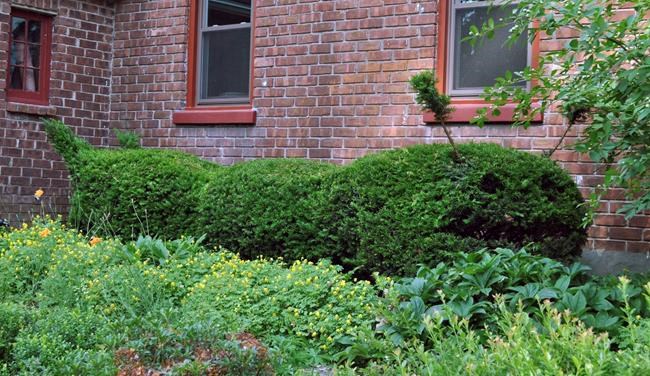
This undated photo shows a row of yews along a house foundation in New Paltz, N.Y. With dense, small leaves and readiness to resprout from pruning cuts, yews are easily pruned as a topiary — in this case as a giant caterpillar. (Lee Reich via AP)

Only certain plants are suitable for pruned topiary. (Topiaries created with wire frames “plugged” with hens-and-chicks plants or embraced by vining plants are a different story, for another time.) The ideal topiary plant is slow-growing, tolerant of repeated pruning, and able to re-sprout from older wood. Especially for smaller topiaries viewed at close range, small leaves are needed to create a surface with a crisp edge.

If possible, select a species or variety whose natural shape approximates its intended shape: Densa yew for a low sphere, or Pyramidalis yew for an obelisk, as examples.

Evergreens generally are used for topiary, but occasionally a deciduous plant such as English hawthorn or European beech is used. A drawback to a deciduous topiary, of course, is that it is bare in winter (although beech does not shed its dead leaves until spring). Deciduous plants generally grow more exuberantly than do evergreens, so also require more diligence to keep growth in check.

Many species of evergreens have been used for topiary. The quintessential ones are yew and boxwood. Some other suitable plants include arborvitae, hemlock, holly and rosemary.

DEVELOPING YOUR SHAPE

In most cases, begin shaping your plant while it is young. You could, however, carve a shape out of an old overgrown yew, much as you would out of wood or stone, because yew grows so densely and sprouts so freely from old wood.

Or maybe a growing plant will suggest a form that you could then develop. You might even juxtapose two plants, or let one grow up through the other to create, for example, a pedestal on which sits a verdant animal.

In any case, topiary lends itself more to bold shapes than to intricate designs whose details are swallowed up between prunings. Site your topiary so that it receives good light on all sides, for dense growth throughout.

Most young topiary plants that are still in their formative stage need nothing more than frequent shearing or clipping off of the ends of stems in order to encourage dense branching. Clipping individual stems is the preferred method for plants with large leaves because shearing would mangle individual leaves. Obviously, where a stem protrudes in the direction where you want growth, leave it.

KEEPING IN SHAPE

Once a topiary is fully grown and shaped, it needs pruning at least once a year, two or three times a year in some cases. Where a plant needs only once-a-year pruning and is reliably cold-hardy, prune just after midsummer. By then, the spring flush of growth has ceased, and there is less chance that pruning will stimulate regrowth before the following spring.

Cut freehand, or use a guide to make sure your topiary is not gradually changing shape over the years. A guide is also useful when you have more than one matching topiary. If you cut freehand, step back frequently to check and admire your work.

What is to be done with a neglected topiary? Severe cuts may be needed to stimulate growth within the plant. Repair a leafless hole by widening it, cutting old wood around the hole back to healthy wood. If severe cuts are needed, renovation is possible only if the plant is one capable of sprouting from old, perhaps leafless, wood. Otherwise, start again with a new plant.

___

Online:

http://www.leereich.com/blog

http://leereich.com
Report Error Submit a Tip

More Stories

Unsafe conditions force Sea Bears, Honey Badgers into winner-take-all CEBL final in Winnipeg Saturday

Joshua Frey-Sam 4 minute read Preview

Unsafe conditions force Sea Bears, Honey Badgers into winner-take-all CEBL final in Winnipeg Saturday

Joshua Frey-Sam 4 minute read Updated: Yesterday at 2:49 PM CDT

BRAMPTON — The Canadian Elite Basketball League’s new Finals format lasted one minute and 46 seconds.

And it’s possible even that was too long.

What was supposed to be a historic best-of-three series between the Winnipeg Sea Bears and the Brampton Honey Badgers will now return to the league’s previous format of a single-game elimination. Wednesday’s Game 1 at the CAA Centre in Southern Ontario was cancelled shortly after tip-off due to condensation on the court, which made the playing surface unsafe for competition.

The championship will flip to the Manitoba capital for a single, winner-take-all contest at Canada Life Centre on Saturday (2:30 p.m.).

Read
Updated: Yesterday at 2:49 PM CDT

Inmate captured after escape from Manitoba jail

Free Press staff 1 minute read Preview

Inmate captured after escape from Manitoba jail

Free Press staff 1 minute read Updated: Yesterday at 1:46 PM CDT

Manitoba RCMP have arrested an inmate who escaped from Milner Ridge Correctional Centre Wednesday.

Mounties apprehended Justin Paul at about 11 a.m. Thursday near Highway 11 and Minnewawa Street W in Lac du Bonnet.

Court records show Paul was in custody charged with multiple offences, including assault, uttering threats, robbery, theft and numerous weapon offences.

Last April, Paul pleaded guilty to failing to appear in court and was sentenced to six months probation.

Read
Updated: Yesterday at 1:46 PM CDT

Manitoba supports MAID delay: Asagwara

Carol Sanders 5 minute read Preview

Manitoba supports MAID delay: Asagwara

Carol Sanders 5 minute read 2:00 AM CDT

The number of Manitobans receiving medical assistance in dying in 2026 is on track with previous years while the plan to extend it to those suffering from mental illness is delayed indefinitely by the federal government — a move Manitoba’s health minister supports.

“There’s so much more work that needs to be done,” Uzoma Asagwara said.

The parliamentary committee that issued its recommendation in June was the third special committee of Parliament struck to assess the eligibility of people with mental illness since 2021, when MAID eligibility was expanded to include people who were not at the end of their lives.

A key condition for MAID eligibility is that a patient must be suffering from a grievous and irremediable medical condition.

Read
2:00 AM CDT

It’s one thing to climb aboard rail-relocation train, quite another to pay for the ride

Dan Lett 5 minute read Preview

It’s one thing to climb aboard rail-relocation train, quite another to pay for the ride

Dan Lett 5 minute read Wednesday, Aug. 12, 2026

Anyone who wants a brighter, safer, healthier future for the city of Winnipeg should really want the renewed hopes of rail relocation to finally become reality. And the sooner, the better.

Premier Wab Kinew announced Wednesday the province was going to forge a plan to relocate the Canadian Pacific Kansas City central yards and many of other the lines that run through Winnipeg to a bypass that runs around the city.

This “plan to design a plan” strategy was devised by a task force headed up by former federal MP and cabinet minister Lloyd Axworthy, who in 2024 was given a two-year mandate to find the best way to rid the city of some or all of its rail infrastructure.

For the record, Kinew and Axworthy said a relocation would likely take 20 years to complete, which makes this week’s announcement an important statement of intent, but little more. The sobering reality is that this promising idea has been proposed by political leaders, and then abandoned, for decades.

Read
Wednesday, Aug. 12, 2026

Psychologist sentenced to house arrest after affair with patient

Dean Pritchard 4 minute read Updated: Yesterday at 5:31 PM CDT

A psychologist who didn’t disclose her sexual affair with a mental-health patient under her care when she testified on his behalf before the Criminal Code Review Board has been sentenced to 18 months house arrest.

Rainbow Stage star relates to Elle Woods’ perseverance

Ben Waldman 4 minute read Preview

Rainbow Stage star relates to Elle Woods’ perseverance

Ben Waldman 4 minute read Yesterday at 5:00 AM CDT

Nearly 9,000 aspiring barristers and solicitors cross their fingers and send in their LSAT scores to Harvard University each year, but less than 10 per cent of applicants wind up on campus in Cambridge, Mass.

In Legally Blonde, the musical opening tonight at Rainbow Stage, Elle Woods (Claire Mac Master) defies the undercutting judgment of her blue-blood boyfriend Warner (Duncan Cox) to earn a spot in the Ivy League, leaving her doubters aghast and crimson-faced.

“What?” asked Elle — played by Reese Witherspoon in the 2001 film version — “Like it’s hard?”

The New York-born Mac Master never had any aspirations to pursue a law career, but can relate to her character’s plucky self-determination based on her experience at Toronto Metropolitan University’s undergraduate acting program, which accepts 25 applicants each year from an international pool of hundreds.

Read
Yesterday at 5:00 AM CDT