Rare Steinbeck story, set in Paris, published this week
Advertisement
Read this article for free:
or
Already have an account? Log in here »
To continue reading, please subscribe:

Digital Subscription
One year of digital access for only $205*
- Enjoy unlimited reading on winnipegfreepress.com
- Read the E-Edition, our digital replica newspaper
- Access News Break, our award-winning app
- Play interactive puzzles
*First annual payment billed as $205.00 + GST for one year. This annual subscription will automatically renew at $233.00 + GST every 52 weeks (10% off the regular annual price of $259.35). Offer available to new and qualified returning subscribers only. Cancel any time.
To continue reading, please subscribe:
Add Free Press access to your Brandon Sun subscription for only an additional
$1 for the first 4 weeks*
- Enjoy unlimited reading on winnipegfreepress.com
- Read the E-Edition, our digital replica newspaper
- Access News Break, our award-winning app
- Play interactive puzzles
*Your next Brandon Sun subscription payment will increase by $1.00 and you will be charged $17.95 plus GST for four weeks. After four weeks, your payment will increase to $24.95 plus GST every four weeks.
Read unlimited articles for free today:
or
Already have an account? Log in here »
Hey there, time traveller!
This article was published 31/07/2019 (2604 days ago), so information in it may no longer be current.
NEW YORK – Ernest Hemingway wasn’t the only Great American Writer with something to say about Paris.
Hemingway’s contemporary and fellow Nobel laureate, John Steinbeck, was best known for “The Grapes of Wrath,” ”Of Mice and Men” and other fiction set in his native California. But he was a world citizen for much of his adult life, and he absorbed enough of Paris to write down some memories and impressions, and add a funny, fictional spin.
In the mid-1950s, Steinbeck wrote a series of columns for the French newspaper Le Figaro titled “One American In Paris.” One of those pieces, widely believed to have never come out in English, appears this week in the summer issue of The Strand Magazine , a literary quarterly which has published rare works by Hemingway, F. Scott Fitzgerald and many others.
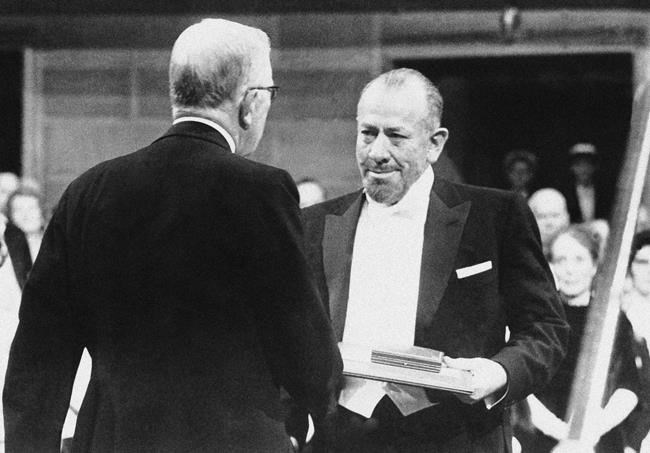
“Steinbeck is seen as a uniquely American writer, who wrote about American themes … but this story casts light on Steinbeck the international traveller,” says Strand Managing Editor Andrew Gulli, who found the Paris story in the online Steinbeck archive at the Harry Ransom Center at the University of Texas at Austin.
In his Paris piece, Steinbeck teases the French café culture and apparently his own literary stature as a serious, even self-important, writer who helped define the Great Depression through the impoverished but steadfast Joad family of “The Grapes of Wrath.” The heroes of “One American in Paris” represent a more privileged class: a French chef, his trusted cat Apollo — and the unexpected zest of Apollo’s catnip.
“I am sometimes criticized for avoiding the great discordant notes of the times and closing my ears to the drums of daily doom,” Steinbeck notes drolly. “But I have found that the momentary sound very shortly becomes a whisper and the timely fury is forgotten, while the soft verities persist year after year. We have not survived on great things, but on little ones, like a little story I have here.”
Unlike Hemingway, Steinbeck had no youthful or war time experiences in Paris. During World War II, he worked in London, Italy and North Africa as a correspondent for the New York Herald Tribune; he didn’t arrive in Paris until 1946, the year after the war ended, when he was in his mid-40s. Years later, he would acknowledge that his view of the city was “naive,” but “it is an eye of delight.” Susan Shillinglaw, a Steinbeck scholar and a professor of English at San Jose State University, said the author’s affection inspired the humour of his Le Figaro contributions.
“His intention was to have a light touch, to write with an uninformed eye, so just write about ‘little things’ that delighted him,” she told the AP in a recent email. “He loved to write, and it didn’t always have to be serious. Some of his writing is funny, deft, wry, engaging. He liked to contact ordinary people.”
His tale in The Strand is set in a restaurant called “The Amiable Fleas,” where patrons include a painter whose work is invisible, an architect with a grudge against the flying buttress and a poet “whose work was so gloriously obscure that even he did not understand it.” But no one has grander thoughts at the Fleas than its owner and chef, one M. Amite, whose imagination has been fired by receiving a star from the Michelin Guidebook.

“The star did it,” Steinbeck reports. “Ambition fed on the star and grew happy from its feeding. M. Amité dreamed, planned, lived and suffered for a second star.”
Much of the plot centres on an expected visit from the Michelin reviewer and the momentary crisis of Apollo’s disappearance. The cat is not only M. Amite’s confidant, but official taster, his approval the final step for a given recipe. Through coincidences more in line with an O. Henry story than “The Grapes of Wrath,” the cat and his palate will leave everyone satisfied.
“Olympus is not proof against pity. The Muses can forgive. Having been mischievous and cruel, they sometimes make amends,” Steinbeck writes. “Today, a novelist sits every day at The Amiable Fleas, a novelist whose work is so despondent that the whole world flocks to him. Tourist buses stop to disgorge pilgrims, and even cynical Parisians rub their hands and lick their lips when they enter.”
____
Online: https://strandmag.com/