Barlow’s thirst for water justice rewarding

Advertisement

Advertise with us

It’s difficult to fathom that a water crisis exists in Canada. As a hyper-privileged person on this planet, the lack of this public good and basic necessity for life seems like a problem that other people have. Think Flint, Mich.; Cape Town, South Africa; Chile; Shoal Lake 40 First Nation. Many Canadians live under the illusion that clean drinking water is in abundance, that it is somehow protected from the greedy reach of corporations and that we have designed a system of governance to ensure that we all have access to this most basic need.

Read this article for free:

or

Already have an account? Log in here »

To continue reading, please subscribe:

Subscribe and receive a limited-edition Free Press branded hat or tote.

Digital Subscription

One year of digital access for only $205*

  • Enjoy unlimited reading on winnipegfreepress.com
  • Read the E-Edition, our digital replica newspaper
  • Access News Break, our award-winning app
  • Play interactive puzzles

*First annual payment billed as $205.00 + GST for one year. This annual subscription will automatically renew at $233.00 + GST every 52 weeks (10% off the regular annual price of $259.35). Offer available to new and qualified returning subscribers only. Cancel any time.

To continue reading, please subscribe:

Add Free Press access to your Brandon Sun subscription for only an additional

$1 for the first 4 weeks*

  • Enjoy unlimited reading on winnipegfreepress.com
  • Read the E-Edition, our digital replica newspaper
  • Access News Break, our award-winning app
  • Play interactive puzzles
Start now

*Your next Brandon Sun subscription payment will increase by $1.00 and you will be charged $17.95 plus GST for four weeks. After four weeks, your payment will increase to $24.95 plus GST every four weeks.

Hey there, time traveller!
This article was published 21/09/2019 (2507 days ago), so information in it may no longer be current.

It’s difficult to fathom that a water crisis exists in Canada. As a hyper-privileged person on this planet, the lack of this public good and basic necessity for life seems like a problem that other people have. Think Flint, Mich.; Cape Town, South Africa; Chile; Shoal Lake 40 First Nation. Many Canadians live under the illusion that clean drinking water is in abundance, that it is somehow protected from the greedy reach of corporations and that we have designed a system of governance to ensure that we all have access to this most basic need.

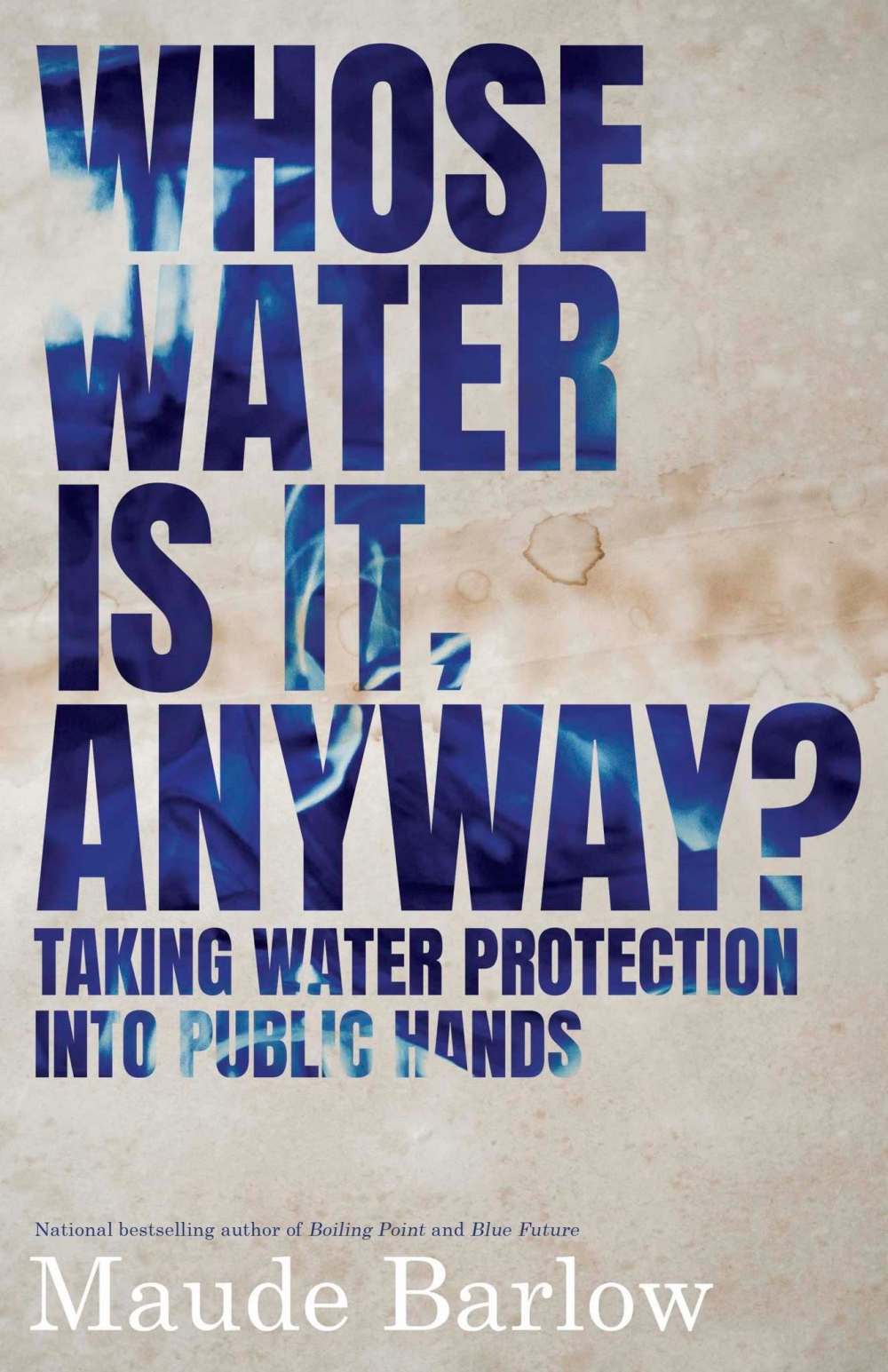
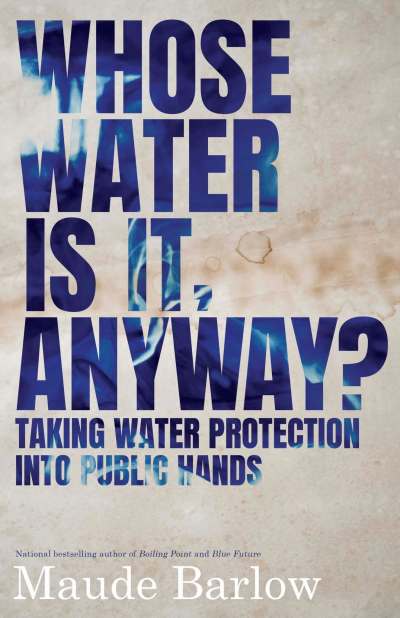
But we couldn’t be more wrong. And thanks to Maude Barlow, a hero in the Canadian and global progressive movement and a founding member of the Council of Canadians, the battle to ensure our global thirst is quenched is ratcheting up. In Whose Water Is It, Anyway?: Taking Water Protection Into Public Hands, Barlow passionately describes the history of how water, on a global scale, has been systematically transformed from a public good to an economic commodity — right under our noses.

Through the development of international trade deals and the neoliberal forces that brought in waves of privatization in the 1980s and ’90s, Barlow succinctly connects the dots as to how powerful global entities such as the World Bank and the World Water Forum began to push a global agenda that saw even the UN support the ideological position that water should be bought and sold like any other product. The old story that the free market will somehow manage to produce just and efficient pathways of distribution of resources pervaded and persists.
Barlow describes the global movement of resistance that took place during the ’90s and early 2000s that sought (and continues to seek) to ensure that water is protected and that it is viewed as a fundamental human right. Through the leadership and determination of humans across the planet, Barlow notes that the UN General Assembly finally, in 2015, “recognized water and sanitation as two distinct rights in yet another unanimously adopted resolution.”

But as we all know, talk is cheap, and UN resolutions often can be devalued and become inflationary. This is not lost on Barlow, who argues that “there will always be a need for the grassroots to bridge political debates into everyday reality.” This is the essence of democracy, global citizenship and cosmopolitanism.

And for Barlow, this democratic and grassroots engagement has manifested itself in the Blue Communities movement — a social justice movement designed to ensure that all humans have universal access to clean drinking water and that giant water corporations (like Nestlé, which pumps 4.7 million litres per day out of the aquifers surrounding Guelph for chump change) are denied access to our water. You only have to recall (or Google) the eerie interview with Nestlé CEO Peter Brabeck-Letmathe to understand what is at stake in terms of the sinister intentions of multinational corporations who salivate at the scarcity of water.

And it is through the grassroots Blue Communities movement that resistance to the privatization of water is achieved. Barlow describes the powerful examples throughout the world of how communities have stomped on the private control of water and taken back their right to clean drinking water and proper sanitation. Through positive activism, many community groups, schools, churches, youth, seniors and concerned citizens are engaged in this fight to ensure a sustainable and ethical source of drinking water for everyone on planet Earth.

Fortunately, Barlow provides a blueprint for the work and pathway for hope. She carves out a starting point for Manitobans and Canadians who care deeply about the fate of all our neighbours, our waterways and all species and systems on planet Earth. Time is of the essence, and the time for moral courage is nigh. As Bolivian activist and shoemaker Oscar Olivera asserts, “I would rather die of a bullet than thirst.”

Matt Henderson is assistant superintendent of Seven Oaks School Division.
Report Error Submit a Tip

More Stories

Brighter days ahead after Camp Arnes

Joshua Frey-Sam 5 minute read Preview

Brighter days ahead after Camp Arnes

Joshua Frey-Sam 5 minute read Yesterday at 6:00 AM CDT

Keishna Abenstein remembers what it was like to be a teenager who was stuck in her shell.

She also recalls how much going to summer camp at Camp Arnes helped her spread her wings.

Abenstein has watched her middle child, Teagen, go through a similar roller-coaster as a teenager. Teagen, described as a social butterfly in his childhood, has become a bit more reserved in his adolescence after many of his closest elementary school friends went to a different middle school, forcing him to make new friends as he began the next chapter of his education.

Abenstein saw an opportunity for a similar experience at Camp Arnes that could impact her son the same way it did for her.

Read
Yesterday at 6:00 AM CDT

On eve of Folklorama, Ghana pavilion scrambles to replace stolen outfits

Chris Kitching 4 minute read Preview

On eve of Folklorama, Ghana pavilion scrambles to replace stolen outfits

Chris Kitching 4 minute read Friday, Jul. 31, 2026

Volunteers from Folklorama’s Ghana pavilion scrambled to replace cultural costumes for about 40 young dancers after the outfits were stolen in Winnipeg days before the annual festival begins.

Two plastic storage bins containing the costumes, to be worn by children and teenagers, were taken from the trunk of a parked car on Banning Street, near Notre Dame Avenue in the West End, likely late Wednesday or early Thursday.

“I felt sad that this has happened. I felt completely devastated for the mother who had them in her car,” said pavilion co-ordinator Abigail Larson. “The initial feeling of sadness changed to, ‘OK, how do we make this a positive?’”

The costumes belong to the Ghana Union of Manitoba Dancers, whose members have rehearsed for months for Folklorama, which begins Sunday.

Read
Friday, Jul. 31, 2026

Domestic-duty distribution must suit you both

Maureen Scurfield 5 minute read Yesterday at 2:00 AM CDT

DEAR MISS LONELYHEARTS: I fear I’m going to end up with prolonged indigestion! My husband — a pretty boring cook — has decided it’s his turn to be the house parent again, and that I should go back to my profession, as he has come to hate his job.

I couldn’t be happier! He knows I love my work and I know he’s bored stiff by his accounting career. (He sometimes even has nightmares about numbers!)

The trouble is he’s a lousy housekeeper and cook. He’s patient and fun with our three kids, but I know that once he gets them off to school this fall, he’ll be on the couch watching TV until they get home.

I’m not looking forward to this. The place is always a wreck when he’s on home duty. Also, as soon as the kids come through the door, he makes them adult-sized sandwiches and store-bought snacks. So when I get home from work, they’re not hungry for a healthy dinner and my man certainly won’t be busy cooking up something nice for the two of us.

Kreviazuk, in her own voice

Eva Wasney 7 minute read Preview

Kreviazuk, in her own voice

Eva Wasney 7 minute read Friday, Jul. 31, 2026

Chantal Kreviazuk is in the midst of a very busy year.

In May, the Winnipeg-born singer-songwriter released her 11th studio album, In My Own Voice — a project that reclaims and reimagines a selection of hit songs she’s written for some of the world’s biggest artists.

The 12-track album features Kreviazuk performing ethereal covers of Pitbull’s Feel This Moment, Drake’s Over My Dead Body and Gwen Stefani’s Rich Girl, among others.

But she didn’t stop there.

Read
Friday, Jul. 31, 2026

Fatigue no excuse for Bombers’ dismal play

Taylor Allen 6 minute read Preview

Fatigue no excuse for Bombers’ dismal play

Taylor Allen 6 minute read Friday, Jul. 31, 2026

Visiting teams used to fear playing at Princess Auto Stadium.

At one time, it wasn’t a question of whether the Winnipeg Blue Bombers would win at home — it was a question of by how much.

From 2017 to 2025, the Blue and Gold posted a dominant 54-14 record in front of the team’s diehard fans.

Those days, however, are firmly in the rearview mirror.

Read
Friday, Jul. 31, 2026

Giant Tiger decision creates giant void for desperate population

Niigaan Sinclair 5 minute read Preview

Giant Tiger decision creates giant void for desperate population

Niigaan Sinclair 5 minute read Friday, Jul. 31, 2026

A lot of Winnipeggers may shrug, but the end of Giant Tiger’s downtown store is a giant problem for many of the people living in the centre of the city.

It would have been difficult for anyone going into or passing by the Canadian discount chain’s Donald Street and Ellice Avenue location Thursday to miss the red notices posted on the store’s windows advising it will close on Nov. 7.

According to a 2024 Downtown Winnipeg BIZ report, about 18,000 people live in Winnipeg’s downtown.

More than 60,000 people work there, and some days — when there’s a big concert or the Jets play at Canada Life Centre, for example — the number of people spending time in the area increases significantly.

Read
Friday, Jul. 31, 2026