Barlow’s thirst for water justice rewarding

Advertisement

Advertise with us

It’s difficult to fathom that a water crisis exists in Canada. As a hyper-privileged person on this planet, the lack of this public good and basic necessity for life seems like a problem that other people have. Think Flint, Mich.; Cape Town, South Africa; Chile; Shoal Lake 40 First Nation. Many Canadians live under the illusion that clean drinking water is in abundance, that it is somehow protected from the greedy reach of corporations and that we have designed a system of governance to ensure that we all have access to this most basic need.

Read this article for free:


or

Already have an account? Log in here »

To continue reading, please subscribe:

Subscribe and receive a limited-edition Free Press branded hat or tote.

Digital Subscription

One year of digital access for only $205*

  • Enjoy unlimited reading on winnipegfreepress.com
  • Read the E-Edition, our digital replica newspaper
  • Access News Break, our award-winning app
  • Play interactive puzzles

*First annual payment billed as $205.00 + GST for one year. This annual subscription will automatically renew at $233.00 + GST every 52 weeks (10% off the regular annual price of $259.35). Offer available to new and qualified returning subscribers only. Cancel any time.

To continue reading, please subscribe:

Add Free Press access to your Brandon Sun subscription for only an additional

$1 for the first 4 weeks*

  • Enjoy unlimited reading on winnipegfreepress.com
  • Read the E-Edition, our digital replica newspaper
  • Access News Break, our award-winning app
  • Play interactive puzzles
Start now

*Your next Brandon Sun subscription payment will increase by $1.00 and you will be charged $17.95 plus GST for four weeks. After four weeks, your payment will increase to $24.95 plus GST every four weeks.

Hey there, time traveller!
This article was published 21/09/2019 (2521 days ago), so information in it may no longer be current.

It’s difficult to fathom that a water crisis exists in Canada. As a hyper-privileged person on this planet, the lack of this public good and basic necessity for life seems like a problem that other people have. Think Flint, Mich.; Cape Town, South Africa; Chile; Shoal Lake 40 First Nation. Many Canadians live under the illusion that clean drinking water is in abundance, that it is somehow protected from the greedy reach of corporations and that we have designed a system of governance to ensure that we all have access to this most basic need.

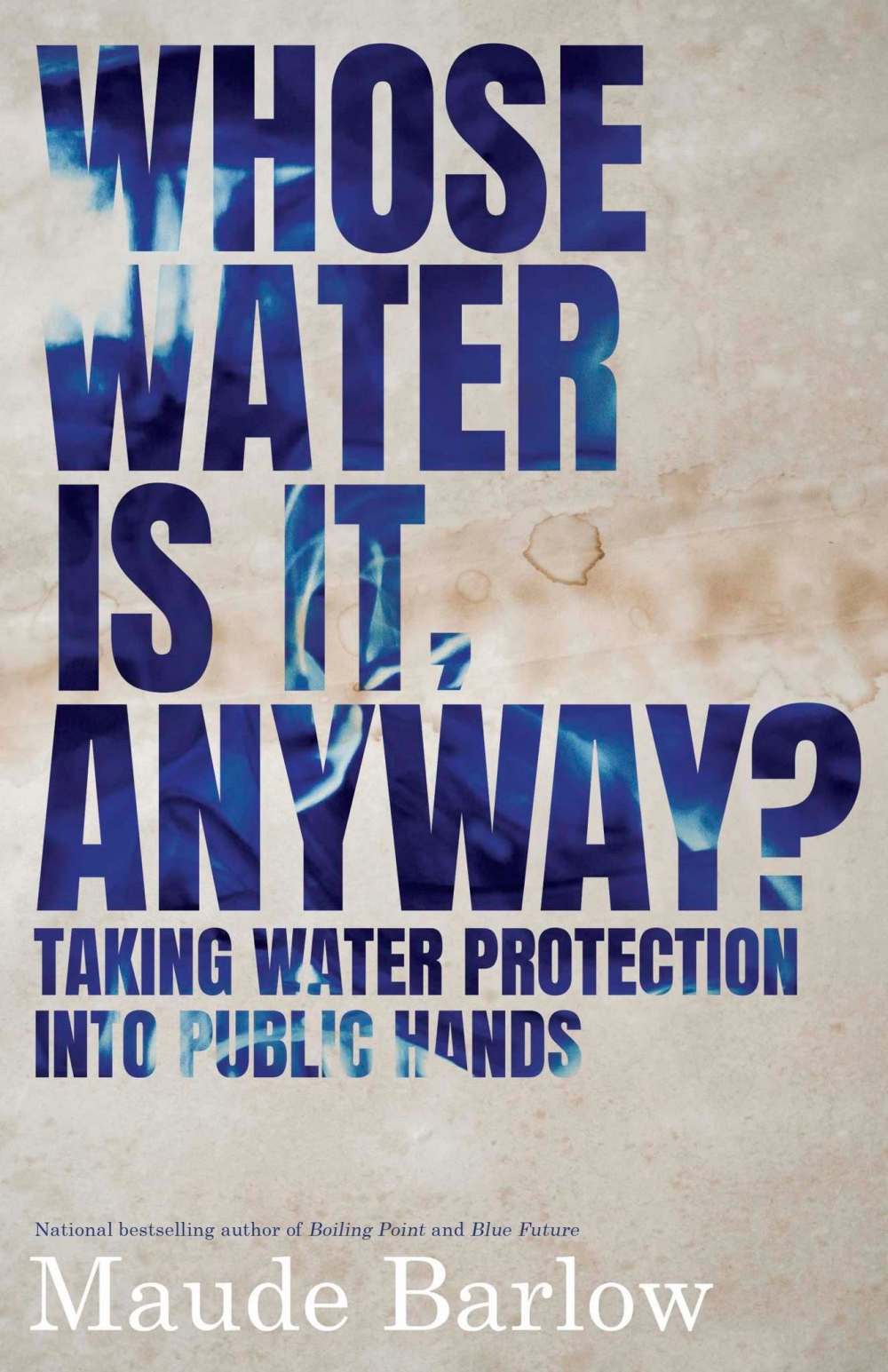
But we couldn’t be more wrong. And thanks to Maude Barlow, a hero in the Canadian and global progressive movement and a founding member of the Council of Canadians, the battle to ensure our global thirst is quenched is ratcheting up. In Whose Water Is It, Anyway?: Taking Water Protection Into Public Hands, Barlow passionately describes the history of how water, on a global scale, has been systematically transformed from a public good to an economic commodity — right under our noses.

Through the development of international trade deals and the neoliberal forces that brought in waves of privatization in the 1980s and ’90s, Barlow succinctly connects the dots as to how powerful global entities such as the World Bank and the World Water Forum began to push a global agenda that saw even the UN support the ideological position that water should be bought and sold like any other product. The old story that the free market will somehow manage to produce just and efficient pathways of distribution of resources pervaded and persists.
Barlow describes the global movement of resistance that took place during the ’90s and early 2000s that sought (and continues to seek) to ensure that water is protected and that it is viewed as a fundamental human right. Through the leadership and determination of humans across the planet, Barlow notes that the UN General Assembly finally, in 2015, “recognized water and sanitation as two distinct rights in yet another unanimously adopted resolution.”

But as we all know, talk is cheap, and UN resolutions often can be devalued and become inflationary. This is not lost on Barlow, who argues that “there will always be a need for the grassroots to bridge political debates into everyday reality.” This is the essence of democracy, global citizenship and cosmopolitanism.

And for Barlow, this democratic and grassroots engagement has manifested itself in the Blue Communities movement — a social justice movement designed to ensure that all humans have universal access to clean drinking water and that giant water corporations (like Nestlé, which pumps 4.7 million litres per day out of the aquifers surrounding Guelph for chump change) are denied access to our water. You only have to recall (or Google) the eerie interview with Nestlé CEO Peter Brabeck-Letmathe to understand what is at stake in terms of the sinister intentions of multinational corporations who salivate at the scarcity of water.

And it is through the grassroots Blue Communities movement that resistance to the privatization of water is achieved. Barlow describes the powerful examples throughout the world of how communities have stomped on the private control of water and taken back their right to clean drinking water and proper sanitation. Through positive activism, many community groups, schools, churches, youth, seniors and concerned citizens are engaged in this fight to ensure a sustainable and ethical source of drinking water for everyone on planet Earth.

Fortunately, Barlow provides a blueprint for the work and pathway for hope. She carves out a starting point for Manitobans and Canadians who care deeply about the fate of all our neighbours, our waterways and all species and systems on planet Earth. Time is of the essence, and the time for moral courage is nigh. As Bolivian activist and shoemaker Oscar Olivera asserts, “I would rather die of a bullet than thirst.”

Matt Henderson is assistant superintendent of Seven Oaks School Division.

Report Error Submit a Tip

More Stories

Rainbow Stage’s Legally Blonde a lovely legal musical

Holly Harris 5 minute read Preview

Rainbow Stage’s Legally Blonde a lovely legal musical

Holly Harris 5 minute read Friday, Aug. 14, 2026

Omigod, you guys! Rainbow Stage kicked off its penultimate summer production Thursday with a high-octane joy machine bathed in a sea of pink.

Inspired by the 2001 Hollywood film starring Reese Witherspoon, and Amanda Brown’s same-titled novel, the award-winning Legally Blonde: The Musical — featuring a book by Heather Hach, with music/lyrics by Laurence O’Keefe and Nell Benjamin — opened on Broadway in April 2007, followed by a subsequent West End run.

The tale — equal parts cheesy rom-com and potent siren call for female autonomy and empowerment — focuses on quintessential Cali-girl Elle Woods (a pitch-perfect Claire Mac Master). A proud daughter and president of Delta Nu sorority house, she enrols at Harvard Law School to win back her upwardly mobile ex-boyfriend, Warner Huntington III (Duncan Cox).

Laser-focused on marrying a “Jackie, not a Marilyn,” Warner dreams of becoming an American senator, latching onto uber-preppy fellow pupil Vivienne Kensington (Julie Davis), who becomes Elle’s arch nemesis.

Read
Friday, Aug. 14, 2026

Don’t be a big loser — check out Real Love Summer Fest ReunionBig Loser takes the stage at 8:20 p.m. tonight as part of the Real Love Summer Fest Reunion, a one-day event put on by the indie promotion company, which ran the festival in the Interlake area for a decade until last summer’s final edition near Teulon.

Bookers Gil Carroll and Adam Soloway have programmed a full day of music at Blue Note Park (220 Main St.), the outdoor venue adjacent to Times Change(d) High and Lonesome Club.

First up at 4 p.m. is folk-rock songwriter tofusmell, followed at 5 p.m. with a rare performance by indie-songwriting darlings Animal Teeth, a group with several summer fest bills under its belt. Up-and-coming pop-rockers Synthetic Friend take the stage at 6, followed at 7 by the fun electronic dance pop of French Class.

After playing with his full band at last month’s Winnipeg Folk Festival, Amos the Kid will perform a solo set at 8 p.m. Sans band, the performer shows off his affable roots as a Gord Downie acolyte with catchy earworms to match.

Ratcheting up heat can lead to cold feet

Maureen Scurfield 5 minute read Yesterday at 2:00 AM CDT

DEAR MISS LONELYHEARTS: I came home early from my family’s beautiful lake cottage with my heart broken in pieces. I’d taken my new love out there and he seemed so happy to go with me. Friends of mine at the lake helped by offering me their romantic cabin while they were away on a road trip.

After two days of bliss on the beach, walking the sandy shores at twilight, plus some great lovemaking, our trip felt absolutely magical to me. It was like the honeymoon I hope to have with him someday. I happily told my guy that over breakfast in the morning. His face fell.

He went out right away for a “long run,” and then he went again for a second one right after lunch. He didn’t come back for many hours, so I finally went down to the kiosks at the beach at 5 p.m. looking for him, asking if anyone had seen my guy.

One guy said, “Yeah, he was with your other visitor today — the red-headed girl.” I’d had no other visitor. I suddenly realized he must have met another woman at the beach, and passed her off as my friend. I just lost it!

Firefighter’s death fuels cancer fight

Zoe Pierce 5 minute read Preview

Firefighter’s death fuels cancer fight

Zoe Pierce 5 minute read Yesterday at 2:01 AM CDT

The United Fire Fighters of Winnipeg is mourning the loss of Winnipeg firefighter Darrel Maynard while continuing its work to raise awareness of occupational cancer and improve health protections for firefighters.

Maynard, a senior firefighter II and acting lieutenant with the Winnipeg Fire Paramedic Service, died Aug. 5 at age 41 after a three-year battle with occupational cancer.

He served Winnipeg for nearly two decades and leaves behind his wife Francine and sons Colin and Christian.

“Darrel was an incredible, incredible person, an incredible firefighter, and really, really special to all of us,” said Nick Kasper, president of UFFW.

Read
Yesterday at 2:01 AM CDT

Barlow’s thirst for water justice rewarding

Reviewed by Matt Henderson 4 minute read Preview

Barlow’s thirst for water justice rewarding

Reviewed by Matt Henderson 4 minute read Saturday, Sep. 21, 2019

It’s difficult to fathom that a water crisis exists in Canada. As a hyper-privileged person on this planet, the lack of this public good and basic necessity for life seems like a problem that other people have. Think Flint, Mich.; Cape Town, South Africa; Chile; Shoal Lake 40 First Nation. Many Canadians live under the illusion that clean drinking water is in abundance, that it is somehow protected from the greedy reach of corporations and that we have designed a system of governance to ensure that we all have access to this most basic need.

But we couldn’t be more wrong. And thanks to Maude Barlow, a hero in the Canadian and global progressive movement and a founding member of the Council of Canadians, the battle to ensure our global thirst is quenched is ratcheting up. In Whose Water Is It, Anyway?: Taking Water Protection Into Public Hands, Barlow passionately describes the history of how water, on a global scale, has been systematically transformed from a public good to an economic commodity — right under our noses.

Through the development of international trade deals and the neoliberal forces that brought in waves of privatization in the 1980s and ’90s, Barlow succinctly connects the dots as to how powerful global entities such as the World Bank and the World Water Forum began to push a global agenda that saw even the UN support the ideological position that water should be bought and sold like any other product. The old story that the free market will somehow manage to produce just and efficient pathways of distribution of resources pervaded and persists.

Barlow describes the global movement of resistance that took place during the ’90s and early 2000s that sought (and continues to seek) to ensure that water is protected and that it is viewed as a fundamental human right. Through the leadership and determination of humans across the planet, Barlow notes that the UN General Assembly finally, in 2015, “recognized water and sanitation as two distinct rights in yet another unanimously adopted resolution.”

Read
Saturday, Sep. 21, 2019

Manitoba family finalist for cattle producers environmental award

Aaron Epp 4 minute read Preview

Manitoba family finalist for cattle producers environmental award

Aaron Epp 4 minute read Yesterday at 2:00 AM CDT

A family in western Manitoba is one of seven finalists for a national environmental award honouring beef cattle producers.

Connor and Kyla English, alongside Connor’s parents, Brian and Leanne English, are nominated for the Canadian Cattle Association’s Environmental Stewardship Award. The 30-year-old award is presented to beef farmers and ranchers who explore innovative ways to protect, preserve and enhance their operations and the environment simultaneously.

This year’s recipient will be announced on Wednesday during a banquet at the Canadian Beef Industry Conference in Winnipeg.

The English family’s roots near Bradwardine — about 265 kilometres west of Winnipeg — date back to 1898. Today, Connor, Kyla, Brian and Leanne manage a herd of about 320 breeding cows on nearly 445 hectares (1,100 acres) of owned and rented pasture and forage land.

Read
Yesterday at 2:00 AM CDT