WEATHER ALERT

Printmaker puts Winnipeg on the map

Advertisement

Advertise with us

‘I did not like Winnipeg at all at first,” artist Miriam Rudolph admits, sounding a bit sheepish. She had come to Winnipeg in 2003 from a Mennonite community in Paraguay to attend art school at the University of Manitoba, and it was an adjustment.

Read this article for free:

or

Already have an account? Log in here »

To continue reading, please subscribe:

Subscribe and receive a limited-edition Free Press branded hat or tote.

Digital Subscription

One year of digital access for only $205*

  • Enjoy unlimited reading on winnipegfreepress.com
  • Read the E-Edition, our digital replica newspaper
  • Access News Break, our award-winning app
  • Play interactive puzzles

*First annual payment billed as $205.00 + GST for one year. This annual subscription will automatically renew at $233.00 + GST every 52 weeks (10% off the regular annual price of $259.35). Offer available to new and qualified returning subscribers only. Cancel any time.

To continue reading, please subscribe:

Add Free Press access to your Brandon Sun subscription for only an additional

$1 for the first 4 weeks*

  • Enjoy unlimited reading on winnipegfreepress.com
  • Read the E-Edition, our digital replica newspaper
  • Access News Break, our award-winning app
  • Play interactive puzzles
Start now

*Your next Brandon Sun subscription payment will increase by $1.00 and you will be charged $17.95 plus GST for four weeks. After four weeks, your payment will increase to $24.95 plus GST every four weeks.

Hey there, time traveller!
This article was published 30/09/2019 (2473 days ago), so information in it may no longer be current.

‘I did not like Winnipeg at all at first,” artist Miriam Rudolph admits, sounding a bit sheepish. She had come to Winnipeg in 2003 from a Mennonite community in Paraguay to attend art school at the University of Manitoba, and it was an adjustment.

“Somehow I didn’t love the city,” she says. “I didn’t love the weather.”

Rudolph came around, and then some. When she and her husband left Winnipeg to pursue graduate degrees, first in Minneapolis and then in Edmonton, they missed the city. “We were gone seven years, and the only place we really wanted to come back to — that felt like a home to me for the first time ever — was Winnipeg,” Rudolph says.

Partly, she suggests, this was because of the warmth, generosity and friendliness of Winnipeggers. But it might also have something to do with her art. Rudolph, who specializes in printmaking, started to make “maps” of our town and its neighbourhoods, images that combine realistic details with a subjective emotional experience to build a powerful sense of place and belonging.

At this month’s Art Talk/Art Walk at the Free Press Café, Rudolph will be talking about her art practice and issues of home — what makes us feel at home and what happens when people are exiled from home.

“The mapping kind of started when I moved to Winnipeg from South America,” Rudolph says. At first, she made memory landscapes of Paraguay.

SUPPLIED <p/>
Miriam Rudolph paints about places she has lived — Paraguay and Winnipeg — in such pieces as this one titled disPOSSESSION.
SUPPLIED <p/> Miriam Rudolph paints about places she has lived — Paraguay and Winnipeg — in such pieces as this one titled disPOSSESSION.

“At some point there was this shift, and I really wanted to know the city better. At the time, buses didn’t have any announcements of their stops, so I would sit there, following along with my maps.

“After I got to know the city better and I had certain circuits I would frequent, then the landmarks started to stand out,” Rudolph says. “And that’s how the Winnipeg maps started, as I was getting connected with the city.”

Rudolph often uses a wonky perspective that combines an aerial overview with on-ground angles. Some of the early images are based on photographs and convey specific architectural details of actual homes. “So many people over the years have come up and said, ‘My house is in your print,’” Rudolph says.

The information is edited, though, tweaked and transformed, with houses brought together into imaginary streets. “It’s the character, the essence of the neighbourhood,” Rudolph says, rather than an exact replica.

This early work was autobiographical, according to Rudolph.

“It’s important to have a personal connection, but I also wanted to address larger issues,” she goes on.

The body of work she began during her graduate degree at the University of Alberta looked at much darker aspects of home and place.

“There was this one thing I had been carrying for years, and it seemed so complicated I didn’t know how to tackle it,” Rudolph says.

Rudolph's piece titled Enclosure.

She started to look at dispossession and displacement, focussing on land-use issues in Paraguay, especially around the Loma Plata region where she had grown up.

Rudolph began the work with a lot of research — reading, note-taking and writing. She looked into the effects of deforestation, intensive industrial agriculture and large-scale cattle ranching, as well as issues of Indigenous land rights, environmental threats and climate change.

In these carefully constructed works — Rudolph uses intricate printmaking techniques that can involve dozens of plates — dark tones and ghostly semi-transparent forms suggest loss and exile.

There is a sense of resilience, though, in works that look at the practice of seed saving and the preservation of traditional knowledge.

Back in Winnipeg after that stint away, Rudolph continues to address these questions of home — why a sense of home matters, how we create it and how it can be destroyed. As she has suggested in an artist’s statement, her work is about “home and belonging, farewells and new beginnings, holding on and letting go.”

This First Fridays’ Art Talk/Art Walk with Miriam Rudolph takes place at the Free Press News Café at 237 McDermot Ave., on Friday, Oct. 4, at 6 p.m., with a guided art tour of the Exchange afterwards. Call 204-421-0682 or email wfpnewscafe@gmail.com to reserve tickets, which include dinner and cost $25 plus tax.

alison.gillmor@freepress.mb.ca
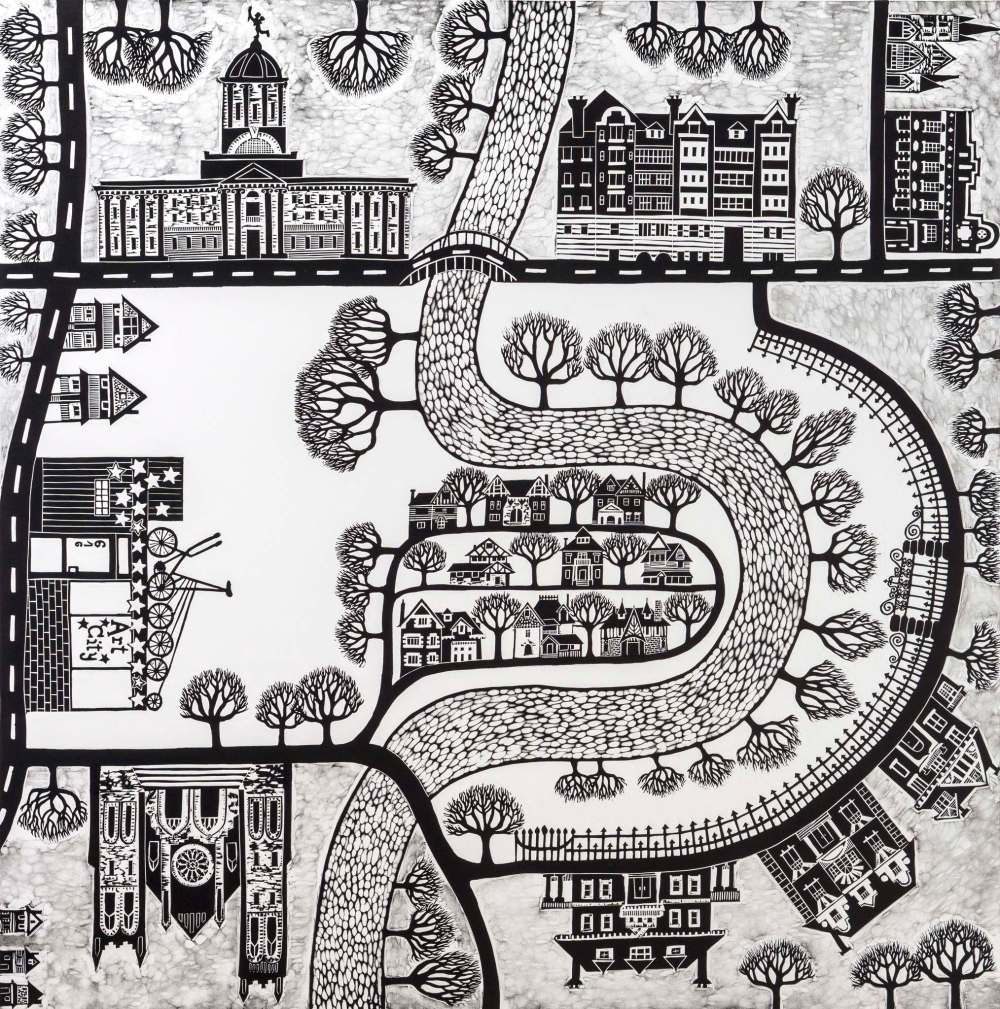
My Winnipeg, by Miriam Rudolph.
Alison Gillmor

Alison Gillmor
Writer

Studying at the University of Winnipeg and later Toronto’s York University, Alison Gillmor planned to become an art historian. She ended up catching the journalism bug when she started as visual arts reviewer at the Winnipeg Free Press in 1992.

Our newsroom depends on a growing audience of readers to power our journalism. If you are not a paid reader, please consider becoming a subscriber.

Our newsroom depends on its audience of readers to power our journalism. Thank you for your support.

Report Error Submit a Tip

More Stories

Imperialist crusades: 21st-century style

John R. Wiens 5 minute read Preview

Imperialist crusades: 21st-century style

John R. Wiens 5 minute read 2:00 AM CDT

In the 11th century and lasting into the 13th, the papacy launched a series of at least eight military campaigns we now refer to as the Crusades, or Holy Wars. They were an imperialistic call to arms for Christians to retake Jerusalem, which was at the time under Muslim rule.

Spiritual rewards for participation were implied, and other incentives offered, to dull the extra taxation demanded to fund the campaigns. Over time, the “crusades” morphed to become massacres of not only Muslims but also Jews and Christian dissidents — in other words, any enemies of the papacy. If today’s news sounds like déjà vu all over again, it probably should.

The stories keep repeating themselves in many forms. We now know that two 20th century world wars, global in scope, were caused by imperialistic ambitions, changes in the balance of international powers and corresponding arms races. The first was attributed to the assassination of the heir to the Austro-Hungarian throne by a Bosnian Serb, a kind of “regime change” initiative. The second resulted from rising tensions between Allied and Axis powers, triggered by the rise of European fascism and Japanese militarism. The human toll of both was unimaginable.

In the First World War, 15 to 22 million people, including soldiers and civilians, were killed and another 23 million were wounded. These numbers do not account for those otherwise affected — victims of chemical warfare whose compromised health shortened their lives; of the subsequent Spanish flu epidemic amplified by the displacement of peoples; others who died from other diseases caused by war conditions; and those who were malnourished or starved. Nor do they account for the ongoing trauma and resentments passed on intergenerationally to this day.

Read
2:00 AM CDT

Work permits extended to 2027 for international grads

Carol Sanders 6 minute read Preview

Work permits extended to 2027 for international grads

Carol Sanders 6 minute read Monday, Jul. 6, 2026

The federal government is offering a reprieve for international graduates who found work and settled in Manitoba, giving the province more time to process a backlog of provincial nominee applications.

Read
Monday, Jul. 6, 2026

‘People are fatigued’: Swan River mayor disappointed in federal response to flooding

Chris Kitching 6 minute read Preview

‘People are fatigued’: Swan River mayor disappointed in federal response to flooding

Chris Kitching 6 minute read Updated: 12:29 PM CDT

Canadian Armed Forces members and volunteers from a veteran-led disaster aid organization are expected to visit flood-hit homes in Swan River on Wednesday, a week after the town’s mayor and Premier Wab Kinew called for military assistance.

Mayor Lance Jacobson said he was told officials will go door-to-door to conduct assessments and find out individual needs, although more details are expected at a meeting with representatives of the Office of the Fire Commissioner, which is co-ordinating the response, the CAF and volunteer-led Team Rubicon Canada.

He’s been frustrated by the pace of the federal government’s response.

“(Homeowners) are trying to clean up and it’s painstaking, this kind of work they’re doing. We needed these people to be mobilized Monday,” Jacobson said.

Read
Updated: 12:29 PM CDT

Tragedy on two wheels: Motorbike deaths rising

Morgan Modjeski 4 minute read Preview

Tragedy on two wheels: Motorbike deaths rising

Morgan Modjeski 4 minute read 2:01 AM CDT

This year has been a tragic one for Manitoba’s motorcycle community.

The latest fatality involves a 56-year-old Steinbach woman who crashed in Whiteshell Provincial Park on Sunday, the sixth motorcycle-related death of 2026.

The woman died in hospital after she lost control while heading eastbound on Highway 44 near Provincial Road 312. RCMP said Tuesday she flipped the bike into the south ditch at about 5:30 p.m. Her identity has not been released.

RCMP said the investigation is ongoing, but preliminary findings indicate debris or gravel on a curve in the road may have been a factor.

Read
2:01 AM CDT

City considers million-dollar chop to tree planting program

Joyanne Pursaga 4 minute read Preview

City considers million-dollar chop to tree planting program

Joyanne Pursaga 4 minute read Updated: Yesterday at 5:36 PM CDT

The City of Winnipeg is one step away from chopping $1.2 million from its tree planting program to fill a separate budget gap.

The Manitoba government recently directed the city to spend an additional $1.236 million of its provincial “strategic infrastructure basket” funding on the Assiniboine Park Conservancy Journey to Churchill Exhibit, according to a city finance report.

Finance officials recommend the city fill that budget gap by transferring the same amount from the urban forest tree planting budget, which council’s executive policy committee voted in favour of Tuesday.

A local tree protection group said any funding loss would hurt an already ailing city canopy.

Read
Updated: Yesterday at 5:36 PM CDT

Mayor takes RM to court to recover legal fees

Tyler Searle 4 minute read Preview

Mayor takes RM to court to recover legal fees

Tyler Searle 4 minute read Updated: Yesterday at 12:00 PM CDT

Three years after winning a legal appeal against the Rural Municipality of St. Andrews, the area’s mayor has filed litigation to recover costs from the court battle that followed a coup by a group of former councillors.

Mayor Joy Sul filed a statement of claim against the RM north of Winnipeg on June 30, seeking indemnity for nearly $50,000 in legal fees she incurred while fighting council’s attempts to strip her of key responsibilities.

“Several years ago, I went to court because I believed the actions being taken against me were wrong and contrary to municipal law,” Sul said in a statement to the Free Press Monday.

“I want to be very clear about one thing: I am not seeking a windfall, damages, or any personal financial gain. I am simply seeking reimbursement for the legal costs I actually incurred while successfully defending my elected position.”

Read
Updated: Yesterday at 12:00 PM CDT