Celebrating both Hanukkah, Christmas
Advertisement
Read this article for free:
or
Already have an account? Log in here »
To continue reading, please subscribe:
Digital Subscription
One year of digital access for only $1.44 a week*
- Enjoy unlimited reading on winnipegfreepress.com
- Read the E-Edition, our digital replica newspaper
- Access News Break, our award-winning app
- Play interactive puzzles
*Billed as $5.77 plus GST every four weeks. After 52 weeks, price increases to the regular rate of $19.95 plus GST every four weeks. Offer available to new and qualified returning subscribers only. Cancel any time.
To continue reading, please subscribe:
Add Free Press access to your Brandon Sun subscription for only an additional
$1 for the first 4 weeks*
- Enjoy unlimited reading on winnipegfreepress.com
- Read the E-Edition, our digital replica newspaper
- Access News Break, our award-winning app
- Play interactive puzzles
*Your next Brandon Sun subscription payment will increase by $1.00 and you will be charged $17.95 plus GST for four weeks. After four weeks, your payment will increase to $24.95 plus GST every four weeks.
Read unlimited articles for free today:
or
Already have an account? Log in here »
Hey there, time traveller!
This article was published 14/12/2019 (2504 days ago), so information in it may no longer be current.
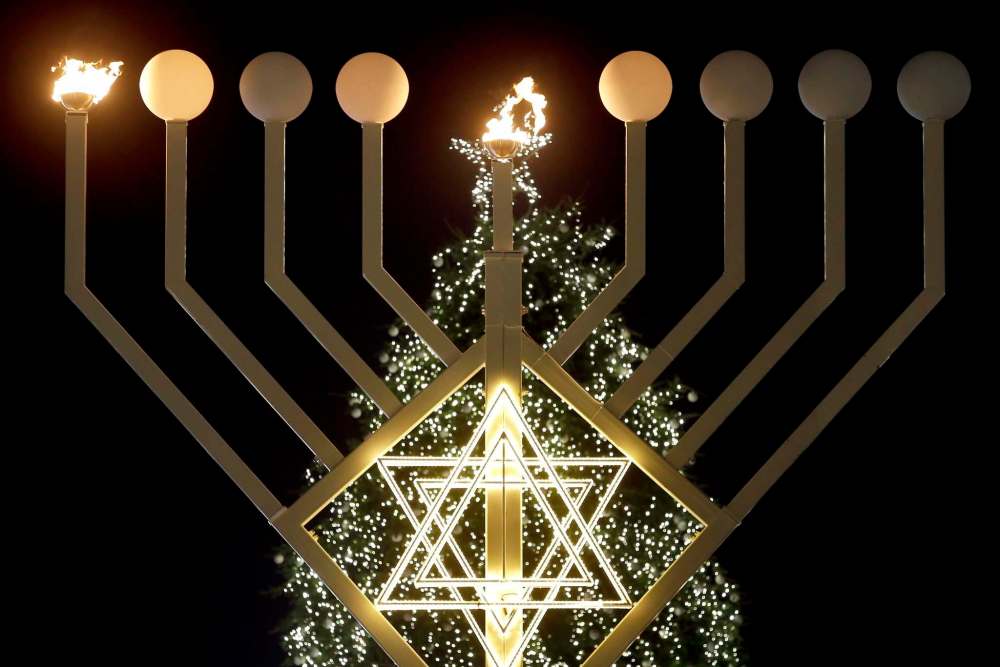
The Jewish holiday of Hanukkah generally falls somewhere between late November and late December. This winter, the eight-day holiday begins on the evening of Dec. 22, ensuring that it overlaps with Christmas Eve and Christmas celebrations. For families who only celebrate one holiday or the other, this overlap is a non-issue, but for interfaith families, the overlap can make the holiday season more exciting and more festive, but also more hectic and more challenging.
Good planning, good communication and mutual respect, however, make it possible for interfaith families to fully immerse themselves and fully enjoy both holidays and traditions.
Winnipegger Cindy Chodirker grew up celebrating Hanukkah with large family parties, singing, potato-pancake and jam-buster eating, and the lighting of the nine-branch menorah or candelabra, which is the central observance of the holiday. Her husband, Will Bowyer, grew up in a home without any religion, but celebrated Christmas as a cultural holiday replete with tree decorating, gift giving and a big family breakfast.
Chodirker and Bowyer are now the parents of four-year-old Emmy and one-year-old Lyla, who they are raising as Jewish. But they still celebrate both Hanukkah and Christmas.
“The way we explain it to them is that they are Jewish, because Mommy is Jewish,” Chodirker says, “but we celebrate Christmas, too, because Daddy’s family celebrates Christmas.”
In order to manage the holiday overlap this year, Chodirker communicated with her extended family in advance to request that none of their annual Hanukkah get-togethers be scheduled for Christmas Eve or Christmas Day. This will ensure that the Chodirker-Bowyers can fully immerse themselves in Christmas celebrations with their paternal grandparents, aunts, uncles and cousins, without feeling torn or stressed about getting to another gathering on the same day.
Communication and co-ordination are also going to ensure that the December holidays are enjoyable, manageable and memorable for Mallory Calof, her husband Justin Jones and their children, seven-year-old Jayden and two-year-old Harper.
They celebrate Hanukkah, which Calof celebrated growing up, and Christmas, which Jones always celebrated in a traditional but non-religious way.
“I don’t think that the overlap of holidays will affect how we celebrate this year,” Calof says. “We can light the menorah before we leave for our Christmas dinner or bring it along to share our traditions with my husband’s family.”
With Hanukkah falling during the school break this year, it also means that Calof and Jones will have more freedom and flexibility to stay out late with their kids and celebrate with family and friends during the week.
Prior to the actual holidays, the couple will decorate their home for both Hanukkah and Christmas and also make sure to find time to read to their children from their favourite holiday book, Daddy Christmas and Hanukkah Mama, by Selina Alko.
Jayden also will take the book to school, as he has done every year, and proudly read it to his classmates.
“All children should learn about a variety of beliefs and cultures,” Calof says. “This helps them learn empathy, respect and an understanding of both similarities and differences among cultures.”
In fact, the holidays are an ideal time to reinforce core family values and teach children to ask questions and to be confident and proud of who they are.
“Still, the best part of the holidays,” Calof says, “is spending time with the people you love. My kids can feel that love at all of our holiday celebrations.”

Chodirker echoes that sentiment.
“Our focus of the holidays is on spending time with family,” she says, “so I think the more celebrations we can have, the better, as this means more time spent with our families.”
Both Chodirker and Calof hope, and are confident, that as their children grow up they will associate all of the holidays that they celebrate, both Jewish and non-Jewish, with good times and good memories.
For their two interfaith families, the overlap of Hanukkah and Christmas, which is widely referred to as the December Dilemma, is no dilemma at all.
swchisvin@gmail.com
The Free Press is committed to covering faith in Manitoba through our Religion in the News project. This reporting continues because readers like you step forward to fund it.
Donate now to support our reporting on religion.
Your donation is eligible for a charitable tax receipt.
BECOME A FAITH JOURNALISM SUPPORTER
The Free Press acknowledges the financial support it receives from members of the city’s faith community, which makes our coverage of religion possible.