Underground churches worrisome for China’s leaders
Advertisement
Read this article for free:
or
Already have an account? Log in here »
To continue reading, please subscribe:

Digital Subscription
One year of digital access for only $205*
- Enjoy unlimited reading on winnipegfreepress.com
- Read the E-Edition, our digital replica newspaper
- Access News Break, our award-winning app
- Play interactive puzzles
*First annual payment billed as $205.00 + GST for one year. This annual subscription will automatically renew at $233.00 + GST every 52 weeks (10% off the regular annual price of $259.35). Offer available to new and qualified returning subscribers only. Cancel any time.
To continue reading, please subscribe:
Add Free Press access to your Brandon Sun subscription for only an additional
$1 for the first 4 weeks*
- Enjoy unlimited reading on winnipegfreepress.com
- Read the E-Edition, our digital replica newspaper
- Access News Break, our award-winning app
- Play interactive puzzles
*Your next Brandon Sun subscription payment will increase by $1.00 and you will be charged $17.95 plus GST for four weeks. After four weeks, your payment will increase to $24.95 plus GST every four weeks.
Read unlimited articles for free today:
or
Already have an account? Log in here »
Hey there, time traveller!
This article was published 18/01/2020 (2385 days ago), so information in it may no longer be current.
CHENGDU, China — Li Chengju glared at her prison interrogator as he pressed her to renounce her Christian church and condemn her pastor.
Her captor warned she would not be so lucky as the pastor, who was locked in secret detention but at least might get a day in court.
“Look at you. You sweep the floors at church,” the interrogator said. “You think you’re getting a trial like your pastor? You don’t qualify.”
Li still refused to sign the document disowning her church.
“I’m a citizen who has faith,” she told the interrogator. “God knows everything you are doing and he will judge you one day.”
Then she repeated a saying she’d heard at church about the Chinese president: “Xi Jinping is sinning against God. If he doesn’t repent, he will be judged by God.”
Li, who recounted her detention in a recent interview with the Los Angeles Times, belonged to the Early Rain Covenant Church, which authorities here in Chengdu dissolved in late 2018 as part of a sweeping campaign by the government to rein in the country’s fastest-growing religion: Protestant Christianity.
The state-sanctioned Three-Self Church has long been the only legal place for Christians to worship in China, even as the country saw a proliferation of so-called house churches — congregations such as Early Rain that meet in office buildings, hotel conference rooms and other makeshift sanctuaries.
The government calls its campaign “Sinicization” —a euphemism for turning faith into a tool for indoctrination in Chinese Communist Party ideology. The official five-year plan, issued in 2018, calls for inserting “patriotic education” and “socialist core values” into churches, revising the Bible, and using church sermons to enforce party leadership and reject foreign influences.
One pastor in Hong Kong, who spoke on the condition that his name not be published, said the message was made clear when a group of Chinese officials visited in 2016.
“You keep talking about separation of church and state,” he said they told him and other theologians. “But Chinese tradition is that state leads and church follows… In China, you are a tool to transform the people.”
The pastor said the campaign in some ways was repeating history.
In the 1950s, the newly established People’s Republic of China co-opted Protestant leaders with the Three-Self Church’s anti-colonial slogan: “Self-governance, self-support, self-propagation.”
But by the Cultural Revolution of the 1960s, all religion was violently purged. Even the Three-Self Church was not immune, and many of its founders were tortured, sent to labour camps and worked to death.
The house church movement sprang up at the end of the Cultural Revolution, starting in rural areas, where mass conversion in provinces such as Henan brought the number of Christians to three million by 1982. It rapidly spread to cities in the 1980s and 1990s, as rural preachers followed migrant workers and university students disillusioned by the Tiananmen Square massacre turned to Christianity.
By 2018, official statistics said there were 39 million Protestants in China. Scholars estimate that including house church worshippers pushes the real number to at least 80 million — almost six per cent of China’s population, on par with Communist Party membership.
Fenggang Yang, founding director of the Center on Religion and Chinese Society at Purdue University, predicts that by 2030 China will have more Christians than any other country.
He said that growth has been particularly worrisome to Xi, who became general secretary of the Communist Party in 2012 and Chinese president in 2013 with a governing ideology centred on Communist Party control over all aspects of life.
“Since Xi took power, militant atheism has prevailed in China,” Yang said, contrasting that approach to the “enlightenment atheism” of previous Chinese leaders.
“Enlightened atheism emphasized sympathy and education,” he said. “Militant atheism wants to control by political force.”
Experts described Sinicization as a creeping process that starts when authorities ask house churches to register with the government, often promising not to interfere with the preaching content.
“Then they start to document you,” said the pastor of a large house church in Chengdu who spoke on the condition of anonymity. “Then your children cannot go to church. Then you have to plant a flag.”
Eventually, clergy are forced to change their sermons to align with “socialist core values” and paste Communist Party slogans on the walls.
Having seen that process unfold at other churches, the pastor refused to register. Police began standing outside the church daily and following and harassing attendees.
In August, his church left its makeshift sanctuary in an office building, breaking into small groups that met in houses instead.
“Church is not a location,” the pastor said. “Church is a group of people.”
His congregation has been preparing for his arrest, hiring lawyers and training members to lead smaller fellowship groups if he and the elders disappear.
The pastor of Early Rain, an outspoken former human rights lawyer named Wang Yi, has been detained since his church was shut down on Dec. 9, 2018. One of the church elders, Qin Defu, is also imprisoned, sentenced in November to four years for “illegal business operations.”
In contrast to many traditional house churches, which focus on eternal salvation, their church harboured Puritan visions of changing China by being a “city on a hill.” Members supported families of detained activists, worked with abandoned children and the disabled and prayed each year on the anniversaries of the Sichuan earthquake and Tiananmen Square massacre.
Its message of social and cultural renewal through Christianity resonated deeply with Li, who grew up in a mud house in mountainous Yunnan province and became a Christian while working as a real estate agent in Shenzhen in 2008.
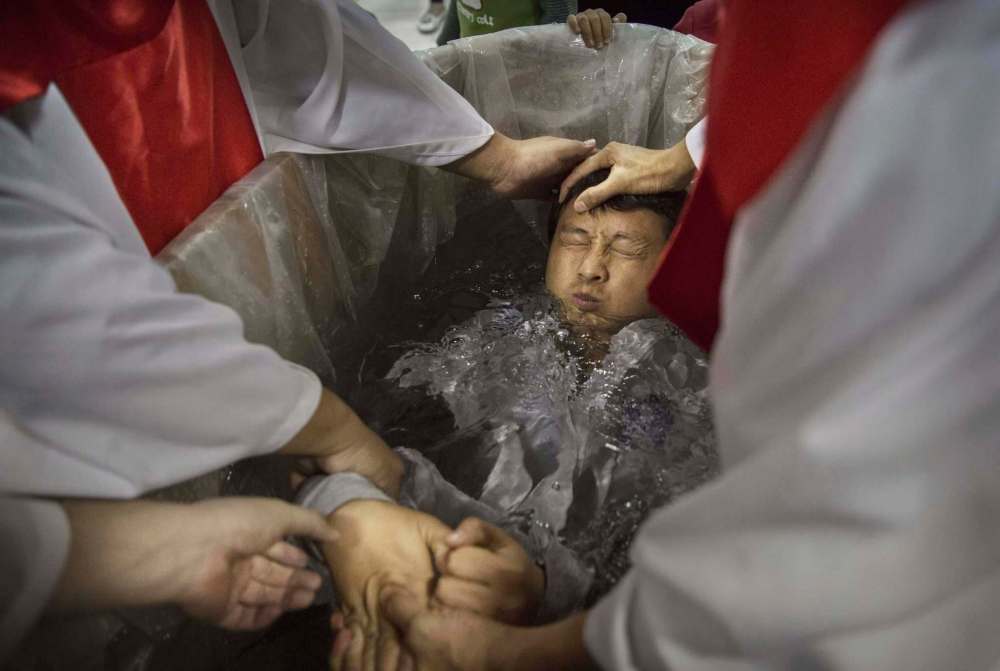
Though she was baptized in a Three-Self church, her faith began to blossom only after she joined Early Rain in 2017. She and her husband had moved to Chengdu because they wanted their daughter to go to a church-run school. They’d heard that Early Rain had one and decided to go after watching one of Wang’s sermons online.
“I used to feel marginalized as a Christian,” said Li, now 34. “Here, I understood that we are really the mainstream people of society.”

Early Rain members continue to meet in small groups or gather online. But many are under house arrest or have been forced to leave Chengdu after landlords evicted them or police changed the locks on their doors.
Others have fled China, prompting authorities to confiscate passports to prevent a larger exodus.
Li, who has moved to a suburb where there is less surveillance, said the church would persevere.
“Every day, we’re in a battle with fear,” she said. “But we can pray, and God will be faithful.”
— Los Angeles Times
The Free Press is committed to covering faith in Manitoba through our Religion in the News project. This reporting continues because readers like you step forward to fund it.
Donate now to support our reporting on religion.
Your donation is eligible for a charitable tax receipt.
BECOME A FAITH JOURNALISM SUPPORTER
The Free Press acknowledges the financial support it receives from members of the city’s faith community, which makes our coverage of religion possible.