Trudeau cancels Caribbean trip amid pressure to end pipeline protests
Advertisement
Read this article for free:
or
Already have an account? Log in here »
To continue reading, please subscribe:

Digital Subscription
One year of digital access for only $205*
- Enjoy unlimited reading on winnipegfreepress.com
- Read the E-Edition, our digital replica newspaper
- Access News Break, our award-winning app
- Play interactive puzzles
*First annual payment billed as $205.00 + GST for one year. This annual subscription will automatically renew at $233.00 + GST every 52 weeks (10% off the regular annual price of $259.35). Offer available to new and qualified returning subscribers only. Cancel any time.
To continue reading, please subscribe:
Add Free Press access to your Brandon Sun subscription for only an additional
$1 for the first 4 weeks*
- Enjoy unlimited reading on winnipegfreepress.com
- Read the E-Edition, our digital replica newspaper
- Access News Break, our award-winning app
- Play interactive puzzles
*Your next Brandon Sun subscription payment will increase by $1.00 and you will be charged $17.95 plus GST for four weeks. After four weeks, your payment will increase to $24.95 plus GST every four weeks.
Read unlimited articles for free today:
or
Already have an account? Log in here »
Hey there, time traveller!
This article was published 16/02/2020 (2431 days ago), so information in it may no longer be current.
OTTAWA – Prime Minister Justin Trudeau has cancelled his planned trip to the Caribbean this week amid criticism over his government’s handling of a series of anti-pipeline protests that have disrupted rail service in parts of Canada.
The Prime Minister’s Office announced the cancellation Sunday evening, the night before Trudeau was scheduled to fly to Barbados where he was expected to pitch Caribbean leaders on why Canada should get a seat on the United Nations Security Council.
“Following the government’s ongoing efforts to address infrastructure disruptions across the country, the prime minister will convene the Incident Response Group tomorrow to discuss steps forward,” a statement from the PMO reads.
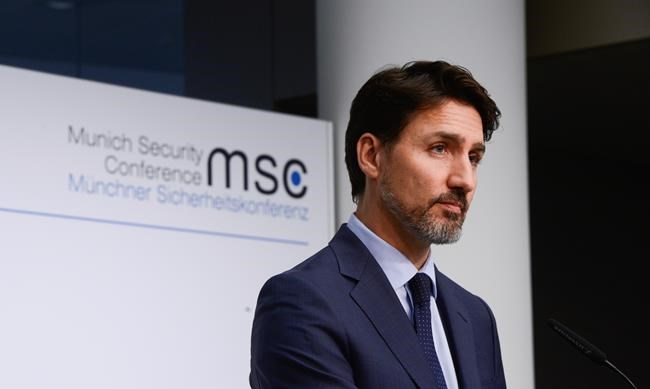
Foreign Affairs Minister Francois-Philippe Champagne will represent Canada in Trudeau’s place, clearing the way for the prime minister to handle the protests.
“We will remain in close contact with other orders of government and partners,” the statement reads. “Our priority remains the safety and security of all Canadians and the swift resolution of this issue to restore service across the rail system in accordance with the law.”
The cancellation followed criticism from Conservative Leader Andrew Scheer last week for “running around” Africa and Europe as protesters opposed to the Coastal GasLink pipeline project in British Columbia blockaded rail lines in B.C., Ontario and other parts of the country.
Scheer as well as various industry groups have called on the federal government to intervene and end the blockades, which they say are causing major damage to the economy. Trudeau has preached the importance of dialogue in reaching a peaceful conclusion to the standoff.
The blockades, which have caused cancellations to passenger and freight service, have been erected to protest the Coastal GasLink project in northern B.C., which is part of a $40-billion LNG Canada export project in Kitimat aimed at getting liquefied-natural gas to foreign markets.
The prime minister’s visit to Barbados was to coincide with a gathering of leaders from across what is known as the Caribbean Community, or Caricom, which includes 15 countries as full members and five others as associate members.
Trudeau used similar summits in Ethiopia and Germany last week to make his pitch for a seat on the Security Council to a large cross-section of leaders from across Africa and Europe.
The prime minister had actually left the door open to cancelling his trip to Barbados when he was asked on Friday whether it was still wise to leave Canada when the anti-pipeline blockades were causing havoc with the country’s rail system and economy.
“We have been fully engaged, fully seized with this as a government. I myself have been on direct phone calls with premiers like (B.C.) Premier (John) Horgan and my team,” Trudeau said. “As for next week’s schedule, right now the schedule still stands. But we will, of course, see.”
Exactly what the cancellation means for Trudeau’s Security Council aspirations will remain to be seen.
Canada would appear on the surface to have an edge over its chief competitors for a spot at the Security Council table, Norway and Ireland. Not only is Canada in the same hemisphere as the Caribbean, it has longstanding historical ties with the region.
Those ties include shared British and French colonial pasts and, more recently, the provision of millions of dollars in Canadian foreign assistance as Caribbean nations began to gain their independence in the 1960s.
Yet with successive federal governments shifting foreign aid toward the lowest-income countries over the past decade, most of the aid Canada was delivering to the Caribbean has dried up. And while free-trade talks with Caricom were launched in 2007, they have largely gone nowhere.

The result is that while some have previously describe Canada’s ties with the Caribbean as a “special relationship,” University of Ottawa associate professor Stephen Baranyi said: “It’s a bit of a stretch to still call it a special relationship.”
Canada, Norway and Ireland are vying for two seats available to Western European countries as well as Canada, Australia, New Zealand and Israel. Members of the UN will vote in June, with the winners sitting for two-year terms.
Canada last sat on the Security Council in 2000, with Stephen Harper’s Conservative government having lost a bid for a seat in 2010.
Trudeau has said he is seeking a seat for Canada on the powerful UN Security Council because it is where the world’s most pressing issues are debated.
This report by The Canadian Press was first published Feb. 16, 2020.
Related Articles
Singh points to parallels between Riel, Wet'suwet'en

Advertisement Advertise With Us
Advertisement Advertise With Us