Federal, B.C. ministers seek meeting with First Nations in hope of blockade solution

Advertisement

Advertise with us

OTTAWA - An upcoming meeting in British Columbia is emerging as the focal point for hopes of a speedy and peaceful end to the blockades that have disrupted rail and road traffic across large swaths of the country for more than a week.

Read this article for free:


or

Already have an account? Log in here »

To continue reading, please subscribe:

Subscribe and receive a limited-edition Free Press branded hat or tote.

Digital Subscription

One year of digital access for only $205*

  • Enjoy unlimited reading on winnipegfreepress.com
  • Read the E-Edition, our digital replica newspaper
  • Access News Break, our award-winning app
  • Play interactive puzzles

*First annual payment billed as $205.00 + GST for one year. This annual subscription will automatically renew at $233.00 + GST every 52 weeks (10% off the regular annual price of $259.35). Offer available to new and qualified returning subscribers only. Cancel any time.

To continue reading, please subscribe:

Add Free Press access to your Brandon Sun subscription for only an additional

$1 for the first 4 weeks*

  • Enjoy unlimited reading on winnipegfreepress.com
  • Read the E-Edition, our digital replica newspaper
  • Access News Break, our award-winning app
  • Play interactive puzzles
Start now

*Your next Brandon Sun subscription payment will increase by $1.00 and you will be charged $17.95 plus GST for four weeks. After four weeks, your payment will increase to $24.95 plus GST every four weeks.

Hey there, time traveller!
This article was published 17/02/2020 (2397 days ago), so information in it may no longer be current.

OTTAWA – An upcoming meeting in British Columbia is emerging as the focal point for hopes of a speedy and peaceful end to the blockades that have disrupted rail and road traffic across large swaths of the country for more than a week.

The meeting, which would involve the federal and B.C. ministers responsible for Indigenous relations sitting down with First Nations opposed to the Coastal GasLink pipeline project, has yet to be scheduled.

That has raised questions about how long Ottawa, in particular, is willing to wait as pressure mounts on the federal Liberal government to end the protests due to the economic damage they are causing. The pipeline has support from the Wet’suwet’en First Nation’s elected band council but is opposed by the nation’s hereditary chiefs, who claim authority on traditional territory off the First Nation’s formal reserve.
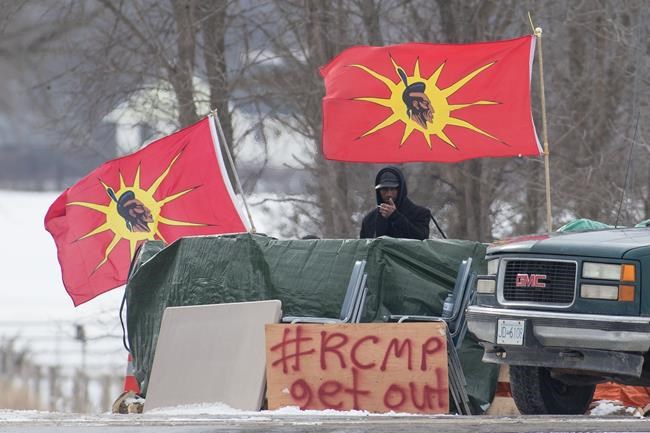
A protester stands between Mohawk Warrior Society flags at a rail blockade on the tenth day of demonstration in Tyendinaga, near Belleville, Ont., Sunday, Feb. 16, 2020. The protest is in solidarity with the Wet'suwet'en hereditary chiefs opposed to the LNG pipeline in northern British Columbia. THE CANADIAN PRESS/Lars Hagberg

Carolyn Bennett, the federal minister of Crown-Indigenous relations, reiterated her desire to meet with those opposed to the $6.6-billion natural-gas pipeline as she sat down Monday with B.C. Indigenous Relations Minister Scott Fraser.

“We have reached out through a joint letter to the Wet’suwet’en hereditary chiefs about meeting with us at the earliest opportunity and are hopeful we can all work together to establish a process for ongoing and constructive dialogue and action to address the issues at hand,” the ministers said in a joint statement late Monday.

“Our primary focus is everyone’s safety and ultimately, a peaceful resolution to the situation.”

The two were invited last week to meet by Gitxsan chief Norm Stephens after members of the First Nation erected a blockade near New Hazelton in support of neighbouring Wet’suwet’en chiefs.

Bennett’s sitdown with Fraser in Victoria came as Prime Minister Justin Trudeau held an emergency, closed-door meeting with cabinet ministers in Ottawa to discuss the blockades.

Trudeau emerged from the meeting emphasizing his desire to find an end to the crisis, adding he had reached out to a number of premiers and Indigenous leaders to discuss the standoff. But the prime minister was tightlipped about his plan to reach that conclusion.

“I understand how worrisome this is for so many Canadians and difficult for many people and families across the country,” Trudeau said. “We’re going to continue to focus on resolving the situation quickly and peacefully, and that’s what we’re going to do.”

The prime minister, who cancelled a two-day trip to Barbados this week to deal with the crisis at home, did not take any questions before being driven away by his RCMP security detail.

Public Safety Minister Bill Blair, Justice Minister David Lametti and others who attended the meeting with Trudeau were similarly mum on how they planned to address the crisis.

The ministerial meetings in Ottawa and Victoria came as protesters continued to block rail lines as well as highways and bridges in different parts of the country. Those included shutting down for the first time the Thousand Islands Bridge border crossing near Kingston, Ont.

The Ontario Provincial Police indicated they didn’t plan on breaking up that protest, saying “the OPP has no role to play in the underlying issues of the event and is not in a position to resolve them.” Protesters lifted their blockade of the bridge in the afternoon.

Mounties in Manitoba also reported about eight to ten demonstrators at a CN Rail crossing on Highway 75 in southern Manitoba. The highway and rail line both run south to the U.S. border crossing at Emerson, Man.

RCMP spokesman Robert Cyrenne said police were stopping traffic for safety, but that vehicles were still able to pass in both directions. CN said train movement in the area had been stopped and that the company was “evaluating our legal options very closely.”
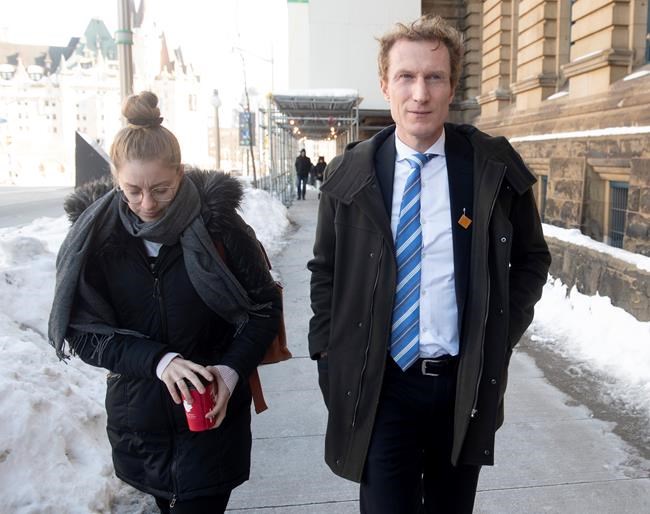
Indigenous Services Minister Marc Miller arrives at the Office of the Prime Minister and Privy Council building for a meeting of the Federal governments Incident Response Group in Ottawa, Monday February 17, 2020. THE CANADIAN PRESS/Adrian Wyld

The RCMP said it had deployed a liaison team to the site to “establish a dialogue and maintain open and ongoing communication.”

Police have largely refrained from direct action against the blockades since the RCMP enforced an injunction outside Houston, B.C. earlier this month, where opponents of the Coastal GasLink project were preventing access to a work site for the pipeline.

While more than 20 people were arrested and the company is preparing to resume work, the RCMP raid sparked more protests and blockades across the country.

Coastal GasLink signed agreements with all 20 elected band councils along the pipeline route, including the Wet’suwet’en First Nation’s council. But Wet’suwet’en’s hereditary chiefs are opposed to the project and say the council does not have authority over the relevant land.

Indigenous Services Minister Marc Miller, who met Saturday with representatives of the Mohawk First Nation near Belleville, Ont., where a rail blockade has shut down train service across much of Eastern Canada, has invoked the Oka and Ipperwash crises in pressing for a peaceful solution.

A Quebec police officer died during a raid in 1990 after Mohawks south of Montreal blocked the Mercier Bridge, which became the Oka crisis.

Five years later, an Ontario Provincial Police officer shot and killed protester Dudley George during a standoff over a land claim by Chippewa protesters outside a Ipperwash Provincial Park.

This report by The Canadian Press was first published Feb. 17, 2020.

— with reporting by Nicole Thompson in Toronto, Rob Drinkwater in Edmonton and Amy Smart in Vancouver.

Note to readers: This is a corrected story. An earlier version incorrectly stated that Ministers Bennett and Fraser had also sent their letter to Gitxsan chief Norm Stephens.

Report Error Submit a Tip

More Stories

Supportive housing operator sued after man with dementia walks away

Erik Pindera 4 minute read Preview

Supportive housing operator sued after man with dementia walks away

Erik Pindera 4 minute read 6:00 AM CDT

The Public Guardian and Trustee of Manitoba is suing a health services company after a man with dementia under its care allegedly wandered away from an apartment it operates for vulnerable people and was later found face down in a puddle — unresponsive, hypothermic and severely injured.

The public trustee — a provincial government agency that, among other duties, makes financial and personal care decisions for vulnerable adults who cannot do so themselves — filed the lawsuit against Cambridge Health Inc. and a related numbered company in the Court of King’s Bench earlier this month.

The agency did so on behalf of a now-38-year-old man, who has been under its care since 2018, as a result of his frontotemporal dementia. The disease often starts in mid-life, rather than old age, as is the case with most other forms of dementia.

The lawsuit alleges the man, who resided at a Henderson Highway apartment complex where Cambridge Health operated a supportive residence for people with complex behavioural health issues, was in a common area of the home at about 4:30 p.m. on April 3 last year.

Read
6:00 AM CDT

Cultivating compassion in young people

Jordan Laidlaw 5 minute read 2:00 AM CDT

We live in the unenviable era of rising American imperialism and the emergence of a precarious new world order.

As U.S. President Donald Trump escalates his annexation threats over Canada, Greenland and Venezuela; deteriorates decades-long relations with NATO; and offers concessions to totalitarian North Korea; we must remain steadfast and vigilantly united against these ominous — and markedly unusual — sociopolitical developments.

We have so much to learn from our past. As historical patterns suggest, these threats are not idle nor mere political rhetoric. Rather, these threats should be treated with utmost seriousness. As Winston Churchill so famously uttered, “Those that fail to learn from history are doomed to repeat it.”

As a Canadian public educator, I hold the vehement conviction that we need to instruct our youth on the societal dangers of imperialism, while simultaneously exploring the “contentious” concepts of sharing and acceptance.

Bumps in the road as students collect free bus passes

Maggie Macintosh 5 minute read Preview

Bumps in the road as students collect free bus passes

Maggie Macintosh 5 minute read Tuesday, Sep. 8, 2026

Alexis Enns left her guidance counsellor’s office empty-handed, but no less excited about starting Grade 12 — even though she still didn’t know how she would get there or her timetable — on Tuesday.

Read
Tuesday, Sep. 8, 2026

DNA on beer can helps solve killing

Dean Pritchard 4 minute read Preview

DNA on beer can helps solve killing

Dean Pritchard 4 minute read Yesterday at 2:00 AM CDT

Two years after 74-year-old James Monaghan was stabbed in his Sherburn Street home, DNA found on a beer can led police to his killer.

Shara Harper, 29, pleaded guilty to manslaughter and on Tuesday was sentenced to six years in prison.

A neighbour found Monaghan dead in his home on July 29, 2022. He had been stabbed twice in the chest and back.

The investigation into Monaghan’s killing had stalled until June 2024, when DNA found on an empty beer can in Monaghan’s home was confirmed to be a match for Harper.

Read
Yesterday at 2:00 AM CDT

Ministers seek meeting in hope of ending blockades

Lee Berthiaume, The Canadian Press 6 minute read Preview

Ministers seek meeting in hope of ending blockades

Lee Berthiaume, The Canadian Press 6 minute read Monday, Feb. 17, 2020

OTTAWA - An upcoming meeting in British Columbia is emerging as the focal point for hopes of a speedy and peaceful end to the blockades that have disrupted rail and road traffic across large swaths of the country for more than a week.

The meeting, which would involve the federal and B.C. ministers responsible for Indigenous relations sitting down with First Nations opposed to the Coastal GasLink pipeline project, has yet to be scheduled.

That has raised questions about how long Ottawa, in particular, is willing to wait as pressure mounts on the federal Liberal government to end the protests due to the economic damage they are causing. The pipeline has support from the Wet'suwet'en First Nation's elected band council but is opposed by the nation's hereditary chiefs, who claim authority on traditional territory off the First Nation's formal reserve.

Carolyn Bennett, the federal minister of Crown-Indigenous relations, reiterated her desire to meet with those opposed to the $6.6-billion natural-gas pipeline as she sat down Monday with B.C. Indigenous Relations Minister Scott Fraser.

Read
Monday, Feb. 17, 2020

South Winnipeg neighbourhood will be first to go geothermal

Chris Kitching 4 minute read Preview

South Winnipeg neighbourhood will be first to go geothermal

Chris Kitching 4 minute read Updated: Yesterday at 7:28 PM CDT

A new neighbourhood in south Winnipeg will be Manitoba’s first to use a shared, large-scale geothermal system to heat and cool hundreds of homes over coming decades.

The province is giving up to $4 million to the developers of Southwood Circle, just north of the University of Manitoba’s Fort Garry campus, for a district geothermal system as part of the NDP’s goal to reach net-zero greenhouse gas emissions by 2050.

“It means a whole neighbourhood can tap into geothermal, which means low-carbon heating and cooling for at least 1,000 homes,” Premier Wab Kinew said at a news conference Wednesday.

Geothermal systems, equipped with pumps and pipes, use underground temperatures to heat and cool one or more buildings. Proponents point to long-term energy and cost savings compared with conventional heating and cooling systems.

Read
Updated: Yesterday at 7:28 PM CDT