

There’s no ‘quick fix’ in B.C. pipeline talks: government liaison says
Advertisement
Read this article for free:
or
Already have an account? Log in here »
To continue reading, please subscribe:
Monthly Digital Subscription
$1 per week for 24 weeks*
- Enjoy unlimited reading on winnipegfreepress.com
- Read the E-Edition, our digital replica newspaper
- Access News Break, our award-winning app
- Play interactive puzzles
*Billed as $4.00 plus GST every four weeks. After 24 weeks, price increases to the regular rate of $19.95 plus GST every four weeks. Offer available to new and qualified returning subscribers only. Cancel any time.
Monthly Digital Subscription
$4.99/week*
- Enjoy unlimited reading on winnipegfreepress.com
- Read the E-Edition, our digital replica newspaper
- Access News Break, our award-winning app
- Play interactive puzzles
*Billed as $19.95 plus GST every four weeks. Cancel any time.
To continue reading, please subscribe:
Add Free Press access to your Brandon Sun subscription for only an additional
$1 for the first 4 weeks*
*Your next subscription payment will increase by $1.00 and you will be charged $16.99 plus GST for four weeks. After four weeks, your payment will increase to $23.99 plus GST every four weeks.
Read unlimited articles for free today:
or
Already have an account? Log in here »
Hey there, time traveller!
This article was published 28/02/2020 (2210 days ago), so information in it may no longer be current.
SMITHERS, B.C. – Wet’suwet’en hereditary chiefs met for a second day with senior government ministers over a pipeline dispute that’s sparked protests and economic disruptions, but one participant warned against expecting a broad resolution on Friday to all the issues being discussed.
Federal Crown-Indigenous Relations Minister Carolyn Bennett and British Columbia Indigenous Relations Minister Scott Fraser began the long-sought talks Thursday afternoon before returning the next morning to the Wet’suwet’en office in Smithers, B.C., where talks continued into Friday night.
A spokesman for Bennett said the talks would continue late into Friday night and there may be no comment until Saturday morning.
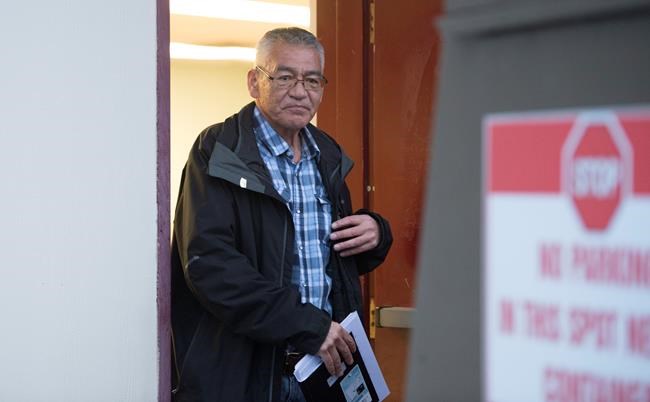
The hereditary chiefs have urged Prime Minister Justin Trudeau and B.C. Premier John Horgan to join them at the table, and on Friday Bennett left the door open to that possibility in the future.
“We would want any meeting with the prime minister and the premier to be a good meeting, and therefore we have to do the work,” she said.
“It’s really important that minister Fraser and I have been delegated by the premier and the prime minister to do this work and that’s what we’re going to do.”
Horgan said he has no plans to go to Smithers in the near future.
“I am hopeful, as I have always been, that there can be a peaceful resolution and a way forward, not just in Wet’suwet’en territory, not just in British Columbia, but indeed across the country.”
Fraser noted he had 25 hours of initial conversations with the chiefs several weeks ago and the province has been working closely with them.
“The important thing is we are willing to roll up our sleeves and get to the complex and difficult issues and we began that yesterday and we’re going to continue that today,” he said.
Bennett and Fraser added they were open to continuing talks over the weekend.
Nathan Cullen, a former NDP MP who is acting as a liaison between the governments and chiefs, said a substantial amount of work is being done but the parties were unlikely to reach a broad resolution on Friday.
“It is important, it seems to me, to the chiefs and to Canada and B.C., that even if we only can arrive at interim steps here, they’re durable. There’s no such thing as a quick fix in this,” he said.
Establishing trust is important to arrive at solutions, which have to be found at a negotiating table, Cullen said.
“It wasn’t going to happen at a blockade. It wasn’t going to happen at a protest,” he said. “I still remain hopeful that what comes out of today is something that can be built upon.
“For those folks that are expecting a full and final resolution of this matter after a day and a half of talks, I think that is a very, very high expectation to have.”

He also said Trudeau and Horgan have “explicitly not” ruled out a meeting with the chiefs.
The hereditary chiefs’ opposition to a natural gas pipeline in their traditional territory has sparked shows of support across the country that have halted rail service for the past three weeks.
However, some Wet’suwet’en members are divided on the project and all 20 elected band councils along the route have signed deals with Coastal GasLink.
Wet’suwet’en matriarch Bonnie George was not invited to the meeting but entered the room with others on Thursday and read a statement on behalf of pipeline supporters. She returned to the discussions Friday morning.
Gary Naziel, a Wet’suwet’en hereditary subchief, said later Friday that pipeline supporters “said (our) piece and left.”
The RCMP’s presence in Wet’suwet’en territory has been a source of tension and a large crux of the solidarity blockades across Canada.
The Mohawk Council of Kahnawake in Quebec proposed Friday that its Peacekeepers head up a temporary Indigenous police force to patrol the Wet’suwet’en territory and allow the RCMP to withdraw entirely from the area.
Cullen said the offer isn’t a part of the discussions in Smithers and new ideas are coming in from everywhere.
“That’s helpful to an extent but it’s going to be the people around that table who are going to make the solutions happen.”
The RCMP has already ended patrols along a critical roadway in Wet’suwet’en territory while the negotiations unfold, while Coastal GasLink consented to a two-day pause in its activities in northwestern B.C.
Sgt. Janelle Shoihet said the RCMP is aware of the Mohawk council’s offer but any decisions around police service delivery would need to include the federal and provincial governments and the affected parties.
“The B.C. RCMP has been fully engaged in discussions with the Wet’suwet’en hereditary chiefs around our presence in the territory,” she said. “We remain committed to continuing those discussions as we look at short-term and long-term solutions.”

The dispute over the pipeline began months ago, but tensions began to rise on Dec. 31 when the B.C. Supreme Court granted the company an injunction calling for the removal of any obstructions.
The RCMP began to enforce that injunction on Feb. 6. Hours later, protesters started holding up railway traffic outside of Belleville, Ont., thwarting freight and passenger rail travel.
Via Rail said Friday that most service will progressively return to operation as of Tuesday, including between Toronto, Montreal and Ottawa. It also said one train would run from Toronto to Vancouver and return in the opposite direction next week.
During question period Friday, Conservative finance critic Pierre Poilievre said the economic repercussions of the blockades have amounted to a “war on working people” and demanded to know how government would fight back.
Transport Minister Marc Garneau told a Commons committee on Thursday that Ottawa is trying to analyze the economic impacts but it could take up to six months.
Garneau said a total of $300 billion worth of goods moves by train every year in the country.
“What’s important here to realize is, even if we start tomorrow and we had all the barricades down, it takes weeks, perhaps months to get back up to speed.”
This report by The Canadian Press was first published Feb. 28, 2020.
— With files from Graeme Hamilton in Montreal, Teresa Wright and Joan Bryden in Ottawa and Beth Leighton and Laura Kane in Vancouver.