

Lessons learned on farm take root in classroom

Advertisement
Read this article for free:
or
Already have an account? Log in here »
To continue reading, please subscribe:
Monthly Digital Subscription
$1 per week for 24 weeks*
- Enjoy unlimited reading on winnipegfreepress.com
- Read the E-Edition, our digital replica newspaper
- Access News Break, our award-winning app
- Play interactive puzzles
*Billed as $4.00 plus GST every four weeks. After 24 weeks, price increases to the regular rate of $19.95 plus GST every four weeks. Offer available to new and qualified returning subscribers only. Cancel any time.
Monthly Digital Subscription
$4.99/week*
- Enjoy unlimited reading on winnipegfreepress.com
- Read the E-Edition, our digital replica newspaper
- Access News Break, our award-winning app
- Play interactive puzzles
*Billed as $19.95 plus GST every four weeks. Cancel any time.
To continue reading, please subscribe:
Add Free Press access to your Brandon Sun subscription for only an additional
$1 for the first 4 weeks*
*Your next subscription payment will increase by $1.00 and you will be charged $16.99 plus GST for four weeks. After four weeks, your payment will increase to $23.99 plus GST every four weeks.
Read unlimited articles for free today:
or
Already have an account? Log in here »
Hey there, time traveller!
This article was published 04/03/2020 (2201 days ago), so information in it may no longer be current.
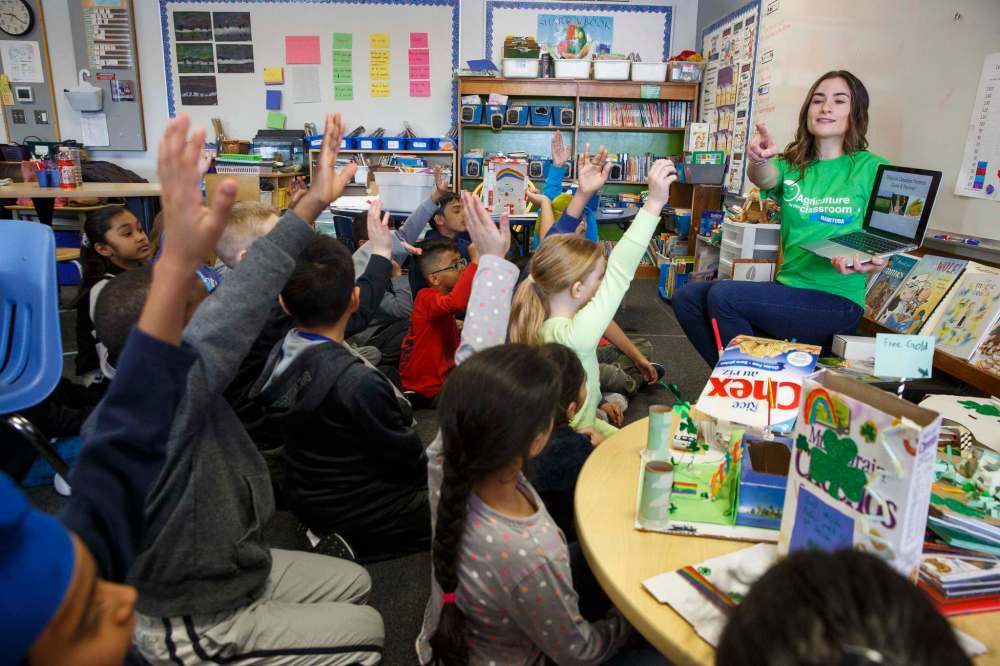
A chorus of questions broke out Wednesday in Bairdmore School, after a presenter informed a Grade 3 class soy is used to make their crayons — one of many farm-related facts shared with the students during Canadian Agriculture Literacy Month.
A total of 21 students crowded on the carpet around Samantha Clemis to learn about the crops grown in Manitoba, job opportunities in agriculture, and how technology is being used on farms.
Despite growing up surrounded by farmers fields in Carman, Clemis recalls she and her classmates learned little about the people working all around them to harvest crops.
While agricultural-related topics can be embedded into science, geography and other lessons, agriculture itself wasn’t explicitly part of the provincial curriculum, and that hasn’t changed.
“When you’re in elementary school, you don’t really think of agriculture as a future job. You’ve got your standard teacher, doctor, whatever, but if you would’ve told me in elementary school that I was going to get an agronomy degree, I wouldn’t have believed it,” said Clemis, who is studying for a masters in plant science at the University of Manitoba.
Perhaps unsurprisingly then, Clemis was motivated to ensure students across the province learn the lessons about agriculture she didn’t get the chance to in her grade-school years.
Clemis is one of 165 volunteer agriculture professionals scheduled to visit 188 schools across Manitoba during March to share lessons prepared by Agriculture in the Classroom Manitoba.
On Wednesday, her hour-long lesson at the south Winnipeg school included teaching about the 150 types of potato varieties grown across the country, showing mustard seed samples, and telling students about jobs related to farming — many of which require using drones or other advanced technology.
After asking the students if they liked building with Lego, she told them farm manager and farm equipment repair roles require lots of hands on work.

“It just helps children learn the basics of how their food gets from the farm gate to the plate,” said Sue Clayton, executive director of Agriculture in the Classroom Manitoba.
Clayton said as Manitobans become more distanced from farms, it’s important citizens are well-informed about the agriculture industry so they can have trust in the food system. Not only that, she added, but the Canadian Agriculture Literacy Month lessons introduce students to jobs in an industry where there’s a high demand for skilled employees.
While the number of farms and farm operators are on the decline Canada-wide, individual farms are getting larger and using more land, according to Statistics Canada. Between 2011 and 2016, the average age for farmers rose, as did the area of cropland across Canada, with the latter increasing almost seven per cent during that time.
maggie.macintosh@freepress.mb.ca
Twitter: @macintoshmaggie
Maggie Macintosh
Education reporter
Maggie Macintosh reports on education for the Free Press. Originally from Hamilton, Ont., she first reported for the Free Press in 2017. Read more about Maggie.
Funding for the Free Press education reporter comes from the Government of Canada through the Local Journalism Initiative.
Every piece of reporting Maggie produces is reviewed by an editing team before it is posted online or published in print — part of the Free Press‘s tradition, since 1872, of producing reliable independent journalism. Read more about Free Press’s history and mandate, and learn how our newsroom operates.
Our newsroom depends on a growing audience of readers to power our journalism. If you are not a paid reader, please consider becoming a subscriber.
Our newsroom depends on its audience of readers to power our journalism. Thank you for your support.
Maggie Macintosh
Education reporter
Maggie Macintosh reports on education for the Free Press. Originally from Hamilton, Ont., she first reported for the Free Press in 2017. Read more about Maggie.
Funding for the Free Press education reporter comes from the Government of Canada through the Local Journalism Initiative.
Every piece of reporting Maggie produces is reviewed by an editing team before it is posted online or published in print — part of the Free Press‘s tradition, since 1872, of producing reliable independent journalism. Read more about Free Press’s history and mandate, and learn how our newsroom operates.
Our newsroom depends on a growing audience of readers to power our journalism. If you are not a paid reader, please consider becoming a subscriber.
Our newsroom depends on its audience of readers to power our journalism. Thank you for your support.
Advertisement Advertise With Us
Advertisement Advertise With Us
History
Updated on Wednesday, March 4, 2020 7:33 PM CST: Fixes typo in lede.