WEATHER ALERT

Transit ridership, revenue in steep decline during COVID-19 pandemic

Advertisement

Advertise with us

TORONTO - Ridership on two of Ontario's largest transit agencies is down between 80 and 90 per cent since the start of the COVID-19 pandemic, in a situation a national industry group said mirrors the experience of many local services.

Read this article for free:


or

Already have an account? Log in here »

To continue reading, please subscribe:

Subscribe and receive a limited-edition Free Press branded hat or tote.

Digital Subscription

One year of digital access for only $205*

  • Enjoy unlimited reading on winnipegfreepress.com
  • Read the E-Edition, our digital replica newspaper
  • Access News Break, our award-winning app
  • Play interactive puzzles

*First annual payment billed as $205.00 + GST for one year. This annual subscription will automatically renew at $233.00 + GST every 52 weeks (10% off the regular annual price of $259.35). Offer available to new and qualified returning subscribers only. Cancel any time.

To continue reading, please subscribe:

Add Free Press access to your Brandon Sun subscription for only an additional

$1 for the first 4 weeks*

  • Enjoy unlimited reading on winnipegfreepress.com
  • Read the E-Edition, our digital replica newspaper
  • Access News Break, our award-winning app
  • Play interactive puzzles
Start now

*Your next Brandon Sun subscription payment will increase by $1.00 and you will be charged $17.95 plus GST for four weeks. After four weeks, your payment will increase to $24.95 plus GST every four weeks.

Hey there, time traveller!
This article was published 13/04/2020 (2324 days ago), so information in it may no longer be current.

TORONTO – Ridership on two of Ontario’s largest transit agencies is down between 80 and 90 per cent since the start of the COVID-19 pandemic, in a situation a national industry group said mirrors the experience of many local services.

Both GO Transit and the Toronto Transit Commission said that their ridership is down dramatically as people work from home or self-isolate during the pandemic.

Ridership on GO Transit, in the Greater Toronto and Hamilton Area, has dropped to approximately 33,000 people per day, a 90 per cent decrease.
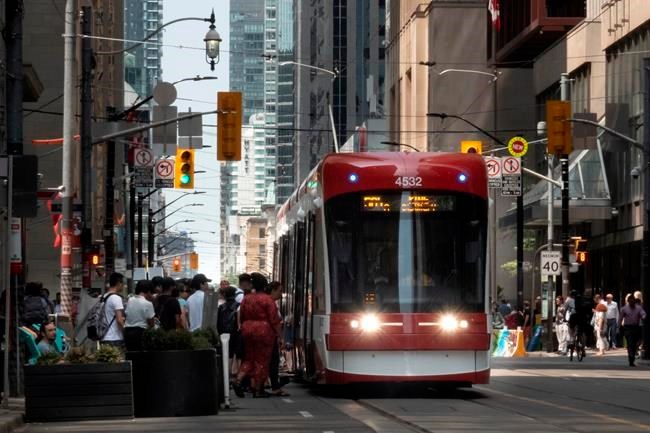
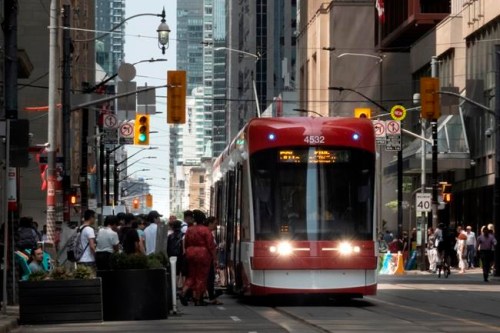
Transit riders board a streetcar in downtown Toronto on Wednesday, July 10, 2019. Ridership on two of Ontario's largest transit agencies is down between 80 and 90 per cent since the start of the COVID-19 pandemic, in a situation a national industry group said mirrors the experience of many local services. THE CANADIAN PRESS/Graeme Roy

The TTC said it has seen an 80 per cent decline, with 10 million daily riders dropping to 2 million.

Marco D’Angelo, CEO of the Canadian Urban Transit Association, said transit providers across the country are seeing similar drops in ridership even as their roles become increasingly vital.

“Looking across Canada, transit operators are facing an impossible choice,” he said. “Do they dramatically cut service as ridership plunges? The numbers would justify that. Nonetheless, across Canada we’re carrying … people who are the lifeline during this crisis.”

The association is asking for $400 million a month in federal aid during the pandemic to keep services running as farebox and other revenues drop.

D’Angelo said the association is currently in discussions with the federal government but has not yet received a firm commitment on a financial package to bolster service.

“They’ve been dealing with every sector of the economy,” he said. “The lines of communication have been constantly open, which has been good — a reason for optimism.”

The federal government did not immediately provide comment.

Metrolinx spokeswoman Anne Marie Aikins said GO Transit has scaled back service several times as ridership has fallen, but trains and buses continued to run reduced hours.

“Most of the people taking GO are people working on the front lines,” she said. “People working in hospitals, they’re in the food service industry, first responders like police and fire. Those are the people taking transit.”

Aikins said system ridership had been dropping steadily since the World Health Organization declared the global pandemic on March 11.

Revenue has also plunged for the agency, down to $1.1 million a week from $11 million weekly prior to the pandemic.

A spokesman for the Toronto Transit Commission said Monday that revenues are also down for that system, from $24 million a week before the outbreak to approximately $4.5 million to $5 million a week currently.

“Our focus is on continuing to keep the city moving,” Stuart Green said in a statement. “Not only because there are still hundreds of thousands of people using our system every day to get to their important jobs, medical appointments and to pick up essential goods and supplies.”

Meanwhile, a union that represents thousands of transit workers across Canada called on the federal government and transit agencies to ensure employees have access to personal protective equipment while on the job.

Amalgamated Transit Union Canada President John Di Nino said workers need masks, gloves, and hand sanitizer to keep them safe. In many cases, it’s not being provided, he said.

“That has been very, very slow in being delivered,” he said. “We’ve seen agencies where some personal protective equipment is being offered, but not the full complement.”

This report by The Canadian Press was first published April 13, 2020.

Report Error Submit a Tip

More Stories

The good, bad and record setting performance in Bombers loss to Elks

Joshua Frey-Sam 7 minute read Preview

The good, bad and record setting performance in Bombers loss to Elks

Joshua Frey-Sam 7 minute read Saturday, Aug. 22, 2026

The Winnipeg Blue Bombers’ 22-19 defeat at the hands of the Edmonton Elks at Commonwealth Stadium in Alberta on Friday was fitting for all the wrong reasons.

The Bombers looked reinvigorated as they jumped out to a 16-point lead in the first half. Then some bad habits reared their ugly head, as the Elks roared back with 19 straight points before kicker Vincent Blanchard walked it off with a 40-yard field goal.

A night that began with so much promise left many fans to wonder what the ceiling actually is for this team in 2026.

On offence, Zach Collaros completed 19 of 30 passes for 219 yards, one touchdown and an interception; Brady Oliveira amassed 118 yards on 16 carries and added a pair of catches for 11 yards; and Nic Demski secured five grabs for 80 yards.

Read
Saturday, Aug. 22, 2026

Pandemic brings steep drop in transit rides

Shawn Jeffords, The Canadian Press 4 minute read Preview

Pandemic brings steep drop in transit rides

Shawn Jeffords, The Canadian Press 4 minute read Monday, Apr. 13, 2020

TORONTO - Ridership on two of Ontario's largest transit agencies is down between 80 and 90 per cent since the start of the COVID-19 pandemic, in a situation a national industry group said mirrors the experience of many local services.

Both GO Transit and the Toronto Transit Commission said that their ridership is down dramatically as people work from home or self-isolate during the pandemic.

Ridership on GO Transit, in the Greater Toronto and Hamilton Area, has dropped to approximately 33,000 people per day, a 90 per cent decrease.

The TTC said it has seen an 80 per cent decline, with 10 million daily riders dropping to 2 million.

Read
Monday, Apr. 13, 2020

CRTC looking into high number of cellphone tornado alerts in Manitoba during June storm

Chris Kitching 4 minute read Preview

CRTC looking into high number of cellphone tornado alerts in Manitoba during June storm

Chris Kitching 4 minute read 2:36 PM CDT

Canada’s telecom regulator is investigating why some Manitobans received an “unusually high number” of tornado alerts on their cellphones when the province was hit by wild thunderstorms June 9.

The Canadian Radio-television and Telecommunications Commission has asked Pelmorex Corp., which operates the national Alert Ready system, and three wireless providers — Bell, Rogers and Telus — to answer a list of questions by Sept. 11.

“Commission staff have been informed of reports concerning tornado alerts that were issued in Winnipeg and southern Manitoba on 9 June 2026, in which members of the public reported receiving an unusually high number of wireless emergency alerts,” Simon Levasseur, the CRTC’s director of financial and multiplatform technology analysis, wrote in a letter dated Wednesday.

“Commission staff is gathering information on the event, any potential root causes that have been identified, as well as corrective actions that have or will be taken to address these causes.”

Read
2:36 PM CDT

Kinew says Manitoba stands with PM in trade war with U.S.

Melissa Martin 6 minute read Preview

Kinew says Manitoba stands with PM in trade war with U.S.

Melissa Martin 6 minute read Saturday, Aug. 22, 2026

The Manitoba government and business leaders are rallying behind Prime Minister Mark Carney’s plan to fight back, after a sudden collapse of trade talks between the U.S. and Canada sparked a new salvo of U.S. tariffs on some Canadian goods.

On Saturday, after Carney vowed to respond with retaliatory tariffs, Manitoba Premier Wab Kinew said his government stood “100 per cent” behind the prime minister’s plan to respond to what Kinew called U.S. President Donald Trump’s “unjustified and immoral” tariffs.

“History will not be kind to Donald Trump, so we should never appease him,” Kinew said. “We should fight back, which is what Canada is doing today.”

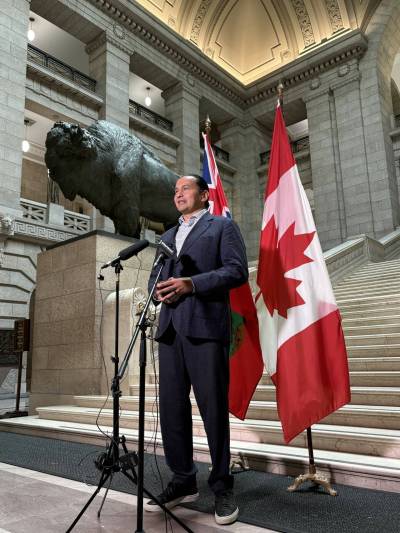
Kinew met reporters for a brief news conference at the legislature on Saturday afternoon, about an hour after finishing a call with Carney and the other premiers. There was a “really strong sense of unity” on that call, Kinew said, and emphasized that he backs the federal decision to “walk away from what would have been a bad deal.”

Read
Saturday, Aug. 22, 2026

Woman pleads guilty in toddler’s death

Erik Pindera 4 minute read Preview

Woman pleads guilty in toddler’s death

Erik Pindera 4 minute read 6:00 AM CDT

A woman who pleaded guilty to failing to provide the necessaries of life after her 13-month-old son died of an drug overdose in their Sherbrook Street apartment will serve a sentence of house arrest.

Latasha Stewart, in her mid-30s, was given the conditional sentence order of two years less a day by provincial court Judge Malcolm McDonald last Wednesday over the Dec. 29, 2022 death of her son Romeo.

“The circumstances in this case are truly tragic. As a result of an adult’s careless drug use, a 13-month-old boy lost his life,” said McDonald.

“It’s hard to imagine a clearer … lesson in the dangers of street-drug use in a household with young children present (than) in this case.”

Read
6:00 AM CDT

Five Things: PM Carney explains why Canada left the U.S. negotiating table

David Baxter, The Canadian Press 5 minute read Preview

Five Things: PM Carney explains why Canada left the U.S. negotiating table

David Baxter, The Canadian Press 5 minute read Saturday, Aug. 22, 2026

OTTAWA - Canada is preparing to hit the U.S. with dollar-for-dollar tariffs in response to new 50 per cent duties on $28 billion worth of Canadian products that took effect when talks between the two nations collapsed as negotiations neared the finish line. 

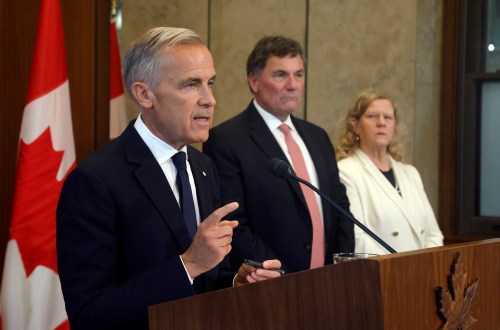
Prime Minister Mark Carney was quiet publicly during the final days of negotiations, but now has now explained his rationale for telling the Canadian negotiating team, led by Canada-U.S. Trade Minister Dominic LeBlanc and chief negotiator Janice Charette, to leave the table.

Restrictions on further trade deals

"The U.S. Introduced at the last hours, in the last hours, efforts to restrict our ability to have other trade deals. You heard me say a moment ago, what we've accomplished in the past year, 20 new deals, economic and security partnerships, the prospect of doubling our market access because we believe in free trade. We're the partner of choice in many respects for countries around the world and the Americans wanted to restrict that. They had language that what they wanted to restrict that, unacceptable," Carney said during a press conference on Parliament Hill.

Read
Saturday, Aug. 22, 2026