Head count

Exploration of census's impact on society more than just a number crunch

Advertisement

Advertise with us

Andrew Whitby, a transplanted Australian now living in the United States, has written a fascinating history of the census, just in time for the launch of the 2020 U.S. census and a year prior to the 2021 Canadian census. Along with his international perspective, as both an economist and computer scientist, The Sum of the People: How the Census Has Shaped Nations, From the Ancient World to the Modern Age brings together a historical, technical and sociological understanding of the census in both ancient and moderns times.

Read this article for free:


or

Already have an account? Log in here »

To continue reading, please subscribe:

Subscribe and receive a limited-edition Free Press branded hat or tote.

Digital Subscription

One year of digital access for only $205*

  • Enjoy unlimited reading on winnipegfreepress.com
  • Read the E-Edition, our digital replica newspaper
  • Access News Break, our award-winning app
  • Play interactive puzzles

*First annual payment billed as $205.00 + GST for one year. This annual subscription will automatically renew at $233.00 + GST every 52 weeks (10% off the regular annual price of $259.35). Offer available to new and qualified returning subscribers only. Cancel any time.

To continue reading, please subscribe:

Add Free Press access to your Brandon Sun subscription for only an additional

$1 for the first 4 weeks*

  • Enjoy unlimited reading on winnipegfreepress.com
  • Read the E-Edition, our digital replica newspaper
  • Access News Break, our award-winning app
  • Play interactive puzzles
Start now

*Your next Brandon Sun subscription payment will increase by $1.00 and you will be charged $17.95 plus GST for four weeks. After four weeks, your payment will increase to $24.95 plus GST every four weeks.

Hey there, time traveller!
This article was published 18/04/2020 (2314 days ago), so information in it may no longer be current.

Andrew Whitby, a transplanted Australian now living in the United States, has written a fascinating history of the census, just in time for the launch of the 2020 U.S. census and a year prior to the 2021 Canadian census. Along with his international perspective, as both an economist and computer scientist, The Sum of the People: How the Census Has Shaped Nations, From the Ancient World to the Modern Age brings together a historical, technical and sociological understanding of the census in both ancient and moderns times.

The American Constitution of 1787 established the first modern decennial (i.e. once a decade) census in Article 1, where it refers to establishing an “Enumeration” to be conducted of “the whole Number of free Persons.” Going forward, and as the population changed, the census would determine each state’s proportionate size within the House of Representatives. The calculation excluded “Indians not taxed” while slaves would be worth “three fifths” of other individuals when doing the count.

Whitby writes that Sweden and the U.S. were the only countries conducting a decennial count in the 18th century, with the U.K. soon to follow. In what would later become Canada, a very early census was conducted in New France in 1666. Not mentioned by the author are the pre-Confederation censuses in the colonies such as those of 1851-52 and 1860-61 in the United Province of Canada.

Sean Kilpatrick / The Canadian Press files
The next U.S. census is slated to take place this year; Canada’s next census will be in 2021.
Sean Kilpatrick / The Canadian Press files The next U.S. census is slated to take place this year; Canada’s next census will be in 2021.

For those seeking detailed information about the early days of the Canadian census, Bruce Curtis’ 2001 book The Politics of Population provides a reliable account of the period spanning the 1840s to the 1870s. Another decent and well-received work is David Worton’s 1998 work The History of the Dominion Bureau of Statistics, which includes chapters on this period as well as up to the early 1970s.

Whitby’s most fascinating chapter is focused on the historical development of punch cards and data processing in the late 1800s. The “Electric Tabulating Machine” designed by Herman Hollerith was first adopted for the 1890 U.S. census. The machine enabled a single operator to “count fifty thousand people a day.” Not mentioned is that the Canadian government also used the machine, as a test case, for its 1891 national census. Hollerith later sold his firm in 1911, and after merging with three other firms, the new company name became the Computing-Tabulating-Recording Company. In 1924 it was renamed International Business Machines — better known as IBM.

The Sum of the People examines the topic of not only who is counted in a national census, but who gets left out, remaining uncounted. This includes population counts in South Africa prior the end of apartheid, Indigenous peoples in the U.S. and Australia (and, not mentioned, in Canada as well) and transient populations with no fixed address. To compensate, statisticians often resort to creating population “estimates” for these hard-to-reach populations.

A fascinating part of Whitby’s work is how, historically, the census is more than a simple counting of heads. As a government tool, it was used to collect taxes in biblical times, for establishing sovereignty in disputed parts of a region (such as modern-day Israel) and, most chillingly, by the Nazis to identify the Jews in occupied Europe.

Andrew Whitby’s Sum of the People is a highly readable, well-written account of how nations have implemented their census. Writing about the census might seem to be somewhat dull at first glance, but readers will soon appreciate how the topic is significant for a number of historical, social and political reasons.

Christopher Adams is writing a history of polling in Canada. He is a past pollster and is the rector of St. Paul’s College at the University of Manitoba.

BORIS MINKEVICH / WINNIPEG FREE PRESS files
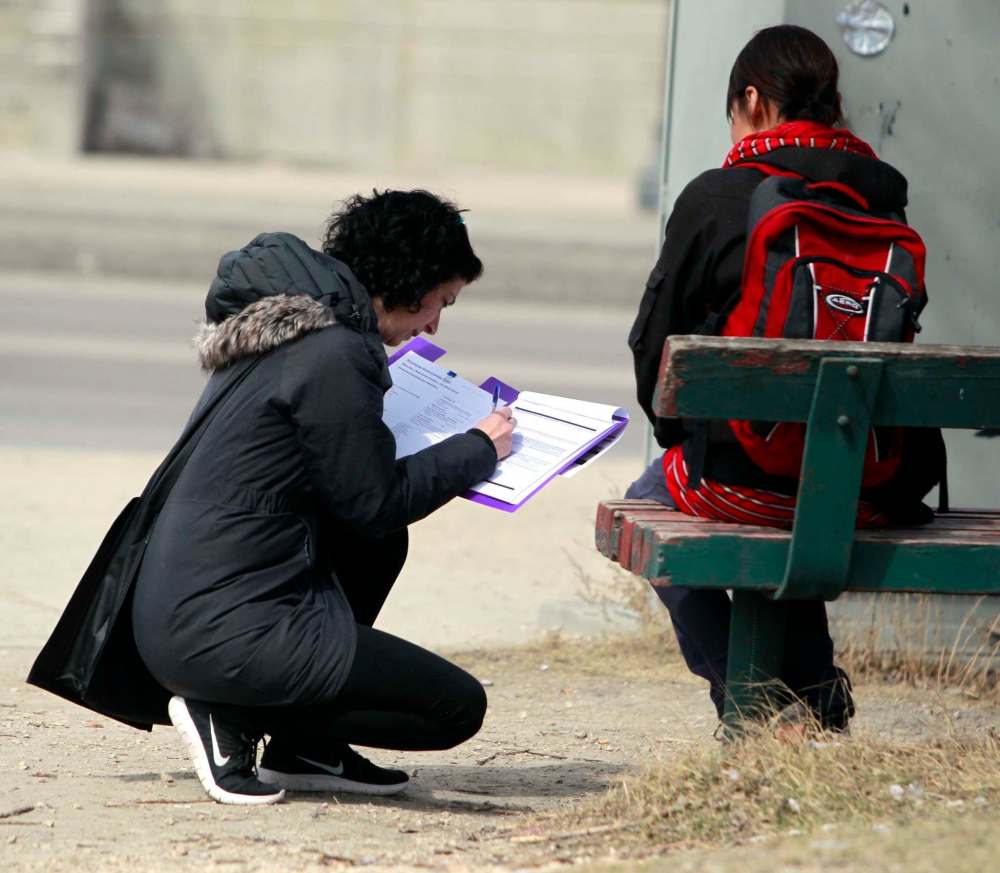
In this 2018 photo, a volunteer interviews a homeless Winnipegger at the corner of Higgins Avenue and Main Street. Statisticians are often forced to resort to creating population estimates for these hard-to-reach populations.
BORIS MINKEVICH / WINNIPEG FREE PRESS files In this 2018 photo, a volunteer interviews a homeless Winnipegger at the corner of Higgins Avenue and Main Street. Statisticians are often forced to resort to creating population estimates for these hard-to-reach populations.
Report Error Submit a Tip

More Stories

Ignore gossip, be good till girlfriend’s back

Maureen Scurfield 5 minute read Yesterday at 2:00 AM CDT

DEAR MISS LONELYHEARTS: I am lonely to the bone. My girlfriend has been away working for the summer, and I promised I wouldn’t cheat on her. But now I have heard through the grapevine she’s seeing a guy who works at her kids’ camp.

I think the source can be trusted, because she’s a friend who cares about me, almost like a sister. Actually I think she kind of wants me herself, but never seems to cross that line. Should I believe her “inside information” when she might be wanting to go out with me herself?

My girlfriend won’t be back until the very end of August and the messages and phone calls back and forth have been less and less frequent. Maybe she’s just busy or getting rested up to see me — or maybe she’s seeing someone else. I’m feeling jealous and I hate it! Maybe I should see somebody else too. Please advise ASAP.

— Lonely and Suspicious, Transcona

Manitoba’s liquor regulator has accused an Exchange District nightclub of exceeding its occupant capacity limit and hindering the work of inspectors.

Diablo, located at Main Street and Bannatyne Avenue, is scheduled to appeal two compliance orders, issued by the Liquor, Gaming and Cannabis Authority of Manitoba, at a Sept. 8 hearing.

An LGCA spokesperson said the compliance orders are part of an ongoing investigation.

The spokesperson said one of the orders was issued after the licensed club was over capacity April 26.

City rescinds Balmoral Street property owner’s order to clean up encampment

Scott Billeck 3 minute read Preview

City rescinds Balmoral Street property owner’s order to clean up encampment

Scott Billeck 3 minute read Yesterday at 5:35 PM CDT

A West Broadway landlord is off the hook for clearing a large riverbank encampment after the City of Winnipeg rescinded an order threatening to stick him with the cleanup bill.

Marvin Sharp, CEO of Astroid Management Ltd., which operates the Pen-Eve Apartments at 35 Balmoral St., said he received a call from the city Tuesday letting him know the order has been cancelled.

In a statement from the city, an official said the order was shelved due to an existing and active easement on the property.

“We have been communicating with the property owner throughout this process and they have been informed of this development,” a spokesperson said.

Read
Yesterday at 5:35 PM CDT

Adding emergency doctors, nurses and support staff is great, but it won’t break the wait-time logjam

Dan Lett 5 minute read Preview

Adding emergency doctors, nurses and support staff is great, but it won’t break the wait-time logjam

Dan Lett 5 minute read 1:15 PM CDT

It was the kind of announcement that should have brought universal applause.

Instead, on Tuesday, when Premier Wab Kinew recently announced his government had recruited more than 4,700 net new health-care professionals and support workers, the proclamation was met with quite a few rolling eyes.

Unions representing health-care staff reacted more with disdain than gratitude. The Manitoba Nurses Union continued its inexplicable war of attrition with the Kinew government, with president Darlene Jackson openly questioning the veracity of the premier’s math.

Why all the grumpiness? Jason Linklater, president of the Manitoba Association of Health Care Professionals, probably said it best. “The metric that matters is whether Manitobans wait less time for care tomorrow than they did yesterday,” he said.

Read
1:15 PM CDT

New Bannatyne eatery brings feast of Asian flavours

Eva Wasney 4 minute read Preview

New Bannatyne eatery brings feast of Asian flavours

Eva Wasney 4 minute read Yesterday at 4:29 PM CDT

Matriarchal influences run deep at House of Ma Kitchen and Bar.

Executive chef Dom Merano took inspiration from his mom’s home cooking while developing the menu for the new Exchange District restaurant — specifically Cynthia Merano’s recipes for lumpia (Filipino spring rolls) and kare-kare (braised beef and peanut stew).

“It tastes like home,” Merano says of the dishes, adding that his mom “felt honoured to be able to share her cooking with people. She was actually here prior to opening helping me roll lumpia.”

Cynthia’s photo is hung among the “Wall of Mas” at the back of the restaurant, where the mothers and grandmothers of True Hospitality staff are given pride of place.

Read
Yesterday at 4:29 PM CDT

Paralyzed foster girl has system under a microscope

Chris Kitching 6 minute read Preview

Paralyzed foster girl has system under a microscope

Chris Kitching 6 minute read Yesterday at 2:00 AM CDT

An internal investigation by Manitoba’s Families Department is nearly complete in the case of a six-year-old girl who is paralyzed after being assaulted by her foster mother in Winnipeg.

The review by child-welfare officials is intended to prevent similar incidents, but it’s unlikely the public will learn the findings or recommendations.

“We’re working closely with the (child and family services) authority to make sure that every recommendation is taken seriously and implemented,” Families Minister Nahanni Fontaine said Monday.

“They’re important (investigations) because they help us identify what went wrong so we can make those changes to ensure something like this tragedy never happens again.”

Read
Yesterday at 2:00 AM CDT