Trudeau, allies call for global unity at UN summit on pandemic recovery
Advertisement
Read this article for free:
or
Already have an account? Log in here »
To continue reading, please subscribe:

Digital Subscription
One year of digital access for only $205*
- Enjoy unlimited reading on winnipegfreepress.com
- Read the E-Edition, our digital replica newspaper
- Access News Break, our award-winning app
- Play interactive puzzles
*First annual payment billed as $205.00 + GST for one year. This annual subscription will automatically renew at $233.00 + GST every 52 weeks (10% off the regular annual price of $259.35). Offer available to new and qualified returning subscribers only. Cancel any time.
To continue reading, please subscribe:
Add Free Press access to your Brandon Sun subscription for only an additional
$1 for the first 4 weeks*
- Enjoy unlimited reading on winnipegfreepress.com
- Read the E-Edition, our digital replica newspaper
- Access News Break, our award-winning app
- Play interactive puzzles
*Your next Brandon Sun subscription payment will increase by $1.00 and you will be charged $17.95 plus GST for four weeks. After four weeks, your payment will increase to $24.95 plus GST every four weeks.
Read unlimited articles for free today:
or
Already have an account? Log in here »
Hey there, time traveller!
This article was published 28/05/2020 (2262 days ago), so information in it may no longer be current.
OTTAWA – Prime Minister Justin Trudeau led a united call for global co-operation at a major United Nations meeting Thursday aimed at mitigating the devastating social and economic impacts of the COVID-19 pandemic.
And UN Secretary-General Antonio Guterres tacitly endorsed Canada’s ability to convene larger groups of countries to serve the greater international good — a key plank in Canada’s platform for a temporary seat on the Security Council.
The COVID-19 conference came as Canada is competing for one of two non-permanent seats on the Security Council next month against Norway and Ireland. Canada is running on a platform of trying to help rebuild the post-pandemic world, and Trudeau said Thursday’s video conference of more than 50 heads of state and government was an example.
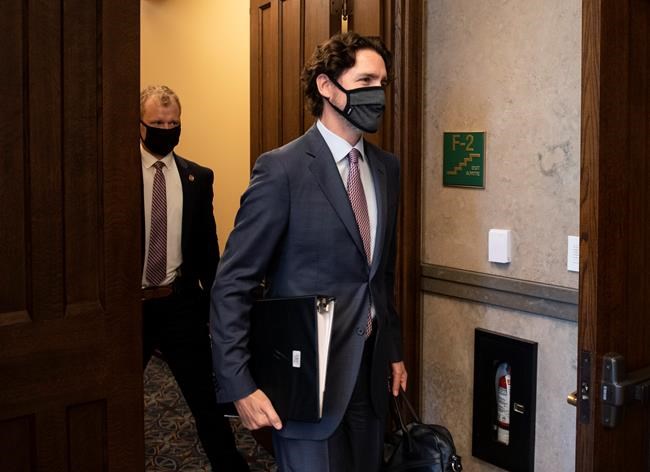
Trudeau said the conference was the result of ongoing work with his conference co-host, Jamaican Prime Minister Andrew Holness, to mitigate the effects of climate change.
“Canada has a long tradition of convening, of gathering people together to deal with larger issues and this is certainly a role we hope to play on the UN Security Council,” Trudeau said.
“We demonstrated (that) today on an issue we’ve been working on over the past five years in terms of development, financing and improving economic flows to countries in need. This is something that we can gather critical masses of consensus around the world.”
Trudeau said Canada, potentially as one of 10 rotating non-permanent members of the council, could help find common ground with its five veto-wielding permanent members who have been deadlocked for years on many issues, notably the carnage in Syria.
“I, of course, agree with the prime minister. I have never seen the council work being paralyzed by elected members,” Guterres said.
Trudeau, Guterres and Holness began the hours-long videoconference by affirming support for the international institutions that need to lead the recovery.
“Our citizens need to have confidence in international institutions that leave no one behind and are capable of overcoming global challenges,” Trudeau said in opening remarks
Remarks by dozens of heads of state and government followed, including Germany’s Angela Merkel, France’s Emmanuel Macron, and Britain’s Boris Johnson, along with representatives of the World Bank, the International Monetary Fund and the private sector.
U.S. President Donald Trump was noticeably absent as was China’s Xi Jinping. Trump has argued that wise leaders put the interests of their own countries first.
Guterres said the U.S. and China would support the various committees that were created in Thursday’s meeting to report back to him by July on the financial recovery.
One by one, Merkel, Macron, Johnson — among others — thrashed Trump’s go-it-alone approach without mentioning his name.
Merkel reminded the gathering that Germany has trumpeted climate change during its past G7 presidency. Trump is hosting the G7 summit this year.
European Commission President Ursula von der Leyen noted the pandemic might push some countries to focus on their own needs.
“This is wrong. We have to work together, and for each other.”
Macron, who has never shied away from criticizing Trump, said the “collective action” of the world’s multilateral system is crucial.
“No single country can find a solution to this crisis. There can be no isolated solution. We have to address issues collectively, such as health, the environment, justice.”
Johnson, sometimes viewed as a kindred political spirit of Trump’s, piled on.
“No single country hold the keys to victory against our invisible enemy,” he said. “If we are to defeat COVID-19, achieve a global recovery, and avoid a future pandemic, then we must work together across borders.”
Ireland and Norway, Canada’s rivals for the two temporary seats on the security council, echoed the sentiment.
“This is no time to seek confrontation and to look inward,” said Norway’s Prime Minister Erna Solberg.
“Let us use this moment to ensure more global co-operation in order to build back a healthier, greener, fairer, gender-equal and sustainable world.”
The subtext of the looming Security Council vote was also on display. Trudeau has been courting the support of various large voting blocs in Africa, Asia and the Caribbean because European countries are expected to rally around Norway and Ireland.
Barbadian Prime Minister Mia Mottley, the current chair of the 20-country Caribbean Community, thanked Trudeau for his remarks, but laid down a clear marker for him and others.
“I hope that this high-level session will not simply be the record of glorious speeches but will trigger action that is needed badly.”
Trudeau said later he wanted to see firm action, noting that Caribbean countries that depend on tourism to support their economies need help to overcome the fiscal damage done by pandemic’s lockdown and closed borders.
Unless countries come together now to co-ordinate a recovery plan, the UN estimates the pandemic could slash nearly US$8.5 trillion from the world economy over the next two years, forcing 34.3 million people into extreme poverty this year and potentially 130 million more over the course of the decade.
The UN said all countries face economic strain due to the pandemic, particularly developing countries which were already in “debt distress” before the crisis and can’t afford to cushion the blow for their citizens or to undertake fiscal stimulus measures.
The conference addressed “six urgent areas of action” to mobilize the financing needed for a global recovery:
— Expanding liquidity in the global economy and maintaining financial stability.
— Addressing debt vulnerability for developing countries “to save lives and livelihoods for billions of people around the world.”
— Involving private sector creditors in recovery plans.
— Enhancing external financing for inclusive growth and job creation.

— Preventing illicit offshore financial holdings and money laundering that siphons off trillions of dollars needed for rebuilding economies.
— Aligning recovery policies with sustainable development goals.
“Despite all the technological and scientific advances of recent decades, we are in an unprecedented human crisis because of a microscopic virus,” said Guterres.
“We need to respond with unity and solidarity.”
This report by The Canadian Press was first published May 28, 2020.