Parents, educators, experts talk to kids on race amid unrest
Advertisement
Read this article for free:
or
Already have an account? Log in here »
To continue reading, please subscribe:

Digital Subscription
One year of digital access for only $205*
- Enjoy unlimited reading on winnipegfreepress.com
- Read the E-Edition, our digital replica newspaper
- Access News Break, our award-winning app
- Play interactive puzzles
*First annual payment billed as $205.00 + GST for one year. This annual subscription will automatically renew at $233.00 + GST every 52 weeks (10% off the regular annual price of $259.35). Offer available to new and qualified returning subscribers only. Cancel any time.
To continue reading, please subscribe:
Add Free Press access to your Brandon Sun subscription for only an additional
$1 for the first 4 weeks*
- Enjoy unlimited reading on winnipegfreepress.com
- Read the E-Edition, our digital replica newspaper
- Access News Break, our award-winning app
- Play interactive puzzles
*Your next Brandon Sun subscription payment will increase by $1.00 and you will be charged $17.95 plus GST for four weeks. After four weeks, your payment will increase to $24.95 plus GST every four weeks.
Read unlimited articles for free today:
or
Already have an account? Log in here »
Hey there, time traveller!
This article was published 03/06/2020 (2273 days ago), so information in it may no longer be current.
NEW YORK – As an African American parent, Cassandre Dunbar in Charlotte, North Carolina, always knew she and her husband would have “the talk” with their son, the one preparing him for interactions with law enforcement.
But she never dreamed it would be necessary at 5 years old.
“I thought the cops were supposed to help us? Are they only helpful to white people?” he asked after taking in TV coverage of protests and overhearing his parents discuss the deaths of George Floyd, Ahmaud Arbery and Breonna Taylor.
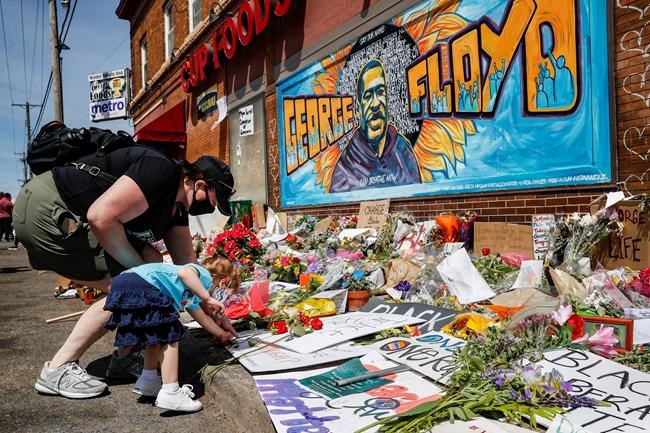
Dunbar explained to her eldest child: “Some people have a hard time understanding that skin colour doesn’t have anything to do with what kind of person you are. I said that, yes, cops are meant to help us all, but some cops aren’t good cops and the bad ones really aren’t helpful to people who look like us.”
Many parents of all races are struggling with similar conversations after a week of outrage and sadness that spilled into streets worldwide after video of Floyd’s death emerged. It came after months of family togetherness in coronavirus lockdown, a time when kids have been cut off from schools and peers.
Floyd, a handcuffed black man, died after a Minneapolis police officer pressed his knee into his neck as he pleaded for air.
To help her kids going forward, Dunbar has been reaching out for guidance from child therapists, early childhood educators and seasoned parents.
How conversations with kids about race and racism play out can be intensely personal for parents. Many white parents in particular believe children are too young for such discussions at age 10 or 11, said Andrew Grant-Thomas, co-founder of Embrace Race, a non-profit that provides resources for parents and educators.
“They think that kids are too naive and fragile and will crumple the moment you even mention the word,” he said. ”By not engaging kids explicitly, essentially you’re leaving them to flounder in this tidal wave of communication about race that they are receiving from a very early age, but without you there to deliberately mediate how they make sense of what they get.”
Howard Stevenson, a clinical psychologist in the Graduate School of Education at the University of Pennsylvania, works with educators and families to understand the trauma and stress of race-based hate. Insights that he offered online in 2016 have been shared by school districts around the country in the past week with parents.
“Both verbal and non-verbal approaches influence what children not only know about race but whether they should speak to it or how they should manage the stress of it,” Stevenson told The Associated Press. “Children watch what their parents don’t do during racial moments as much as what they actually purposely teach.”
He said research shows that the more parents talk to children about race, the more those children “tend to be less overwhelmed by the politics.”
For African American mom Sonya Horton in Brooklyn, New York, that means putting it all on the line for her 11-year-old daughter, Samirah, a budding DJ and anti-bullying activist who attends a predominantly white private school.
The sixth-grader belongs to a school club for black and brown students where they feel free to discuss slights from classmates over things like how they wear their hair, certain foods they particularly like and family traditions.
Of her white classmates, Samirah said: “I feel like they know what racism is but not to the full extent of the meaning of it. I feel like they might think making an inappropriate joke could be racist, but racist could be imitating someone or saying a comment that’s not particularly nice.”
Horton, whose husband is a retired police officer, said they have never “sugar-coated things” for their child.
“I never feel that she’s too young to know or to understand,” Horton said. “We live in a world where it’s out there, and if you’re not open and you’re not talking about it then they may come away with misinformation and miseducation.”
For parents, the first step is checking their own feelings, Stevenson and other experts said. A good second step is listening to the experiences of parents and children of colour without judgment, and accept that racism does exist.
Val Whiting, who is African American and lives in suburban Seattle, said her 19-year-old son, the eldest of two teen boys, has had plenty of practice handling racism in their predominantly white neighbourhood, from racial slurs on the soccer field to a car full of young people shouting the “N-word” before speeding off.
“I wanted to pull out a bazooka and blow up that car full of cowards,” she said. “But we’ve taught him how to make connections and nurture relationships with other people of colour, so he immediately contacted a Facebook group he belongs to in order to share what happened, and get support and guidance. I’m OK with that.”

In Myrtle Beach, South Carolina, Traci Sumter wouldn’t allow her black 15-year-old son to participate in protests.
“I’ve read threats and horrible comments online by neighbours, teachers and people I had considered friends,” she said. “I cried when I saw the George Floyd video. I cried again when I watched my son watch it. The look of disappointment on his face let me know that he felt the world had failed him. Again.”
Ibram X. Kendi is a National Book Award winner, activist, history professor and founding director of the Antiracist Research and Policy Center at American University.
He’s also dad to 4-year-old Imani.
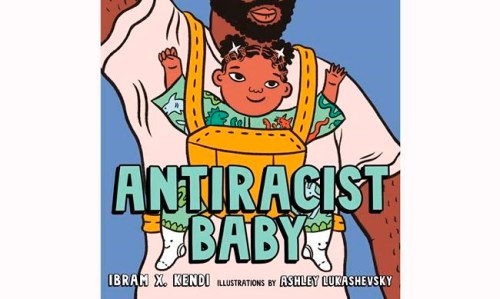
When his daughter was born, Kendi found few books on race and racism for the very young. He wrote his own, a board book in rhyme out this month from the Penguin Young Readers imprint Kokila Books.
Titled “Antiracist Baby,” it’s one of a surge of titles on racism making their way up the Amazon bestseller list.
“The data points to the fact that children as young as 5 or 6 months begin recognizing race, and children as young as 2 to 3 years old start recognizing or even believing in racist ideas,” Kendi said. “Typically parents don’t even know how to begin to have these conversations with these very, very young people, let alone recognizing the importance of having these conversations.”
Through illustrations by Ashley Lukashevsky, Kendi shows that the first step toward making racial equity a reality is opening your eyes to all skin colours.
“Antiracist Baby learns all the colours, not because race is true,” he writes. “If you claim to be colour-blind, you deny what’s right in front of you.”

At Manhattan’s Little Red School House and Elisabeth Irwin High School, Alisa Soriano is an assistant principal who filled in this week as a first-grade teacher. At the school’s regular classroom morning meetings, the recent protests and deaths were discussed via Zoom.
The progressive school is committed to diversity, equity and inclusion work year-round, so even the youngest children weren’t taken aback, Soriano said.
“When you speak to young children with passion and with respect, and with information that is valid to their lives, they listen,” she said.
___
This story corrects the spelling of Traci Sumter.
Related Articles
Black athletes share thoughts on current state of events



Advertisement Advertise With Us
Advertisement Advertise With Us