Calgary brewery hopes to overcome ‘yuck factor’ with beer made with wastewater

Advertisement

Advertise with us

CALGARY - Village Brewery, which describes its blond ale as crisp, dry and slightly fruity, is looking to persuade beer lovers that a new batch made from reused wastewater tastes just as good.

Read this article for free:


or

Already have an account? Log in here »

To continue reading, please subscribe:

Subscribe and receive a limited-edition Free Press branded hat or tote.

Digital Subscription

One year of digital access for only $205*

  • Enjoy unlimited reading on winnipegfreepress.com
  • Read the E-Edition, our digital replica newspaper
  • Access News Break, our award-winning app
  • Play interactive puzzles

*First annual payment billed as $205.00 + GST for one year. This annual subscription will automatically renew at $233.00 + GST every 52 weeks (10% off the regular annual price of $259.35). Offer available to new and qualified returning subscribers only. Cancel any time.

To continue reading, please subscribe:

Add Free Press access to your Brandon Sun subscription for only an additional

$1 for the first 4 weeks*

  • Enjoy unlimited reading on winnipegfreepress.com
  • Read the E-Edition, our digital replica newspaper
  • Access News Break, our award-winning app
  • Play interactive puzzles
Start now

*Your next Brandon Sun subscription payment will increase by $1.00 and you will be charged $17.95 plus GST for four weeks. After four weeks, your payment will increase to $24.95 plus GST every four weeks.

Hey there, time traveller!
This article was published 17/08/2020 (2207 days ago), so information in it may no longer be current.

CALGARY – Village Brewery, which describes its blond ale as crisp, dry and slightly fruity, is looking to persuade beer lovers that a new batch made from reused wastewater tastes just as good.

The Calgary beer-maker has teamed up with University of Calgary researchers and U.S. water technology company Xylem Inc. to brew up a limited 1,600-can batch.

The goal was to show that dirty water — even that flushed from toilets in a major city — can be made safe to drink while helping conserve the globe’s dwindling potable water supply.
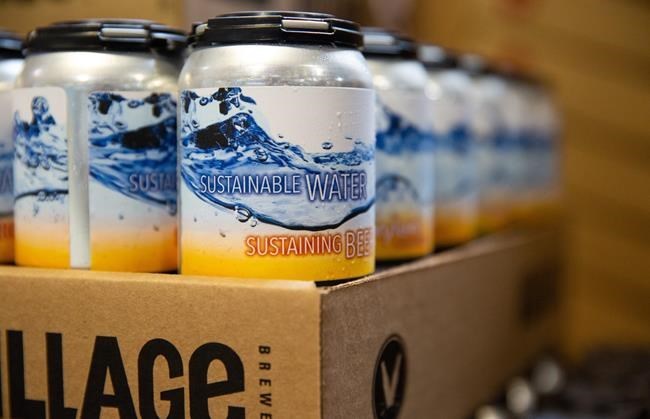
Alberta's first beer made with treated wastewater named
Alberta's first beer made with treated wastewater named "Village Blonde" and brewed as a collaboration between UCalgary's Advancing Canadian Water Assets (ACWA), Village Brewery and Xylem Inc. is shown in this undated handout photo. Village Brewery, which describes its blonde ale as crisp, dry and slightly fruity, is looking to convince beer lovers that a new batch made from reused Calgary wastewater tastes just as good. THE CANADIAN PRESS/HO, UCalgary Riley Brandt *MANDATORY CREDIT*

“Certainly we do expect some eyebrows raised and the yuck factor is real,” said Christine O’Grady, project co-ordinator at Advancing Canadian Wastewater Assets, or ACWA.

“Part of this project … is to start the conversation about how this can be done, why it should be done and that water is a resource that we need to protect.”

ACWA is a research partnership between the University of Calgary and the City of Calgary that involves the Pine Creek Wastewater Treatment Facility by the Bow River in the city’s southeast.

Municipal wastewater normally runs through a complex system involving screens, filters, microbes and ultraviolet light to make it clean enough to return to the river.

The ACWA team took partially treated water from the plant and ran it through more advanced purifying to make it drinkable. That involved ultrafiltration, ozone, ultraviolet light and reverse osmosis.

The idea of making beer from wastewater started out as a joke around the boardroom table while Xylem and ACWA were discussing ways to collaborate.

“Then we said, ‘Well, we can make beer,'” O’Grady said. “We have all the technology. We have the capacity on all sides.”

ACWA approached Village Brewery.

“They’re so progressive and cool. They were all in,” said O’Grady.

Jackson Stuart, the brewery’s marketing manager, said Village was excited to take part in a project that put sustainability front and centre.

He said he’ll be interested to see how keen customers are to sip suds brewed from repurposed wastewater.

“The big thing for us was to try to make sure that the beer tasted the exact same as our other normal Village Blonde and we achieved that,” he said. “We’re confident.”

The only difference in making the beer is that the water didn’t come from the tap, but arrived in tanks.

Alberta Health Services helped the partners develop a safety plan and tested the treated water to make sure it met drinking-water standards.

“With the right measures in place, alternative water sources — such as wastewater, grey water, rooftop-collected rainwater and stormwater — can be made safe for many potable and non-potable end uses,” said public health inspector Jessica Popadynetz.

Bob Sandford, Global Water Futures Chair at the United Nations University’s Institute for Water, Environment and Health, said he believes the “yuck factor” can be overcome.

“The science is absolutely sound and is very convincing. The brewery, too, has done a really good job of explaining this,” he said.

Natural systems have been purifying water to a drinkable standard for hundreds of millions of years, Sandford said.

“We’re drinking water that’s passed through dinosaurs.”

In a changing climate and an increasingly populated world, high-level tertiary treatment technologies such as those used by ACWA will be crucial, he suggested.

“Because of the numbers of emerging contaminants of concern, we need to have evermore sophisticated water-treatment systems and this is what it’s pointing to.”

This report by The Canadian Press was first published Aug. 17, 2020

Report Error Submit a Tip

More Stories

Chefs gather in St. Boniface to see whose version of jollof is best

Eva Wasney 4 minute read Preview

Chefs gather in St. Boniface to see whose version of jollof is best

Eva Wasney 4 minute read Yesterday at 5:30 PM CDT

Chef Alex Bockarie is bringing an age-old African culinary battle to Winnipeg.

On Saturday, five local chefs hailing from Senegal, Liberia, Sierra Leone, Ghana and Nigeria will go head-to-head to determine who makes the best jollof — a rice dish simmered in a savoury tomato-based stew.

“Jollof rice originated from Senegal but it has spread throughout West Africa and every country has its own method of cooking it,” Bockarie says. “It’s a long-standing fight; even among the communities here in Winnipeg, everybody’s always saying that Sierra Leone’s (jollof) is the best, Ghana’s is the best, Nigeria’s is the best.

“It’s a friendly competition; friendly, but very serious too.”

Read
Yesterday at 5:30 PM CDT

Dynacare strike could lead to lab test logjam

Carol Sanders 4 minute read Preview

Dynacare strike could lead to lab test logjam

Carol Sanders 4 minute read Yesterday at 2:00 AM CDT

DOCTORS and health-care advocates are raising concerns about patient care if a Sept. 8 strike goes ahead at the private company that provides nearly all medical lab services in Manitoba.

There is no essential services agreement in place with Dynacare, so if its lab techs are off the job, patients who need blood tests and urinalysis will be directed to hospitals and public clinics for those services.

“There’s only so many of those workers and I’m sure that the public folks are bracing for big crunch of additional patients if the strike really goes ahead,” Noah Schulz of the Manitoba Health Coalition said Monday.

Dynacare serves 1.2 million Manitoba patients a year at 23 community lab locations.

Read
Yesterday at 2:00 AM CDT

Puzzles Palace

1 minute read Monday, Jul. 27, 2026

To solve our puzzles, please subscribe with this special offer: |

Provincially regulated workplaces required to provide free menstrual products

Carol Sanders 4 minute read Preview

Provincially regulated workplaces required to provide free menstrual products

Carol Sanders 4 minute read Yesterday at 5:21 PM CDT

New regulations came into force Tuesday requiring all provincially regulated workplaces in Manitoba to provide free menstrual products to employees.

The amendments to the Workplace Safety and Health Regulation were published March 9 but didn’t take effect until Sept. 1 to give employers six months to purchase supplies, and where needed, dispensers and disposal containers.

Labour Minister Malaya Marcelino said Tuesday that rather than push back, employers have asked for more information.

“The only concern I heard was that people don’t know about it and that we need to spread the word in a better way. That was the only issue,” Marcelino said in an interview.

Read
Yesterday at 5:21 PM CDT

Vacant Portage la Prairie mall ransacked by vandals

1 minute read Yesterday at 11:01 AM CDT

RCMP are investigating after a suspect or suspects broke into the vacant Portage la Prairie Mall and vandalized the building on Monday, causing more than $100,000 in damage.

Mounties were called to the vacant mall on Saskatchewan Avenue West at about 10:30 a.m. on Monday.

Police say the suspect or suspects caused "extensive" damage throughout the building. Most windows inside the building were smashed, a tree was cut down, the general office and several unoccupied storefronts were ransacked and graffiti was spray-painted on walls.

Mounties say they believe the damage will cost more than $100,000 to fix. Nothing appears to have been stolen.

Province accused of meddling in Dynacare contract dispute as strike deadline looms

Carol Sanders 5 minute read Preview

Province accused of meddling in Dynacare contract dispute as strike deadline looms

Carol Sanders 5 minute read Yesterday at 4:30 PM CDT

The union for hundreds of Dynacare lab employees in Manitoba has accused the provincial government of interfering in contract talks ahead of next week’s strike deadline.

The Manitoba Association of Health Care Professionals, which bargains on behalf of 350 lab workers at two dozen Dynacare outlets in Winnipeg, Brandon, and surrounding communities, said Tuesday that the labour board has been asked to review the need for an essential services agreement.

Dynacare and the union agreed in March that Dynacare services are not deemed essential under provincial law, and do not need to continue if a strike is held, MAHCP president Jason Linklater said Tuesday. The union, whose collective agreement with the private company expired March 31, said the NDP government was informed the two sides had agreed no essential services agreement was needed.

After contract negotiations broke down, and a strike deadline of 6 a.m. Sept. 8 was set, physicians and health-care advocates warned that patient care will suffer if the strike goes ahead because Dynacare provides nearly all medical lab services in Manitoba.

Read
Yesterday at 4:30 PM CDT