With COVID-19 cases on the rise, Quebec considers temporarily shutting schools

Advertisement

Advertise with us

MONTREAL - The Quebec government says it's considering shutting schools for up to a month around the holiday season to reduce the spread of COVID-19.

Read this article for free:


or

Already have an account? Log in here »

To continue reading, please subscribe:

Subscribe and receive a limited-edition Free Press branded hat or tote.

Digital Subscription

One year of digital access for only $205*

  • Enjoy unlimited reading on winnipegfreepress.com
  • Read the E-Edition, our digital replica newspaper
  • Access News Break, our award-winning app
  • Play interactive puzzles

*First annual payment billed as $205.00 + GST for one year. This annual subscription will automatically renew at $233.00 + GST every 52 weeks (10% off the regular annual price of $259.35). Offer available to new and qualified returning subscribers only. Cancel any time.

To continue reading, please subscribe:

Add Free Press access to your Brandon Sun subscription for only an additional

$1 for the first 4 weeks*

  • Enjoy unlimited reading on winnipegfreepress.com
  • Read the E-Edition, our digital replica newspaper
  • Access News Break, our award-winning app
  • Play interactive puzzles
Start now

*Your next Brandon Sun subscription payment will increase by $1.00 and you will be charged $17.95 plus GST for four weeks. After four weeks, your payment will increase to $24.95 plus GST every four weeks.

Hey there, time traveller!
This article was published 12/11/2020 (2164 days ago), so information in it may no longer be current.

MONTREAL – The Quebec government says it’s considering shutting schools for up to a month around the holiday season to reduce the spread of COVID-19.

In the past two days, 324 classrooms across Quebec have been closed following COVID-19 outbreaks, Premier Francois Legault said Thursday. He said his government is looking at extending the winter break but said no firm decision has been made.

Legault said he is reluctant to close schools because students already missed several weeks of classes in the spring during the first wave. “It remains the last solution, but currently, when one looks at the situation, we should not exclude any solution,” he told reporters in Quebec City.
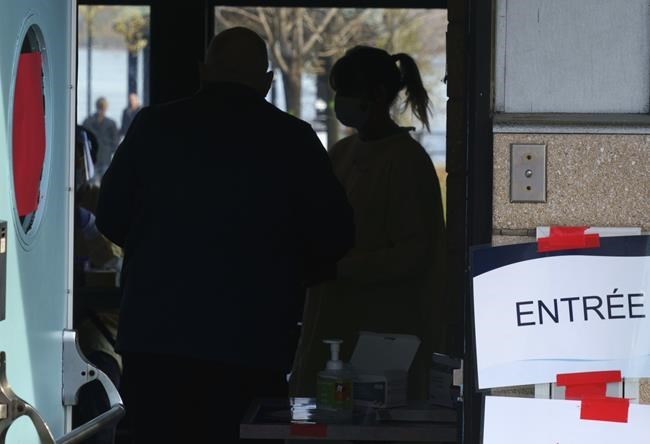
A nurse welcomes a man at a COVID-19 testing clinic in Montreal, on Monday, November 9, 2020. THE CANADIAN PRESS/Paul Chiasson

Quebec reported 1,365 new COVID-19 infections Thursday and 42 more deaths linked to the novel coronavirus, including nine that occurred in the past 24 hours.

According to Health Department data, outbreaks at schools and workplaces accounted for nearly 77 per cent of the province’s 1,509 outbreaks reported Thursday. Legault said 1,174 classrooms across Quebec are closed.

“Schools are a place of transmission,” the premier said. “It is why we’re evaluating the possibility of closing the schools for a limited period of time. We have to consider all our options to break the wave.”

The province will meet with education unions about extending the school year into the summer to make up for lost weeks, and Legault assured that parents will be given advanced warning of any closures.

Students in secondary three, four and five already alternate between in-class instruction and online courses while younger students are in school full-time. Legault said public health hasn’t linked the recent spike in classroom outbreaks to ventilation issues.

In light of recent directives from the World Health Organization regarding ventilation and aerosol transmission of COVID-19, Dr. Horacio Arruda, Quebec’s director of public health, said he’s looking at new data and working with engineers to update the province’s protocols.

Asked about the WHO’s suggestion to reduce class sizes by half, Legault said that logistically, it wouldn’t work. “If tomorrow morning we divide the classes in two, it takes twice as many classes and then it takes twice as many teachers,” Legault said. “The WHO did not tell us where to find these classrooms and teachers to implement this suggestion.”

Legault said the next few weeks could be tough for Quebecers, who he said need to reduce their contact with others. Partial lockdown orders have been place since Oct. 1 and will remain until at least Nov. 23.
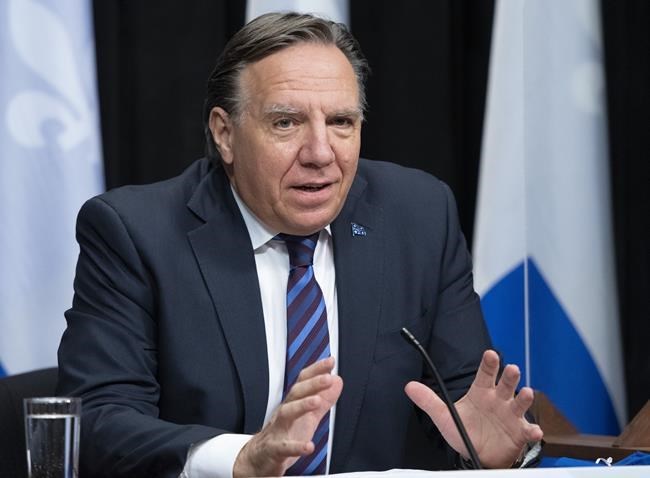
Quebec Premier Francois Legault speaks during a news conference on the COVID-19 pandemic, Thursday, November 12, 2020 at the legislature in Quebec City. THE CANADIAN PRESS/Jacques Boissinot

“At this point, we cannot rule anything out,” he said, regarding additional restrictions, “especially when we look at the situation in the United States and then in Europe.”

Health officials Thursday reported 583 COVID-related hospitalizations, a rise of 10 compared to the previous day. Of those, 86 were in intensive care, a rise of two.

Quebec has reported 119,894 COVID-19 infections and 6,557 deaths linked to the virus since the beginning of the pandemic. Officials reported Thursday that 843 more people had recovered from the disease, for a total of 101,407.

This report by The Canadian Press was first published Nov. 12, 2020.

Report Error Submit a Tip

More Stories

Letters, Oct. 16

6 minute read 2:00 AM CDT

Concern over closure

As advocates for seniors in Manitoba, CARP Manitoba (Canadian Association of Retired Persons) is deeply concerned about the closure of the Lions Club Charleswood Adult Day Club.

This closure will have a significant impact on seniors in the community who rely on the Adult Day Club for social connection, companionship, meaningful activities and stimulation. It will also place additional pressure on other Adult Day Clubs throughout the city, many of which are already experiencing increased demand and are now being required to establish waiting lists.

Families of affected seniors are understandably concerned that, without access to this important community-based support, their loved ones may eventually require admission to personal care homes. Adult Day Clubs play an important role in helping seniors remain independent, connected to their communities and living in their own homes for as long as possible.

Reversing Manitoba’s moose decline

Hank Hristienko 4 minute read Preview

Reversing Manitoba’s moose decline

Hank Hristienko 4 minute read 2:00 AM CDT

As Manitoba’s retired provincial moose manager, I have watched our moose population plummet from historic highs to a state of systemic vulnerability. Reversing this decline, which has seen numbers drop from 45,000 during the 1960s to fewer than 20,000 today, will require balancing the conservation needs of moose, Section 35 constitutional treaty rights, licensed hunter expectations and economic development.

To avert further attrition, all stakeholders, including Manitoba Natural Resources, must accept responsibility for their part in this decline, with industrial and recreational development acting as the primary drivers.

This long-overdue discussion must not devolve into a debate over competing hunting rights; instead, it must focus entirely on building long-term population resilience. Wildlife management must evolve alongside the changing landscapes and dynamics that development brings. We can no longer practise the same methods and hope for a better result. Immediate action is required.

As long as moose are legally managed as a “natural resource,” they will inevitably be viewed through the lens of a commodity rather than a vulnerable species in need of protection. For any population to remain stable or grow, total mortality cannot exceed recruitment — the survival of calves to breeding age. If mortality outpaces recruitment, decline is inevitable.

Read
2:00 AM CDT

MPI still lacking brain injury expert

Nicole Buffie 5 minute read Preview

MPI still lacking brain injury expert

Nicole Buffie 5 minute read Yesterday at 2:00 AM CDT

Manitoba Public Insurance has failed to hire an independent brain injury expert to probe how personal injury claims are handled, nearly two years after it was recommended.

Read
Yesterday at 2:00 AM CDT

Today’s horoscope

Georgia Nicols 4 minute read Preview

Today’s horoscope

Georgia Nicols 4 minute read 2:00 AM CDT

MOON ALERT: Avoid shopping (except for food and gas and important decisions until after 8:30 a.m. After that, the moon moves from Sagittarius into Capricorn.

ARIES (March 21-April 19)

You couldn’t pick a better day for sports training or improving a skill in the arts, music, welding, sculpting, pottery making or doing anything that requires repetition to improve. That’s because you have the patience and the perseverance to keep trying.

TAURUS (April 20-May 20)

Read
2:00 AM CDT

Chronic kidney disease must be recognized

Carrie Thibodeau 5 minute read 2:00 AM CDT

Canada needs a strong plan of action to tackle chronic kidney disease.

Canada is facing a looming health crisis that remains largely unaddressed and invisible at the policy and health system level. More than four million Canadians live with chronic kidney disease (CKD) and 50,000 currently receive dialysis or are living with a transplant, both life-sustaining but burdensome treatments.

With no cure, CKD profoundly impacts quality of life, contributing to lost income, overall poor health, and uncertainty about the future. The implications of CKD extend far beyond patients and families. CKD is now the 11th leading cause of death in Canada and one of our most expensive chronic diseases. Health-care costs exceed $11.7 billion annually, with most expenses incurred in the later stages of the disease, particularly dialysis and transplantation.

By 2050, the total cost burden of CKD is projected to rise to $17.6 billion and an estimated 6.2 million Canadians will be affected, driven by an aging population and rising rates of diabetes and high blood pressure.

Chief says minister offered money to remove highway checkstop

Kelly-Anne Riess 5 minute read Preview

Chief says minister offered money to remove highway checkstop

Kelly-Anne Riess 5 minute read Wednesday, Oct. 14, 2026

The chief of the Bloodvein River First Nation says a Manitoba cabinet minister offered up to $250,000 for economic development as he was trying to persuade her to remove a highway checkstop that has outraged hunters.

Read
Wednesday, Oct. 14, 2026