5,800 years of droppings: Unique approach yields first long-term seabird trend data

Advertisement

Advertise with us

Scientists have sifted through nearly 6,000 years of seabird droppings to get what they say could be the first long-term reading on how their numbers are affected by humans.

Read this article for free:


or

Already have an account? Log in here »

To continue reading, please subscribe:

Subscribe and receive a limited-edition Free Press branded hat or tote.

Digital Subscription

One year of digital access for only $205*

  • Enjoy unlimited reading on winnipegfreepress.com
  • Read the E-Edition, our digital replica newspaper
  • Access News Break, our award-winning app
  • Play interactive puzzles

*First annual payment billed as $205.00 + GST for one year. This annual subscription will automatically renew at $233.00 + GST every 52 weeks (10% off the regular annual price of $259.35). Offer available to new and qualified returning subscribers only. Cancel any time.

To continue reading, please subscribe:

Add Free Press access to your Brandon Sun subscription for only an additional

$1 for the first 4 weeks*

  • Enjoy unlimited reading on winnipegfreepress.com
  • Read the E-Edition, our digital replica newspaper
  • Access News Break, our award-winning app
  • Play interactive puzzles
Start now

*Your next Brandon Sun subscription payment will increase by $1.00 and you will be charged $17.95 plus GST for four weeks. After four weeks, your payment will increase to $24.95 plus GST every four weeks.

Hey there, time traveller!
This article was published 07/12/2020 (2078 days ago), so information in it may no longer be current.

Scientists have sifted through nearly 6,000 years of seabird droppings to get what they say could be the first long-term reading on how their numbers are affected by humans.

“It’s a stinky job, but someone has to do it,” said John Smol of Queen’s University, co-author of a paper published Monday in the journal Proceedings of the National Academy of Sciences.

Smol said the work sheds light on one of the biggest problems in environmental and conservation science: What happened in any particular region before humans showed up?
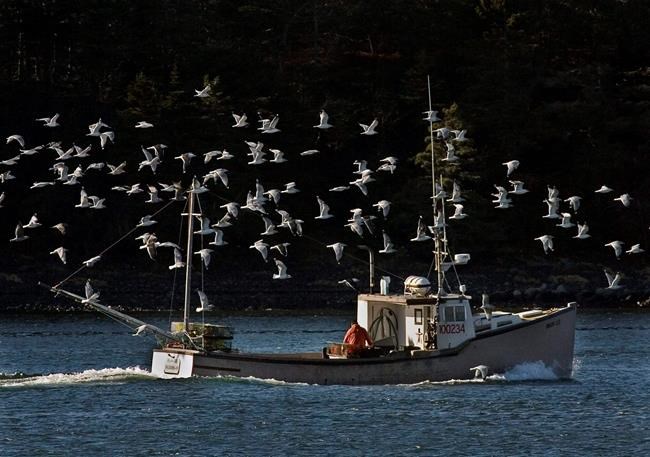
A lobster boat is escorted by a flock of sea gulls as it heads to port in Eastern Passage, N.S., on Monday, Dec. 29, 2008. A paper published today describes how scientists drilled down through 5,800 years of lake sediments — mostly the droppings of thousands of seabirds that have nested there for millennia — on an island off Canada's East Coast to estimate bird populations over the centuries. THE CANADIAN PRESS/Andrew Vaughan

“We call it shifting baselines,” he said. “What is natural? What is a healthy population?”

He and his colleagues decided to see what lake sediments on an uninhabited island near Newfoundland could reveal about its large colony of Leach’s storm petrel, the most common seabird in the northwest Atlantic.

“Lake sediments are like a history book” said Smol. “We’re retrieving these notebooks written in the mud.”

Extensive research on petrel guano revealed five different markers that could be used to estimate bird numbers. They included chemicals in the guano or evidence of algae blooms the droppings nourished. More of each marker meant more birds.

Meanwhile, the scientists used radioactive dating — the same kind used by archeologists — to establish a time sequence for the guano.

It turned out that a gucky, guano-rich, five-metre-long sediment core from the lake reached back 5,800 years into storm petrel history. Previous data only went as far back as the 1980s.

The sediment sequence showed petrelnumbers went up and down over the centuries, sometimes dramatically.

But a big drop occurred in the early 19th century — almost exactly coinciding with the recolonization and permanent establishment of the French colony in the nearby islands of St. Pierre and Miquelon.

The link between the two events isn’t clear. The birds — so oily that they were used occasionally as candles — were not commonly eaten.

“We can’t say it was completely human-induced, but the timing is very, very coincidental,” said Smol.

The end result is that the abundance of Leach’s storm petrel today is only about 16 per cent of what it was before European settlement.

“Here is a way to reconstruct populations on time frames that are ecologically and environmentally relevant,” Smol said. “It also shows that before humans were a significant factor, there were changes.”

The study shows that the human footprint goes backfurther than most people think.It also shows that the definition of “healthy populations” can depend on the time scale used to measure them.

The study raises questions about what conservation targets should be, especially as habitats around the world shrink for thousands of different species.

Even at 16 per cent of the historical average, there are still about 200,000 breeding pairs of Leach’s storm petrel on the island under study.

“It depends what you mean by healthy and stable,” said Smol. “What is ‘healthy’? What is ‘natural’?

“It depends on the moving baselines.”

This report by The Canadian Press was first published Dec. 7, 2020.

— Follow @row1960 on Twitter

Report Error Submit a Tip

More Stories

Firefighter’s death fuels cancer fight

Zoe Pierce 5 minute read Preview

Firefighter’s death fuels cancer fight

Zoe Pierce 5 minute read Yesterday at 2:01 AM CDT

The United Fire Fighters of Winnipeg is mourning the loss of Winnipeg firefighter Darrel Maynard while continuing its work to raise awareness of occupational cancer and improve health protections for firefighters.

Maynard, a senior firefighter II and acting lieutenant with the Winnipeg Fire Paramedic Service, died Aug. 5 at age 41 after a three-year battle with occupational cancer.

He served Winnipeg for nearly two decades and leaves behind his wife Francine and sons Colin and Christian.

“Darrel was an incredible, incredible person, an incredible firefighter, and really, really special to all of us,” said Nick Kasper, president of UFFW.

Read
Yesterday at 2:01 AM CDT

HSC weapons scanners effective, needed at other hospitals: nurses union

Carol Sanders 5 minute read Preview

HSC weapons scanners effective, needed at other hospitals: nurses union

Carol Sanders 5 minute read Yesterday at 9:57 AM CDT

The AI weapons scanners at Health Sciences Centre have detected close to 2,000 items since they were installed at Manitoba’s largest hospital.

From March 6, 2025 to the beginning of this month, a total of 1,973 items had been flagged by the scanners and identified for further review, Shared Health said this week.

Knives, Swiss army knives and other multi-tools, drugs, alcohol, box cutters, syringes and other injection devices were detected, it said. The technology set up at entrances to the adult and children’s emergency rooms and the crisis response centre is designed to identify a wide range of objects that may require review under site safety protocols.

But Manitoba Nurses Union president Darlene Jackson said the technology isn’t available everywhere at HSC, and a sawed-off rifle was discovered in the adult ER earlier this month.

Read
Yesterday at 9:57 AM CDT

Big Loser’s latest a winning mix of country, folk

Ben Waldman 5 minute read Preview

Big Loser’s latest a winning mix of country, folk

Ben Waldman 5 minute read Yesterday at 6:00 AM CDT

The yellow trucker hat for sale on Facebook Marketplace said “Selkirk Lumber,” so Adam Wayne Brown knew he had to hammer home a deal.

Like the other millennial members of Winnipeg folk-country band Big Loser, the bassist has an affinity for the nostalgic, taking every opportunity — through music, through lyrics and through wardrobe — to recall the unique circumstances of growing up in a changing Interlake.

“I remember the matte yellow trucks driving around — the lumber trucks — and so I’ve had this strange memory of something disappearing from my youth and then persisting,” says Brown, who, like the band’s frontman Alex Paradoski, moved to Winnipeg more than a decade ago.

“I have a photo of the Lockport Bridge in my dining room,” chimes in Paradoski, whose first job as a teenager was bunning wieners and chopping fries at Skinner’s, a drive-in mainstay since 1929 along Highway 44.

Read
Yesterday at 6:00 AM CDT

Puzzles Palace

1 minute read Monday, Jul. 27, 2026

To solve our puzzles, please subscribe with this special offer: |

Bombers manage to hand Redblacks another loss

Taylor Allen 7 minute read Preview

Bombers manage to hand Redblacks another loss

Taylor Allen 7 minute read Updated: Yesterday at 8:35 AM CDT

It looked bad. Real bad.

Winnipeg Blue Bombers quarterback Zach Collaros made his return to the lineup on Friday night against the Ottawa Redblacks, and he was once again the victim of a blindside hit.

The one he suffered in Hamilton on July 5 appeared relatively modest in comparison and yet, it sidelined him for a month with a neck injury.

So when Redblacks linebacker Lucas Cormier came around the edge unblocked and hammered Collaros from behind in the second quarter, you could hear a pin drop inside Princess Auto Stadium.

Read
Updated: Yesterday at 8:35 AM CDT

Oliveira shines in win over Redblacks, Collaros rocked again

Taylor Allen 5 minute read Preview

Oliveira shines in win over Redblacks, Collaros rocked again

Taylor Allen 5 minute read Yesterday at 8:57 PM CDT

It wasn’t a stellar performance by any stretch.

But at this point, the Winnipeg Blue Bombers will take a win no matter what it looks like.

The Blue and Gold outlasted the winless Ottawa Redblacks 33-21 on a rainy Friday night at Princess Auto Stadium to improve to 5-4.

“It’s great to finally get a win at home for our fans and to go out and play a better game is very encouraging,” said right guard Patrick Neufeld.

Read
Yesterday at 8:57 PM CDT