

‘Kind of like getting little hugs’
Dedicated retiree has been volunteering as a contact tracer for the province twice a week since April

Advertisement
Read this article for free:
or
Already have an account? Log in here »
To continue reading, please subscribe:
Monthly Digital Subscription
$1 per week for 24 weeks*
- Enjoy unlimited reading on winnipegfreepress.com
- Read the E-Edition, our digital replica newspaper
- Access News Break, our award-winning app
- Play interactive puzzles
*Billed as $4.00 plus GST every four weeks. After 24 weeks, price increases to the regular rate of $19.95 plus GST every four weeks. Offer available to new and qualified returning subscribers only. Cancel any time.
Monthly Digital Subscription
$4.99/week*
- Enjoy unlimited reading on winnipegfreepress.com
- Read the E-Edition, our digital replica newspaper
- Access News Break, our award-winning app
- Play interactive puzzles
*Billed as $19.95 plus GST every four weeks. Cancel any time.
To continue reading, please subscribe:
Add Free Press access to your Brandon Sun subscription for only an additional
$1 for the first 4 weeks*
*Your next subscription payment will increase by $1.00 and you will be charged $16.99 plus GST for four weeks. After four weeks, your payment will increase to $23.99 plus GST every four weeks.
Read unlimited articles for free today:
or
Already have an account? Log in here »
Hey there, time traveller!
This article was published 09/12/2020 (1926 days ago), so information in it may no longer be current.
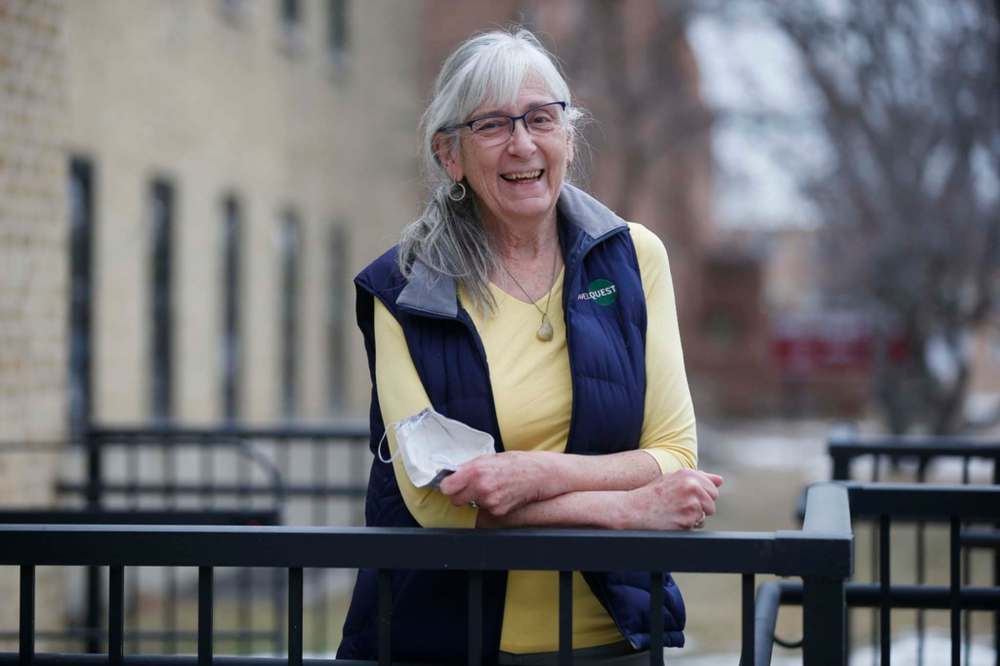
With every phone call she makes, Judith Anderson opens a window a little further on how the pandemic is hitting ordinary Manitobans.
Anderson, a retired professor in the University of Manitoba’s department of biological sciences has, for months, been working the phones at the province’s COVID-19 call centre.
She is one of 48 volunteers making calls to check on people who are battling COVID-19 at home and to others who have been in contact with people who have tested positive for the virus.
There are 17 nurses available to take over if the volunteer believes a health practitioner should step in to decide whether the person is now sick enough to go to the hospital or has specific health questions.
The group collectively makes upwards of 800 calls each day at the centre, which is open seven days a week.
Anderson has worked full-day shifts on Tuesdays and Thursdays since April. She takes a disinfectant wipe to the computer and phone in her cubicle before embarking on the day’s first contact-tracing call.
She talks to people who cough during the conversation. Some who sound like they are having difficulty breathing. Some who sound scared. Others who have to sit down to take a rest before continuing. Some who need reassuring. Some whose call from Anderson will be the only human contact they’ll have all day. Some who end up going from being in isolation as a close contact to being diagnosed with the disease.
And some who, after she forwards the call to a nurse and hangs up, head to the hospital shortly after.
“It is not the work of the phoning and record-keeping on the health status of these contacts that has captured my heart,” Anderson said.
“What has inspired me to continue this volunteering is the little door into understanding the impact of this pandemic… I do this volunteering because a society that engages with public health is the type of society that I want to live in.
“The nurses and call centre manager, and even the WRHA co-ordinator of volunteers, are all so professional and caring and patient, and I like to help them feel we care about what they are doing, or always doing, even without a pandemic.”
Anderson said she and the other volunteers are assigned people to call at random; they don’t, as a matter of course, check on people they’ve spoken with previously.
There is a digital form to check off with answers they receive to questions, including how are you doing; what is your temperature; do you have any of the following symptoms — sore throat, fever or chills, vomiting or diarrhea, loss of taste or smell?
“We’re picking up tiny little fragments to figure out what is going on,” she said. “You can tell when people aren’t well. You hear a cough. Or they sound groggy.
“But you also hear people say ‘I am fantastic, I just washed my floors.’ Ninety-nine per cent of the time they appreciate it. Many know they are sick and want to know what they can do about it.”
Anderson has talked to people who are trying to stay isolated from the rest of their family in a house or apartment. Another who asked how they are going to pay the rent or buy food when they can’t work or go shopping. The mother of a baby who has tested positive. Another mother who is COVID-positive who still gets up, makes meals, wipes down the counters and calls her family before going back to the bedroom and closing the door.
“I’ve talked to a grandchild and told them to ask their grandmother if they have diarrhea,” she says. “That’s probably the first time they’ve asked their grandmother that.”
Anderson won’t forget the saddest call she made.
“When I phoned, a parent had just died; it had just happened,” she said. “You knew that person was isolated and couldn’t get a hug. It was terrible.
“And I was calling because they had a contact and that contact had now died.”
At the other end of the emotional scale, the happiest call she made — and one where both she and the person on the other end of the line were laughing aloud — was with one couple who had to isolate from each other.

“They could only talk by telephone,” she said. “The one was in an area where there was some work needed to be done but (they) would never have offered to do before.
“She said she knows he is well because he is offering to do things. We just laughed.”
Anderson said that with the pandemic still raging in Manitoba she’ll continue helping out for as long as she is needed.
“This is kind of like getting little hugs for me,” she said. “You’re helping the public and, in the end, the public is us.”
kevin.rollason@freepress.mb.ca
Kevin Rollason is a general assignment reporter at the Free Press. He graduated from Western University with a Masters of Journalism in 1985 and worked at the Winnipeg Sun until 1988, when he joined the Free Press. He has served as the Free Press’s city hall and law courts reporter and has won several awards, including a National Newspaper Award. Read more about Kevin.
Every piece of reporting Kevin produces is reviewed by an editing team before it is posted online or published in print — part of the Free Press‘s tradition, since 1872, of producing reliable independent journalism. Read more about Free Press’s history and mandate, and learn how our newsroom operates.
Our newsroom depends on a growing audience of readers to power our journalism. If you are not a paid reader, please consider becoming a subscriber.
Our newsroom depends on its audience of readers to power our journalism. Thank you for your support.
Kevin Rollason is a general assignment reporter at the Free Press. He graduated from Western University with a Masters of Journalism in 1985 and worked at the Winnipeg Sun until 1988, when he joined the Free Press. He has served as the Free Press’s city hall and law courts reporter and has won several awards, including a National Newspaper Award. Read more about Kevin.
Every piece of reporting Kevin produces is reviewed by an editing team before it is posted online or published in print — part of the Free Press‘s tradition, since 1872, of producing reliable independent journalism. Read more about Free Press’s history and mandate, and learn how our newsroom operates.
Our newsroom depends on a growing audience of readers to power our journalism. If you are not a paid reader, please consider becoming a subscriber.
Our newsroom depends on its audience of readers to power our journalism. Thank you for your support.
Advertisement Advertise With Us
Advertisement Advertise With Us