Researchers flag increase in COVID-19 cases in Canadian prisons, jails

Advertisement

Advertise with us

OTTAWA - Rights advocates and researchers are sounding an alarm about COVID-19 cases in Canadian prisons and jails, saying the numbers in recent weeks have surpassed the total during the first nine months of the pandemic.

Read this article for free:


or

Already have an account? Log in here »

To continue reading, please subscribe:

Subscribe and receive a limited-edition Free Press branded hat or tote.

Digital Subscription

One year of digital access for only $205*

  • Enjoy unlimited reading on winnipegfreepress.com
  • Read the E-Edition, our digital replica newspaper
  • Access News Break, our award-winning app
  • Play interactive puzzles

*First annual payment billed as $205.00 + GST for one year. This annual subscription will automatically renew at $233.00 + GST every 52 weeks (10% off the regular annual price of $259.35). Offer available to new and qualified returning subscribers only. Cancel any time.

To continue reading, please subscribe:

Add Free Press access to your Brandon Sun subscription for only an additional

$1 for the first 4 weeks*

  • Enjoy unlimited reading on winnipegfreepress.com
  • Read the E-Edition, our digital replica newspaper
  • Access News Break, our award-winning app
  • Play interactive puzzles
Start now

*Your next Brandon Sun subscription payment will increase by $1.00 and you will be charged $17.95 plus GST for four weeks. After four weeks, your payment will increase to $24.95 plus GST every four weeks.

Hey there, time traveller!
This article was published 11/01/2021 (2101 days ago), so information in it may no longer be current.

OTTAWA – Rights advocates and researchers are sounding an alarm about COVID-19 cases in Canadian prisons and jails, saying the numbers in recent weeks have surpassed the total during the first nine months of the pandemic.

The researchers say that from March to the end of November, there were 1,864 reported novel coronavirus cases among prisoners and jail staff in Canada, more than half of which were in October and November.

Since Dec. 1, there have been over 1,962 cases.
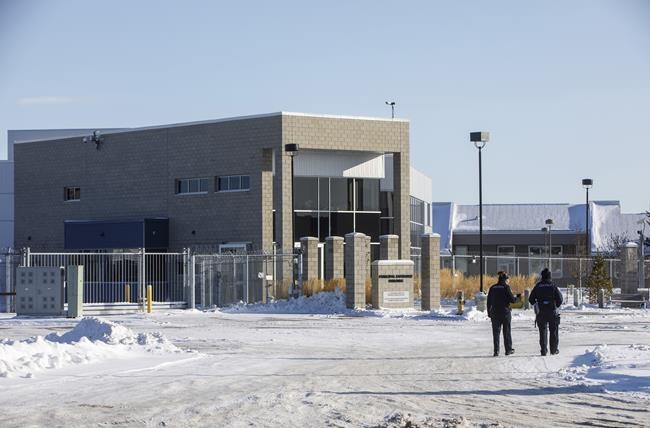
The Edmonton Institution for Women in Edmonton is shown on November 11, 2020. THE CANADIAN PRESS/Jason Franson

Prisoners have accounted for about 80 per cent of reported COVID-19 cases linked to prisons and jails during the pandemic, according to the data.

The findings emerged Monday through the Prison Pandemic Partnership, which brings together academics who study corrections and the Canadian Civil Liberties Association.They are calling on provincial, territorial and federal governments to take bolder steps to protect people in correctional institutions.

Abby Deshman, director of the criminal justice program at the civil liberties association, cites concerns that some inmates do not have adequate access to masks or cleaning and hygiene supplies.

“The people confined in our prisons and jails are at high risk both of contracting COVID-19, and of serious illness and death as a result,” Deshman said in a statement accompanying the latest figures.

“We need to make safe and effective community supervision — which would allow people to effectively physically distance — the number 1 priority. For those who continue to be supervised in jails, effective and humane public health measures need to be implemented.”

When the pandemic began, the number of people in custody in most provinces and territories started declining, said Justin Piché, an associate professor of criminology at the University of Ottawa and member of the partnership team.

Since then, many governments have “taken their foot off the gas as the number of COVID-19 cases accelerated past them,” Piché said.

“Now is the time to do more to contain COVID, not people”.

The initial findings of the partnership “likely represent the tip of the iceberg” due to inconsistent availability of relevant figures, said Kevin Walby, an associate professor of criminal justice at the University of Winnipeg and the team’s principal investigator.“In order to put in place measures to prevent and limit the impact of COVID-19 in prisons, clear and full data is needed.”

According to the latest Correctional Service of Canada figures, 1,211 federal inmates have tested positive for COVID-19, but of these only 73 cases were still active.

Four federal inmates with a COVID-19 diagnosis have died since the beginning of the pandemic.

Since the spread of COVID-19, the federal Parole Board has streamlined a number of its policies, noted Mary-Liz Power, a spokeswoman for Public Safety Minister Bill Blair.

Since March 1, the number of men in federal custody has declined by 1,402, or over 10 per cent, and women by 51, or over seven percent, she said.

“This downward trend in the overall federal inmate population is expected to continue over the coming months.”

The government has also provided $500,000 to five voluntary organizations to develop pilot projects to help reintegrate offenders under supervision at community-based residential facilities, she said.

In addition, the Correctional Service has put in place extensive infection prevention and control measures at institutions across the country, Power said.

This report by The Canadian Press was first published Jan. 11, 2021.

Report Error Submit a Tip

More Stories

Manitoba e-scooter legislation changes set to impose speed limit, age restrictions, sidewalk ban

Matthew Frank 5 minute read Preview

Manitoba e-scooter legislation changes set to impose speed limit, age restrictions, sidewalk ban

Matthew Frank 5 minute read Sunday, Oct. 11, 2026

People riding e-scooters and other personal electric vehicles in Manitoba will have to strap on a helmet, stay off sidewalks and follow new age limits once new provincial rules for the devices take effect next year.

The vehicles, which also include electric skateboards, hoverboards and unicycles, will fall under The Highway Traffic Act starting in 2027, according to the province’s website. E-bikes are excluded from the new rules, according to the province’s frequently-asked-questions page.

All riders must be at least 16 years old and wear properly fitting helmets — that goes for passengers, too, the province said.

The proposed new legislation sets a speed limit of 25 km/h and would prohibit personal electric vehicles from sidewalks unless signs specifically allow sidewalk use. Riders would be using shared paths or roads with speed limits of 50 km/hr or less. They won’t be allowed to operate the vehicles under the influence of alcohol or drugs and they must use hand signals and obey traffic signs.

Read
Sunday, Oct. 11, 2026

What's open, what's closed, what's up on Thanksgiving

Free Press staff 3 minute read Preview

What's open, what's closed, what's up on Thanksgiving

Free Press staff 3 minute read Friday, Oct. 9, 2026

Here's a round-up of things to do and hours of business for services on Thanksgiving Day 2026.

Read
Friday, Oct. 9, 2026

Today’s horoscope

Georgia Nicols 4 minute read Preview

Today’s horoscope

Georgia Nicols 4 minute read 2:00 AM CDT

MOON ALERT: Caution. Avoid shopping (except food and gas) and important decisions from 3:15 a.m. until 8:15 p.m. After that, the moon moves from Scorpio into Sagittarius.

ARIES (March 21-April 19)

It’s tricky because the moon is in your financial house, which might encourage you to negotiate financial matters and discuss shared property, banking details, insurance issues and inheritances. However, there’s a moon alert. Postpone these discussions.

TAURUS (April 20-May 20)

Read
2:00 AM CDT

Former Oilers teammates square off for first time

Ken Wiebe 7 minute read Preview

Former Oilers teammates square off for first time

Ken Wiebe 7 minute read Yesterday at 4:41 PM CDT

Calvin Pickard has been many things to Stuart Skinner.

An ally, sounding board, confidante and most importantly, a close friend.

They were a goalie tandem for parts of three seasons with the Edmonton Oilers, making two trips to the Stanley Cup final, combining for 29 playoff wins, but falling just short of achieving the ultimate goal on both of those occasions.

They were opponents just once last season when the Oilers and Pittsburgh Penguins met for the first time since the trade that shipped Skinner to Pennsylvania, but it was Tristan Jarry – the guy he was traded for – standing at the opposite side of the rink.

Read
Yesterday at 4:41 PM CDT

RJ Mitte, ‘Breaking Bad’ actor and disability rights champion, dies at 34

Andrew Dalton, The Associated Press 3 minute read Preview

RJ Mitte, ‘Breaking Bad’ actor and disability rights champion, dies at 34

Andrew Dalton, The Associated Press 3 minute read Updated: Yesterday at 10:23 PM CDT

LOS ANGELES (AP) — Actor and disability rights advocate RJ Mitte, who brought a lifetime of experience with cerebral palsy to fictional family struggles in an essential role on “Breaking Bad,” died Monday at age 34, authorities and his representatives said.

Cameron County Justice of the Peace Cyndi Hinojosa told The Associated Press she declared Mitte dead at about 1:30 p.m. at what she believed was his home in Brownsville, Texas. She said she was unable to provide a cause, but an autopsy will be performed.

Mitte played Walter White Jr., the son of Bryan Cranston's chemistry teacher-turned-meth dealer Walter White on nearly every episode of the five seasons of the AMC show, which recently ranked as the best of the 21st century in a New York Times poll.

Cranston said he is in “deep despair” for the loss of his “sweet son.”

Read
Updated: Yesterday at 10:23 PM CDT

Comparing the Iran and Vietnam Wars

Peter McKenna 5 minute read Preview

Comparing the Iran and Vietnam Wars

Peter McKenna 5 minute read 2:00 AM CDT

The other day I asked my students in U.S. foreign policy to think about the relevance of the Vietnam War in relation to the ongoing war in Iran. More specifically, I wanted them to identify the similarities and differences between the two wars.

What is immediately striking is how domestic politics played such a seminal role in both conflicts. While American public opinion was generally in favour of U.S. military involvement in Vietnam in the early years, things started to turn very sour after U.S. soldiers started arriving stateside in flag-draped coffins and body bags. As for Iran, just about every single poll and TV newscast since the first few weeks of the war have illustrated an overwhelming public repudiation of President Trump’s military adventurism.

The electoral implications were also quite apparent for the two wars. The U.S.-Iran War is clearly having a positive effect on the Democratic Party’s electability, as it looks set to capture both the House of Representatives and the Senate in the Nov. 3 midterm elections. Democratic President Lyndon Johnson, reading the political tea leaves from the Vietnam fallout, opted not to contest the 1968 U.S. presidential election.

Equally interesting, the U.S. press had a crucial, and mostly negative, impact on both the Vietnam and Iran conflicts. Who could forget Gen. William Westmoreland — the commander of U.S. forces in Vietnam (1964-1968) — maintaining that it was the media’s fault the U.S. lost the war in Vietnam. While I take issue with his thesis, I do believe the news coverage and visuals of the first televised war served to raise serious concerns about why the U.S. was at war in Southeast Asia.

Read
2:00 AM CDT