Quebec river granted legal rights as part of global ‘personhood’ movement

Advertisement

Advertise with us

MONTREAL - With its kilometres of rapids and deep blue waters winding through Quebec's Cote-Nord region, the Magpie river has long been a culturally significant spot for the Innu of Ekuanitshit.

Read this article for free:


or

Already have an account? Log in here »

To continue reading, please subscribe:

Subscribe and receive a limited-edition Free Press branded hat or tote.

Digital Subscription

One year of digital access for only $205*

  • Enjoy unlimited reading on winnipegfreepress.com
  • Read the E-Edition, our digital replica newspaper
  • Access News Break, our award-winning app
  • Play interactive puzzles

*First annual payment billed as $205.00 + GST for one year. This annual subscription will automatically renew at $233.00 + GST every 52 weeks (10% off the regular annual price of $259.35). Offer available to new and qualified returning subscribers only. Cancel any time.

To continue reading, please subscribe:

Add Free Press access to your Brandon Sun subscription for only an additional

$1 for the first 4 weeks*

  • Enjoy unlimited reading on winnipegfreepress.com
  • Read the E-Edition, our digital replica newspaper
  • Access News Break, our award-winning app
  • Play interactive puzzles
Start now

*Your next Brandon Sun subscription payment will increase by $1.00 and you will be charged $17.95 plus GST for four weeks. After four weeks, your payment will increase to $24.95 plus GST every four weeks.

Hey there, time traveller!
This article was published 27/02/2021 (2004 days ago), so information in it may no longer be current.

MONTREAL – With its kilometres of rapids and deep blue waters winding through Quebec’s Cote-Nord region, the Magpie river has long been a culturally significant spot for the Innu of Ekuanitshit.

Now the river, a majestic, world-renowned whitewater rafting destination, has been granted legal personhood status in a bid to protect it from future threats, such as hydro development. Its new status means the body of water could theoretically sue the government.

On Feb. 16, the regional municipality of Minganie and the Innu Council of Ekuanitshit adopted separate but similar resolutions granting the river nine legal rights, including the right to flow, to maintain its biodiversity and the right to take legal action.
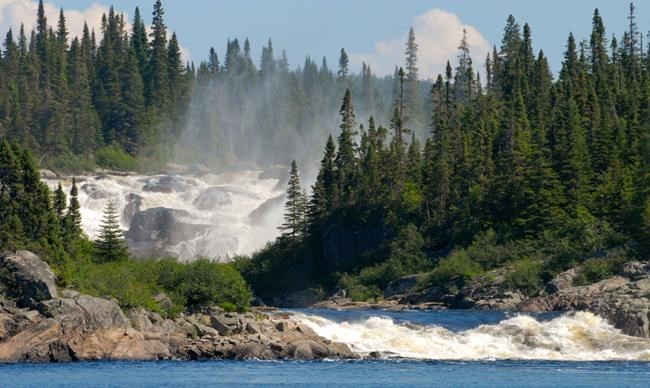
The Magpie river in Quebec is shown in a handout photo. THE CANADIAN PRESS/HO-Boreal River MANDATORY CREDIT

One of the resolutions says the river can be represented by “guardians” appointed by the regional municipality and the Innu, with “the duty to act on behalf of the rights and interests of the river and ensure the protection of its fundamental rights.” It notes the river’s biodiversity, importance to the Innu and potential as a tourism destination as reasons why the body of water needs special protection.

Pier-Olivier Boudreault, with the Quebec branch of the environmental charity Canadian Parks and Wilderness Society, says the move is rooted in the belief that the river is a living entity that deserves rights. “The idea is that the river is living, that it has an existence that doesn’t depend on humans,” he said in a recent interview.

“It’s not a simple resource for humans; it becomes an entity that has a right to live, to evolve naturally, to have its natural cycles.”

Boudreault says the new designation for the Magpie is the first time a river has been granted legal status in Canada. Similar efforts have been successful in countries like New Zealand, India and Ecuador.

David Boyd, an environmental lawyer and United Nations special rapporteur on human rights and the environment, says the idea of granting rights to a river isn’t as far-fetched as it seems. “In our legal system, we declare lots of things to have legal personhood, like municipalities and corporations,” he said.

He said the “environmental personhood” movement is a response to the belief that successive governments around the world have failed to adequately protect the environment, as well as to the growing recognition of Indigenous Peoples’ rights and their legal concepts.

While this is new in Canada, he said the resolution “could have quite a bit of strength” because of the constitutional protection of Indigenous rights. “In theory, you could have a lawsuit brought on behalf of the river to prevent a hydroelectric project from taking place,” he said.

Uapukun Mestokosho, a member of the Innu community who has been involved in the Magpie river conservation effort, said the river is an important part of the traditional territory of the Innu of Ekuanitshit.

For some, spending time on the river is a way to reconnect to traditional land-based practices that were partially abandoned because of the trauma suffered by Indigenous people from colonial violence, including the residential school system.

“People are suffering a lot, with intergenerational traumas linked to the past,” said Mestokosho, who described occupying the territory as “a form of healing.” Mestokosho said her ancestors have always protected the Magpie, known as the Muteshekau-shipu, and that the recognition of the river’s rights will allow them to protect it for future generations.

She and Boudreault agree the biggest threat to the Magpie is likely to come from the province’s hydro utility, which has raised the possibility of damming the fast-flowing river.

Hydro-Quebec insists it has no plans for the Magpie in the “short or even medium term” and that no plans are “even foreseeable” in the next decade. “But in the long term, we do not know what Quebec’s future energy needs will be,” spokesman Francis Labbe wrote in an email.

“Right now, we do not consider it responsible, in terms of Quebec’s energy security, to permanently renounce to the potential of this river.” Any future project would have to meet several criteria, including social acceptability, he noted.

Boudreault says the Innu, members of the regional government and other environmental activists haven’t given up on lobbying the Quebec government to grant the river official protected status. He said he thinks the province has been reluctant to commit to the idea, mostly because of the river’s potential for hydroelectric power.

This report by The Canadian Press was first published Feb. 27, 2021.
Report Error Submit a Tip

More Stories

Results Canada fights for the political will to end global poverty

AV Kitching 9 minute read Preview

Results Canada fights for the political will to end global poverty

AV Kitching 9 minute read 6:00 AM CDT

Sitting at home on a wintry day in March last year, Japneet Singh listened intently as members of grassroots advocacy organization Results Canada began their online presentation on the prevalence of tuberculosis in rural India.

Singh knew all about the reality of the disease. Before he moved to Canada in 2013 he had seen family members affected by the bacterial infection which, in its active form, can damage the lungs, spine, brain and kidneys.

Despite being preventable and curable, TB persists among marginalized groups and is closely linked with those experiencing extreme poverty.

The highly infectious disease spreads quickly through transient populations facing housing insecurity and those living in overcrowded homes.

Read
6:00 AM CDT

The trolls inside the Conservative tent

David McLaughlin 5 minute read Preview

The trolls inside the Conservative tent

David McLaughlin 5 minute read Saturday, Aug. 22, 2026

The Conservative Party of Canada has a troll problem. And it’s coming from inside the tent.

Once, trolls existed only in imagination. They were figures of mythical proportion, big and small. They lived solitary lives under bridges, in caves, or forests. They were considered dim-witted and mean. Best avoided.

Today, they are real, unavoidable, and ubiquitous on social media. They are anything but solitary. There are tribes of them out there and tribal is how they think and post. As for dim-witted and mean, others can opine but they are uniformly mean and dismissive.

Mean to anyone who disagrees with their views. Dismissive of any view but their own. They distribute questionable, at best, facts and opinions grounded in hostility towards anything or anyone deemed disagreeable or heretical to their world view.

Read
Saturday, Aug. 22, 2026

Conservatives call on government to release U.S. trade offer details

Nick Murray, The Canadian Press 4 minute read Preview

Conservatives call on government to release U.S. trade offer details

Nick Murray, The Canadian Press 4 minute read Updated: Yesterday at 3:17 PM CDT

OTTAWA - Federal conservatives are calling on the government to release the full details of the trade offer from the United States that Canada rejected this week.

In a letter to Trade Minister Dominic LeBlanc, Canada-U.S. relations critic Shuvaloy Majumdar said while his party supports the government's decision to reject the deal, Parliament is in the dark on what was on the table.

"If there was a draft text of any agreement that both governments have seen, please release it. The U.S. administration has seen it. Your government has seen it. Canadians deserve to see it," Majumdar wrote.

"Even after addressing Canadians and the media, the public and Members of Parliament still remain in the dark on your government's demands in negotiations with the Trump administration.

Read
Updated: Yesterday at 3:17 PM CDT

Kinew says Manitoba stands with PM in trade war with U.S.

By Melissa Martin 6 minute read Preview

Kinew says Manitoba stands with PM in trade war with U.S.

By Melissa Martin 6 minute read Saturday, Aug. 22, 2026

The Manitoba government and business leaders are rallying behind Prime Minister Mark Carney’s plan to fight back, after a sudden collapse of trade talks between the U.S. and Canada sparked a new salvo of U.S. tariffs on some Canadian goods.

On Saturday, after Carney vowed to respond with retaliatory tariffs, Manitoba Premier Wab Kinew said his government stood “100 per cent” behind the prime minister’s plan to respond to what Kinew called U.S. President Donald Trump’s “unjustified and immoral” tariffs.

“History will not be kind to Donald Trump, so we should never appease him,” Kinew said. “We should fight back, which is what Canada is doing today.”

Kinew met reporters for a brief news conference at the legislature on Saturday afternoon, about an hour after finishing a call with Carney and the other premiers. There was a “really strong sense of unity” on that call, Kinew said, and emphasized that he backs the federal decision to “walk away from what would have been a bad deal.”

Read
Saturday, Aug. 22, 2026

Cool spots for more summer sweets

AV Kitching 3 minute read Preview

Cool spots for more summer sweets

AV Kitching 3 minute read 6:00 AM CDT

You scream, I scream, we all scream for ice cream. Missed seeing your favourite ice cream joint in last month’s Chill Out feature? Cheer up: we’ve compiled our reader suggestions below.

Despite the cooler weather and slight drizzle, it’s still summer and there’s time to to grab a scoop or two of your favourite flavours. So what are you waiting for?

Living up to its name Not a Waffle (2-709 Corydon Avenue) serves ice creams not in traditional waffle cones but heaped into Japanese taiyaki, a fish-shaped sturdy cake. Ice cream flavours on offer include the ever-popular ube, sakura and matcha in soft serve and for hard scoops there are vanilla, chocolate brownie, cookie dough and something called heavenly heart, which is a chocolate and almond combo. The soft serves are on until October this year so there’s still time if you’d like to give this a try.

Our readers simply adore Dug & Betty’s (309 Rue Des Meurons) for their ice cream fix. Made in small batches, popular flavours include sour cherry and chocolate, strawberry balsamic honey and black pepper and lemon meringue pie. There are seven dairy-free options, including soy chocolate caramel cookie dough and oatmeal apple caramel crunch.

Read
6:00 AM CDT

Downtown Rudy’s restaurant announces closure

1 minute read Yesterday at 1:55 PM CDT

A downtown eatery has announced its closure.

Rudy's Eat and Drink, located on the main floor of the Manitoba Hydro building at 375 Graham Ave., posted on social media that the restaurant would be closing after "one last hurrah" on Friday, Aug. 21.

"With heavy hearts it is time to announce that Rudy’s will officially be closing its doors after an incredible 15 years," the post reads.

The post gave no reason for the closure. Rudy's and other restaurants in the building expressed concerns after an assault and resulting lockdown at Hydro Place in late January.