‘We are making personal history’: How the COVID-19 crisis will be remembered

Advertisement

Advertise with us

From packing up their desks alongside laid-off co-workers to getting word that a surgery would be delayed, many Canadians can pinpoint the moment last year when they realized everything was about to change.

Read this article for free:


or

Already have an account? Log in here »

To continue reading, please subscribe:

Subscribe and receive a limited-edition Free Press branded hat or tote.

Digital Subscription

One year of digital access for only $205*

  • Enjoy unlimited reading on winnipegfreepress.com
  • Read the E-Edition, our digital replica newspaper
  • Access News Break, our award-winning app
  • Play interactive puzzles

*First annual payment billed as $205.00 + GST for one year. This annual subscription will automatically renew at $233.00 + GST every 52 weeks (10% off the regular annual price of $259.35). Offer available to new and qualified returning subscribers only. Cancel any time.

To continue reading, please subscribe:

Add Free Press access to your Brandon Sun subscription for only an additional

$1 for the first 4 weeks*

  • Enjoy unlimited reading on winnipegfreepress.com
  • Read the E-Edition, our digital replica newspaper
  • Access News Break, our award-winning app
  • Play interactive puzzles
Start now

*Your next Brandon Sun subscription payment will increase by $1.00 and you will be charged $17.95 plus GST for four weeks. After four weeks, your payment will increase to $24.95 plus GST every four weeks.

Hey there, time traveller!
This article was published 11/03/2021 (1991 days ago), so information in it may no longer be current.

From packing up their desks alongside laid-off co-workers to getting word that a surgery would be delayed, many Canadians can pinpoint the moment last year when they realized everything was about to change.

For a newcomer to Canada, it was the empty shelves at the grocery store that reminded her of the shortages in her home country.

For a Calgary retiree, it was the despair of knowing that even a mother’s love couldn’t mend the dismantling of a routine her daughter with autism depends on.

Travellers wearing safety goggles, protective face masks and rain ponchos are seen heading to the international departure gates at Vancouver International Airport in Richmond, B.C. on March 18, 2020. THE CANADIAN PRESS/Jonathan Hayward

For a Canadian visiting New York City, it was watching one of the world’s largest metropolises scramble under a state of emergency.

In our collective consciousness, the crisis didn’t begin when the World Health Organization’s officially declared COVID-19 a global pandemic on March 11, 2020.

One year later, memory experts say the onset of the pandemic is marked in each of our mindsby personal revelations that ruptured our sense of time into “before” and “after,” shaping the way we remember life as it was and as it is now.

“We are making personal history,” said Peter Graf, a psychology professor and cognitive scientist at University of British Columbia.

“The storytelling part is also important, especially as we’re living through it.”

Psychologists say certain globe-shaking events, such as the 9/11 terrorist attacks or the assassination of John F. Kennedy, can conjure “flashbulb memories” in many people’s minds, allowing them to recount the circumstances of how they received the news in photograph-like detail.

Some studies suggest these recollections are often as emotionally salient as they are inaccurate.

The COVID-19 crisis doesn’t fit into this framework, however, Graf said, because it didn’t come as a sudden catastrophe.

A steady trickle of headlines trackedthe spread of the virus across the globe in the early weeks of 2020, he said.

Then, at some point, the crisis collided with our individual lives with a magnitude that forced us to grapple with the once-unthinkable changes that were headed our way, said Graf.

The memory tends to latch onto new experiences, he said, so people have potent recollections of when they recognized we were on the precipice of a seismic societal shift.

“We always remember the beginning of big things in our lives,” said Graf. “It was a huge event for every person, however they experienced it.”

Graf thinks we may be seeing early signs of what memory scientists call a “reminiscence bump.”

The concept typically refers to the tendency for older adults to have heightened recall of events that occurred during their adolescence and young adulthood.

Graf said the “firsts” we encounter during this coming-of-age period help define our sense of self, so those memories tend to stick with us for the rest of our lives.

He said other types of life-altering experiences can also create “reference points” for what we remember, such as experiences of war or moving to a new country.

In the long term, he said, it’s possible that the pandemic will produce a “reminiscence bump” as our memories cluster around the radical changes we’re dealing with.

“For anybody who now lives through this COVID-19 crisis, and especially for the young people, this will be a reference point in their lives.”

But Graf said there’s another factor that could muddle our memories of the COVID-19 crisis: the mundanity of life under lockdown.

Many of the occasions and interactions that shake up our routines are now off-limits, he said.

While we may have detailed recollections of the pandemic’s mass disruptions, it could be harder for people to summon the specifics of day-to-day life, he said.

“This year will appear in our memory as surprisingly long, despite the fact that what we’ll remember is that there was a year(when) … there was nothing to do.”

Angela Failler, a professor of women’s and gender studies at University of Winnipeg, said the prospect of remembering the pandemic feels far away, because we are still in a period of loss and mourning.

The COVID-19 pandemic has exacerbated many of the deep-rooted inequities afflicting marginalized communities, so it’s unsurprising that the crisis has served as a backdrop to an overdue reckoning with systemic racism,said Failler, who is also the Canada Research Chair on culture and public memory.

“We can trace lines through histories of racism that lead to the present.”

As we reflect on the past year, Failler said we shouldn’t be yearning for a return to “normal,” but rather, imagining how this could be an opportunity to change everything for the better.

“Beyond the immediate urgency, I’m worried that people whose lives are going to be affected in negative ways are going to be forgotten,” said Failler.

“We’ve actually known that these systems don’t work for a lot of people for a long time. And it’s taking a crisis like this to potentially see some changes.”

This report by The Canadian Press was first published March, 11, 2021.

Report Error Submit a Tip

More Stories

Unresolved issues leave little space for you

Maureen Scurfield 5 minute read Yesterday at 2:00 AM CDT

DEAR MISS LONELYHEARTS: My boyfriend — who is newly divorced — has two great children from his marriage. Although he and I have been together since Christmas, it’s obvious he loves his kids much more than he loves me! For instance, he lavishes affection on the kids when they’re over and completely leaves me out. I’m just the cook and dish-washer for the night.

When I brought this up recently, he said, “My girlfriends don’t last, because if I’m openly affectionate with them, the kids tell their mother we’re making out in front of them! They want all my affection and attention when I’m with them.” Then he added, “Stick around, and the kids will probably loosen up.”

Stick around? The explanation and his “advice” totally turned me off. What do you think?

— Not Second-Best to Anyone, St. Vital

Bombers offence stalls in 22-19 loss to Elks

Joshua Frey-Sam 7 minute read Preview

Bombers offence stalls in 22-19 loss to Elks

Joshua Frey-Sam 7 minute read Updated: Yesterday at 8:19 AM CDT

It was a microcosm of the Winnipeg Blue Bombers’ season to this point: a first half that burned bright only to be doused in cold water.

The Bombers began the first leg of their mid-season gauntlet with a 22-19 loss to the Edmonton Elks at Commonwealth Stadium in the Alberta capital on Friday night.

Elks quarterback Cody Fajardo orchestrated an eight-play, 54-yard drive that set up a 40-yard game-winning field goal by Vincent Blanchard that snuck inside the left upright with zeros on the clock.

The drive, which was plagued by poor tackling by the Bombers defence, came after Bombers kicker Sergio Castillo tied the game at 19-19 on a 53-yard boot with 1:41 remaining in the contest.

Read
Updated: Yesterday at 8:19 AM CDT

Residents fear mailbox crime sprees

Morgan Modjeski 4 minute read Preview

Residents fear mailbox crime sprees

Morgan Modjeski 4 minute read Yesterday at 2:01 AM CDT

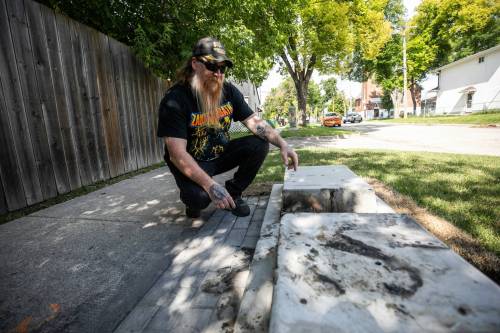
Some North End residents are concerned new community mailboxes will become a target for vandalism and crime after the base of one was recently lit ablaze — before it was even installed.

The community mailboxes started to show up on Andrews Street within the last two weeks. Some have been installed, while at other locations, only the concrete foundation is in place.

“They just dumped them on the boulevard,” said Stephen Giesbrecht, who lives beside one of the boxes in the St. John’s neighbourhood. “They dumped them on the corner and then they were gone.”

One of the concrete slabs has already played host to a fire and some of the hardware needed to install the mailbox melted.

Read
Yesterday at 2:01 AM CDT

Roadside giants towering symbols of Canada’s quirkiness

Jen Zoratti 4 minute read Preview

Roadside giants towering symbols of Canada’s quirkiness

Jen Zoratti 4 minute read Yesterday at 2:01 AM CDT

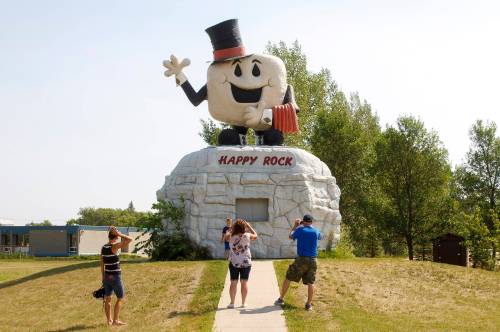
Could you imagine a Canada without Mr. PG repping Prince George, B.C.? Or the Big Nickel in Sudbury? Or, my personal favourite, Happy Rock in Gladstone?

Earlier this summer, CBC’s Cost of Living looked at the economics of these giant roadside attractions — of which there are more than 1,500 in Canada — and the cost of keeping them.

Some are falling into disrepair — this is why public art funding is necessary, by the way, not just for construction, but maintenance — and some towns are weighing whether or not that money is better spent elsewhere.

The main character of the story: Tyra the Tyrannosaurus, the rather literal symbol of Drumheller, Alta., a.k.a. the Dinosaur Capital of the World since 2000, who could be facing extinction after the lease agreement between the town and the Drumheller and District Chamber of Commerce ends in 2029.

Read
Yesterday at 2:01 AM CDT

Canada vows dollar-for-dollar tariff retaliation, suspends trade talks with U.S.

Catherine Morrison, The Canadian Press 7 minute read Preview

Canada vows dollar-for-dollar tariff retaliation, suspends trade talks with U.S.

Catherine Morrison, The Canadian Press 7 minute read Updated: Yesterday at 8:27 AM CDT

OTTAWA - A last-ditch effort to reach a new trade deal before a midnight tariff deadline failed Friday, as Prime Minister Mark Carney suspended talks with the United States and summoned his negotiators back to Ottawa.

The decision meant new 50 per cent tariffs on billions of dollars in Canadian exports to the U.S. took effect at 12:01 a.m., and Carney vowed Canada would retaliate with equal measures of its own.

"In recent weeks, we made important progress toward improving Canada's position as having the best deal in the world with the U.S.," Carney said in a statement just before Trump's tariff deadline.

"However, that progress has not been enough to meet our objectives for Canadians."

Read
Updated: Yesterday at 8:27 AM CDT

ER wait times have hit all-time highs in Winnipeg and are impacting nearly all aspects of hospital operations

Tom Brodbeck 17 minute read Preview

ER wait times have hit all-time highs in Winnipeg and are impacting nearly all aspects of hospital operations

Tom Brodbeck 17 minute read Friday, Aug. 21, 2026

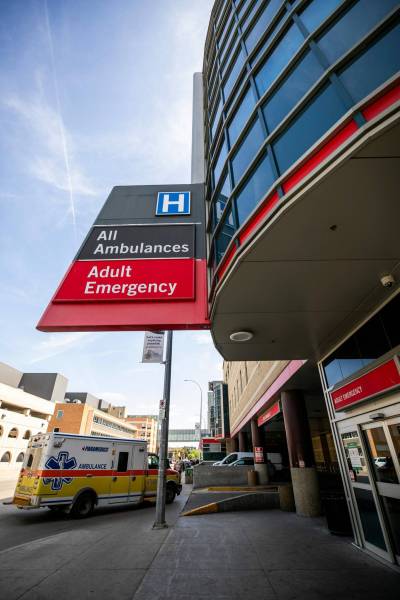
On most days at Health Sciences Centre’s adult emergency department, all 58 treatment beds are filled with sick patients. Another dozen or so brought in by ambulance line the hallways on stretchers, with only one nurse to look after them.

Out in the waiting room, about 30 or 40 people — sometimes more — are slouched in chairs in pain or discomfort, waiting hours to see a doctor. Most have been assessed by a triage nurse, but many will have to wait 10 to 20 hours to be examined by a physician because there’s no room for them in the treatment area.

Some patients leave because they can no longer tolerate the excruciating wait, only to return days later, sicker than they were before.

Welcome to the emergency department at Manitoba’s largest hospital, where some of the highest-acuity patients seek medical care but now face delays that were unimaginable a few years ago.

Read
Friday, Aug. 21, 2026