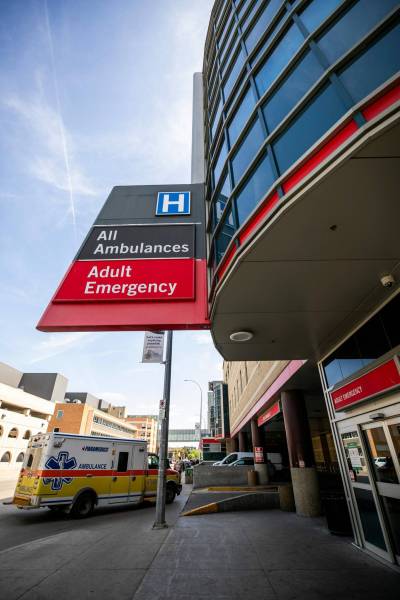
Condition critical Despite government pledges to reduce ER and urgent-care bottlenecks, wait times have hit all-time highs in Winnipeg and are impacting nearly all aspects of hospital operations
Read this article for free:
or
Already have an account? Log in here »
To continue reading, please subscribe:

Digital Subscription
One year of digital access for only $205*
- Enjoy unlimited reading on winnipegfreepress.com
- Read the E-Edition, our digital replica newspaper
- Access News Break, our award-winning app
- Play interactive puzzles
*First annual payment billed as $205.00 + GST for one year. This annual subscription will automatically renew at $233.00 + GST every 52 weeks (10% off the regular annual price of $259.35). Offer available to new and qualified returning subscribers only. Cancel any time.
To continue reading, please subscribe:
Add Free Press access to your Brandon Sun subscription for only an additional
$1 for the first 4 weeks*
- Enjoy unlimited reading on winnipegfreepress.com
- Read the E-Edition, our digital replica newspaper
- Access News Break, our award-winning app
- Play interactive puzzles
*Your next Brandon Sun subscription payment will increase by $1.00 and you will be charged $17.95 plus GST for four weeks. After four weeks, your payment will increase to $24.95 plus GST every four weeks.
Read unlimited articles for free today:
or
Already have an account? Log in here »
On most days at Health Sciences Centre’s adult emergency department, all 58 treatment beds are filled with sick patients. Another dozen or so brought in by ambulance line the hallways on stretchers, with only one nurse to look after them.
Out in the waiting room, about 30 or 40 people — sometimes more — are slouched in chairs in pain or discomfort, waiting hours to see a doctor. Most have been assessed by a triage nurse, but many will have to wait 10 to 20 hours to be examined by a physician because there’s no room for them in the treatment area.
Some patients leave because they can no longer tolerate the excruciating wait, only to return days later, sicker than they were before.
Welcome to the emergency department at Manitoba’s largest hospital, where some of the highest-acuity patients seek medical care but now face delays that were unimaginable a few years ago.
“It’s the worst it’s ever been,” said one ER nurse at HSC, who spoke to the Free Press on condition of anonymity. “Patients are deteriorating while they’re waiting and there’s no place for them to go.”
Her front-line view is echoed by multiple ER doctors and nurses interviewed for this story: Manitoba’s emergency room service delivery is at the brink.
Despite promises made by the NDP government during the 2023 provincial election to reduce ER and urgent care wait times, they continue to rise.
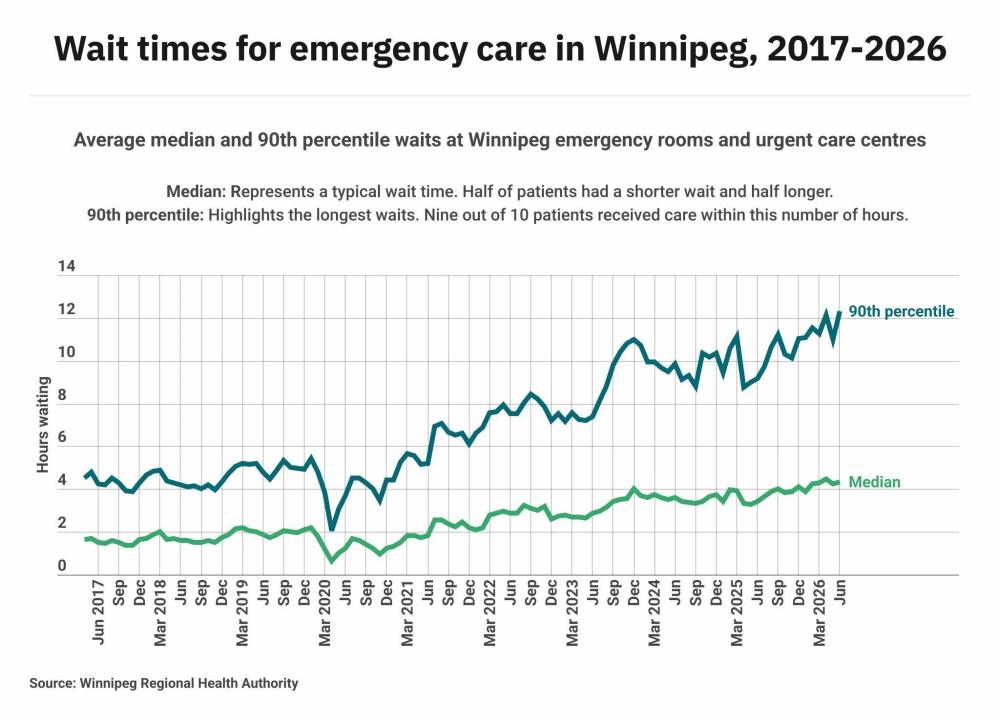
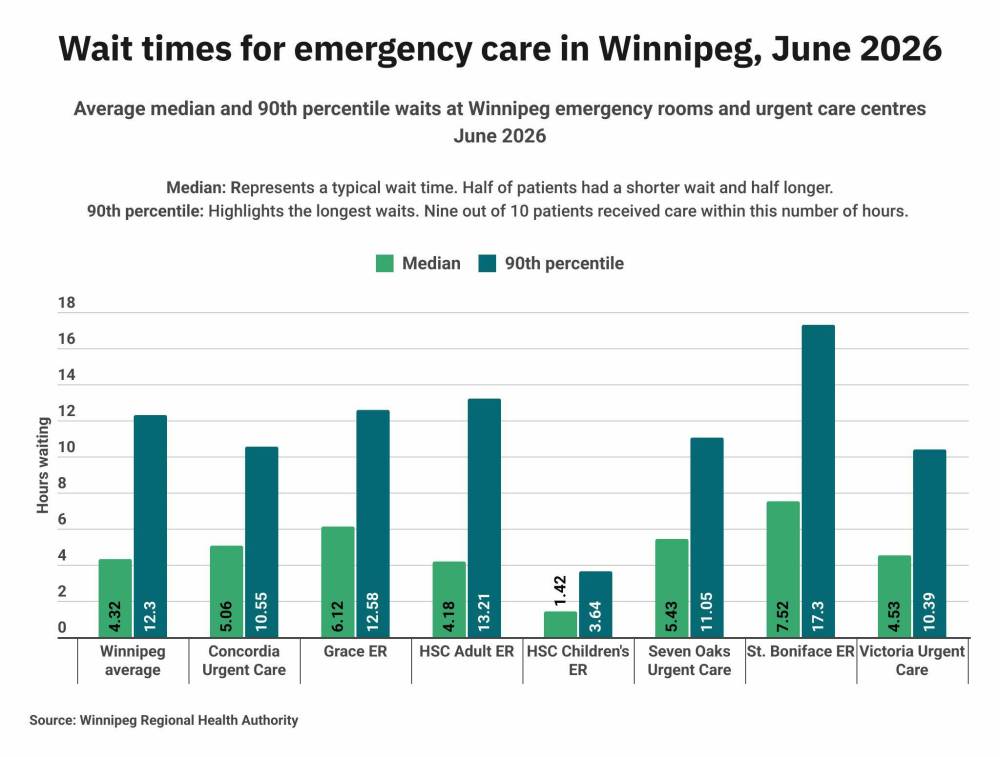
The median wait time for all hospitals in Winnipeg hit a record 4.47 hours in April and remained close to that in June at 4.32 hours, according to the latest available data from the Winnipeg Regional Health Authority.
But it’s the 90th percentile measurement — where nine out of 10 patients experienced a shorter wait time and one in 10 waited longer — that more accurately describes how long some patients are waiting in the ER to see a doctor.
That number hit a staggering 12.3 hours in June for all Winnipeg sites, the highest number on record and about triple what it was prior to the pandemic.
Overall, Manitoba had among the highest ER wait times in Canada in 2024-25, according to the most recent data compiled by the Canadian Institute for Health Information.
“We don’t see any meaningful change in the ER,” said the nurse, who works in triage, assessing and re-assessing patients waiting to be seen by a physician. “The wait times are getting longer, we continue to have admitted patients in the ER, nothing’s improving for us on the ground — we’re getting way worse.”
About half the patients in the ER treatment area — each identified by a number on the wall and separated by curtains — are sick enough to be transferred to a medical ward. But those wards are full, too, often by patients who’ve been there for weeks — sometimes months — owing to a severe shortage of community supports.
Many of those patients no longer require acute care and should be discharged from hospital. However, they remain there (at a cost of about $2,000 a day) because they’re waiting for what’s called “alternate level of care,” — or ALC — like a personal care home bed, home care or supportive housing, which is often not immediately available.
And it all backs up in the ER and drives up wait times.
RUTH BONNEVILLE / FREE PRESS Manitoba faced among the highest emergency-room wait times in Canada in 2024-25.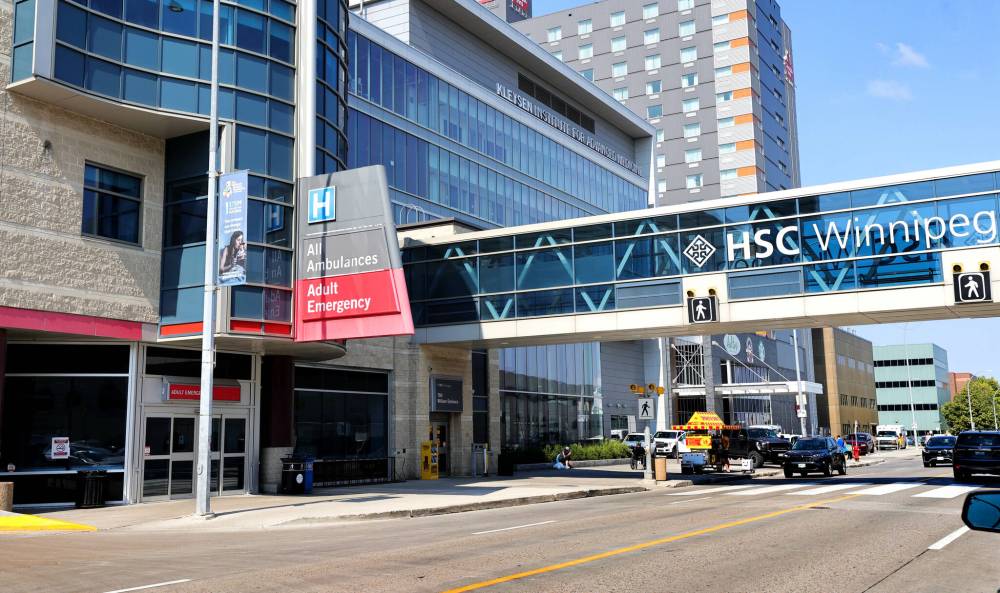
The situation has deteriorated to the point where the WRHA earlier this month directed three long-term care centres — Riverview Health Centre, Deer Lodge Centre and Misericordia Health Centre — to make space for hospital patients, citing “exceptionally high demand for care across the health-care system.”
ER doctors are still able to see life-threatening cases quickly because those are prioritized through the triage system. It’s the ER patients who are sick enough to be in hospital, but are not facing imminent death, that often wait hours or days to see a doctor, or to be admitted to a medical ward.
And the longer they wait, the sicker they get.
“It’s not third-world conditions but we’re kind of pushing the envelope… We’re just waiting for the next bad thing to happen.”
“It’s not third-world conditions but we’re kind of pushing the envelope,” said another triage nurse at HSC. “We’re just waiting for the next bad thing to happen.”
He said ER staff can’t keep up with the growing number of high-acuity patients coming to the department because they’re warehousing so many patients in treatment beds and can’t see new ones quickly enough.
“Half the people in the waiting room, at least, are being neglected because they’re not getting any care,” said the nurse, also speaking on condition of anonymity.
Dr. Shawn Young, HSC’s chief medical officer, doesn’t try to sugarcoat the crisis. He and his team of senior managers spend most of their days scrambling to find spaces for patients, including transfers to other hospitals — sometimes in rural areas. But many of those facilities are full, too.
The best they can do most days is “mitigate risk,” Young said.
“June was awful,” he said, referring to historically high wait times that month. The average time patients waited in the ER treatment area for a medical bed, or to be discharged, was 29.1 hours in June, one of the worst months on record.
The situation was made worse this summer with extreme flooding in parts of rural Manitoba, which forced the closure of the Dauphin Regional Health Centre in June. That took nearly 100 hospital beds out of the system.

Coupled with severe congestion at hospitals in Brandon, Steinbach and Selkirk (where some Winnipeggers now travel to in search of lower wait times), HSC has fewer spots to send patients, said Young.

And it affects almost all aspects of hospital operations, including cancelling elective surgeries to free up beds for admitted ER patients.
“We’ve had a lot of cancellations in surgery these last few months,” said Young, including for cancer patients. HSC cancelled 23 surgeries in the month of June.
PHIL HOSSACK / FREE PRESS FILES ER wait times are so bad at St. Boniface Hospital, staff have started placing patients in makeshift treatment areas because the beds are often full.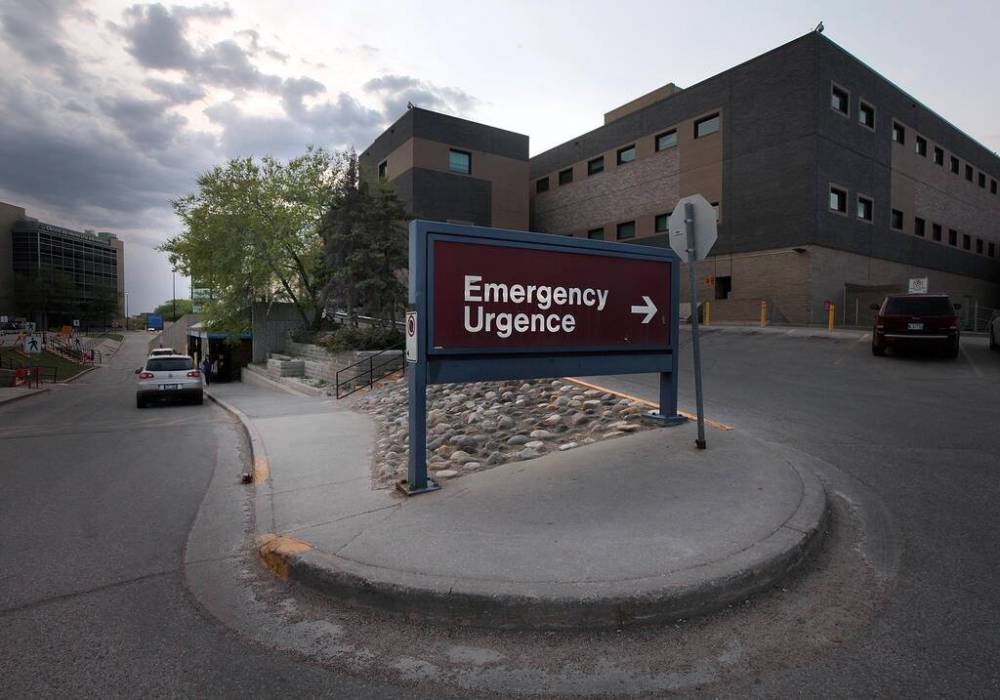
The hospital is so congested, officials are now placing some patients in “non-traditional” spaces on medical wards, including in spare rooms or hallways, to make room for admitted ER patients.
“I think we’ll be doing it for some time,” said Young, who last month provided a Free Press reporter with an in-person tour of HSC, including the adult emergency department.
There are multiple factors driving the growth of ER wait times, including a surge in mental health and addictions patients in recent years. But a growing and aging population — which Young calls the “silver tsunami” — is having the greatest impact, he said.
Baby boomers are living longer and are showing up at the ER sicker and with more complex problems.
“There was not enough planning for that,” Young admits.
HSC is not alone. All Winnipeg hospitals are seeing longer ER and urgent-care wait times. In addition to HSC, Winnipeg’s two other emergency departments are located at Grace and St. Boniface hospitals, while Concordia, Victoria and Seven Oaks hospitals are designated as urgent-care facilities.
“A lot of the things that you’re seeing here (at HSC) you’ll see, scaled a little bit differently, at all the other sites,” said Ray Sanchez, the WRHA’s vice-president of health services and acute care, who took part in the HSC tour. That includes putting patients in non-traditional spaces.
“Every site has nuance to it, but all sites do that,” Sanchez said. “For some sites it’s in the hallway, for some sites it’s a fifth bed in a four-bed room.”
Sanchez says hospitals are chipping away at “access block” — the term used to describe patients occupying beds who should be elsewhere, including in the community. Senior staff monitor patient movement throughout the system on an hourly basis and try to find space for patients almost anywhere.
“We function as a system, so the WRHA and HSC work together and then we best balance our beds across the system every day,” said Sanchez.
There is better communication between sites than there was in the past and the use of technology is helping co-ordinate those efforts, he said.
Staff and management use computer software like Oculys — an electronic bed-mapping system — to track patients throughout all hospitals. It shows patient movement in real time at each site. The data is displayed on screens in wards and on senior managers’ smartphones.
Sanchez said he believes those efforts, and the growth in home-care services, are helping improve patient flow through hospitals. (Although average daily home-care visits were up only 2.1 per cent in June compared with the same month last year, from 16,749 to 17,105).
“It’s just we were so far behind, that we had some catch up to do,” he said. “I feel like we’re catching up.”
But that’s not how front-line medical staff who spoke with the Free Press see it.
Doctors Manitoba, which represents more than 4,000 physicians in Manitoba, has been sounding alarm bells for years over growing ER wait times and what’s causing them.
And every ER physician and nurse who spoke with the Free Press says the province is doing little to fix it.
“Sometimes we make small gains, but we are ultimately losing the battle.”
“It is much worse than it’s ever been,” said Dr. Mona Hegdekar, who has worked as an ER physician at St. Boniface Hospital for the past 15 years. “Sometimes we make small gains, but we are ultimately losing the battle.”
It’s the patients sitting in the waiting room for 10 to 20 hours that concern her the most, particularly those with multiple — and often complex — medical conditions.
“We have had several near misses in the waiting room, we have had cardiac arrests in the waiting room — it’s not good for the patients, it’s not good care for them and it’s also not good for the staff,” said Hegdekar.
“It’s pretty demoralizing — it’s pretty defeating,”
Talk to almost any ER physician in Winnipeg and chances are they’ll tell you the situation in emergency departments is now a full-blown crisis and that very little is being done to fix it.
“I am seeing a very consistent lack of change,” said Dr. Noam Katz, an ER doctor at St. Boniface. “We’re seeing wait times that I would argue were unheard of for most of my career.”
He says the time many patients are forced to wait to see a physician is “inhumane.”
“I’ve seen 90-year-olds who are waiting 23 hours to be seen,” he said. “That’s three working days that somebody is sitting in a chair.”
Ruth Bonneville / Free Press Dr. Noam Katz says the ER wait times many patients endure to see a physician is ‘inhumane.’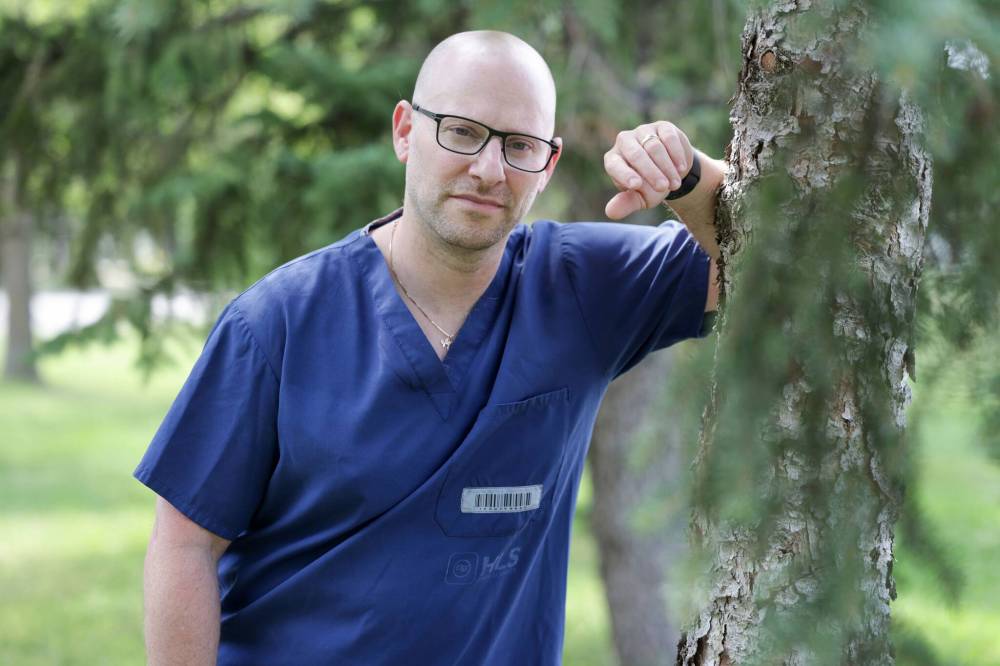
Katz said the government isn’t addressing the real problem that’s driving soaring ER wait times, namely that acute care beds on medical wards are filled with patients — often elderly ones — that should no longer be there.
They should be getting care in a more appropriate setting, like a personal care home or an assisted-living facility. That would allow ERs to transfer admitted patients to those medical wards quicker so they could see new patients coming through the door faster, he said.
“To address the backlog, you need to address the downstream issues,” said Katz.
He said he believes the government is sincere in its efforts to solve the problem, but they’re looking in the wrong places and repeating past mistakes.
“I do think that the definition of insanity is doing the same thing over and over and expecting a different result,” he said. “The rhetoric that is coming out from the government doesn’t match the problem.”
“The rhetoric that is coming out from the government doesn’t match the problem.”
Dr. Ira Ripstein has been an ER physician at St. Boniface for 44 years and says he’s never seen wait times and ER congestion this bad. There were a record 49 admitted patients in the ER waiting for a bed on a medical ward on one recent shift, making it extremely difficult to treat new patients, he said.
“We can’t do our work and that all overflows to the waiting room,” he said. “It reaches a level of despair where the staff feel they can’t fix anything.”
He said the hospital re-organization that began in 2017 under the former Progressive Conservative government — which included converting ERs at Concordia, Seven Oaks and Victoria hospitals to urgent-care centres — made matters worse, putting greater strain on hospitals such as St. Boniface, he said.
ER wait times won’t come down until the province tackles the root causes, he said.
“They have to figure out a way to move the admitted patients out of our department so it can operate properly,” said Ripstein. “They shouldn’t put all of the stress of the system on one department.”
The situation is so bad at St. Boniface — which has the longest ER wait times in Winnipeg (the 90th percentile wait in June was a record 17.3 hours, nearly double what it was for the same month last year) — they’ve started placing some patients in makeshift treatment areas because the beds are often full.
“It’s not super safe, but neither is sitting in the waiting room for 20 hours,” said one ER nurse at St. Boniface, speaking on the condition of anonymity. “Definitely at times patient care can be compromised because we just physically can’t always be there if we’re pulled away to an emergency situation.”
WAYNE GLOWACKI / Free Press Files Dr. Alecs Chochinov, former director of emergency at St. Boniface Hospital: "it breaks my heart that people are waiting up to 24 hours."
Dr. Alecs Chochinov, a former director of emergency at St. Boniface Hospital, says the situation in ERs and urgent-care centres has become progressively worse.
“I was director there for a decade-and-a-half and it breaks my heart that people are waiting up to 24 hours (to see a doctor),” he said.
Chochinov, who now works as an ER doctor at VECTRS — a WRHA agency that assesses critically ill patients in rural and northern areas and decides when they should be transferred to Winnipeg — says governments of all stripes have largely ignored the advice he and his colleagues have given them over the years.
He says most governments in Canada, including in Manitoba, continue to spend money in the wrong places when it comes to reducing ER congestion, like opening after-hours or minor-injury clinics and claiming falsely those services will bring down ER wait times.
“You get this vicious cycle of spending money on the wrong solutions, which draw out people who are frustrated because the right solutions have not been implemented,” said Chochinov, who co-authored a 2024 Canadian Association of Emergency Physicians report on ERs, called EM-Power.
“I never thought it would get this bad.”
ER staff prioritize patient acuity based on the Canadian Triage and Acuity Scale (CTAS). Patients are ranked from one to five — one being the most life-threatening (where patients are almost always seen right away) and five being non-urgent, where patients wait longer to see a physician and could get treatment elsewhere.
But Level 4s and 5s only represent about 15 per cent of patients coming to ERs, said Chochinov. Of those, they only use up about one per cent of physician resources. So diverting them to clinics has no meaningful impact on ER wait times, he said.
It’s the Level 2s and 3s that are the biggest challenge, emergency physicians and nurses say. Those patients may not have life-threatening conditions, but they’re often sick enough to be admitted to hospital. They may also have medical conditions that aren’t immediately detectable.
Until they see a doctor for a complete medical assessment, it’s often unknown how truly ill they are. Some ER doctors and nurses describe those patients as “the most dangerous” because they could be a lot sicker than originally thought.
The longer they wait, the higher the risk of a bad outcome. They’re like ticking time bombs.
Genevieve Price, 82, died on Nov. 22, 2025 after waiting more than 30 hours for care in emergency departments at St. Boniface and Grace hospitals.

Stacey Ross, 55, died on Jan. 15 after waiting 11 hours in St. Boniface Hospital’s emergency room.

“The thing that is maybe the most directly correlated with increased mortality in our emergency departments is the total length of stay in emergency — how long people wait in emergency to get a bed, and that’s now a matter of days,” said Chochinov.
Facebook Genevieve Price died in 2025 after waiting more than 30 hours inside emergency departments at St. Boniface and Grace hospitals.
The problem won’t be solved until governments take a long-term view of health care, he said. That includes doing an in-depth analysis of what medical services are needed and where, including community supports such as home care and long-term care.
“Nobody has actually said ‘what do we really need?” said Chochinov. “How many personal-care-home beds would we need if the system was working optimally, how many more home-care services do we need?”
Hegdekar, the St. Boniface ER physician, said the fact many people — especially the elderly — don’t have a family doctor also contributes to hospital overcrowding and ER congestion.
She said she frequently hears from patients that they don’t have a family physician to provide them with ongoing care.
SUPPLIED Stacey Ross died after waiting 11 hours in St. Boniface Hospital’s emergency room.
“They’ve got this list of medical problems that need regular management,” she said. “For the most part, when they’re managed well, they don’t have to come to the emergency room.”
Chochinov said that until a system-wide approach is taken, including determining what resources are needed in the community and in hospital — and making the required investments over the next several years — the problem will persist.
“I do believe the government is sincere about trying to help it, but in a system this complicated and entrenched, you can’t work around the periphery,” he said.
“Access block is the critical choke point and they haven’t done a thing about that.”
tom.brodbeck@winnipegfreepress.com
Tom Brodbeck:
Manitoba government touts health-care gains, but critics question impact on ER wait times Read More



Tom Brodbeck is an award-winning author and columnist with over 30 years experience in print media. He joined the Free Press in 2019. Born and raised in Montreal, Tom graduated from the University of Manitoba in 1993 with a Bachelor of Arts degree in economics and commerce. Read more about Tom.
Tom provides commentary and analysis on political and related issues at the municipal, provincial and federal level. His columns are built on research and coverage of local events. The Free Press’s editing team reviews Tom’s columns before they are posted online or published in print – part of the Free Press’s tradition, since 1872, of producing reliable independent journalism. Read more about Free Press’s history and mandate, and learn how our newsroom operates.
Our newsroom depends on a growing audience of readers to power our journalism. If you are not a paid reader, please consider becoming a subscriber.
Our newsroom depends on its audience of readers to power our journalism. Thank you for your support.
Related Articles
Mole Mobile on move for your dermatological needs