

Voter suppression is GOP’s last-gasp strategy
Advertisement
Read this article for free:
or
Already have an account? Log in here »
To continue reading, please subscribe:

Digital Subscription
One year of digital access for only $205*
- Enjoy unlimited reading on winnipegfreepress.com
- Read the E-Edition, our digital replica newspaper
- Access News Break, our award-winning app
- Play interactive puzzles
*First annual payment billed as $205.00 + GST for one year. This annual subscription will automatically renew at $233.00 + GST every 52 weeks (10% off the regular annual price of $259.35). Offer available to new and qualified returning subscribers only. Cancel any time.
To continue reading, please subscribe:
Add Free Press access to your Brandon Sun subscription for only an additional
$1 for the first 4 weeks*
- Enjoy unlimited reading on winnipegfreepress.com
- Read the E-Edition, our digital replica newspaper
- Access News Break, our award-winning app
- Play interactive puzzles
*Your next Brandon Sun subscription payment will increase by $1.00 and you will be charged $17.95 plus GST for four weeks. After four weeks, your payment will increase to $24.95 plus GST every four weeks.
Read unlimited articles for free today:
or
Already have an account? Log in here »
Hey there, time traveller!
This article was published 05/04/2021 (2014 days ago), so information in it may no longer be current.
The “Big Lie” endures in the United States. Promoted by former president Donald Trump and given credence by a majority of Republican politicians, the myth persists that the November 2020 presidential election was “Rigged” — the word is always capitalized by Trump as if that makes the charge more truthful — and that Joe Biden and the Democratic Party “stole” the victory.
It is all nonsense, of course. There was no evidence of electoral fraud, yet that has not stopped the spreading of the lie by diehard Trump Republicans and Fox TV commentators. Worse, the “Big Lie” triggered the riot at the U.S. Capitol on Jan. 6.
Months before the election, Trump began targeting mail-in voting as the bogeyman of the contest, a ready-made excuse in case he lost. This is despite the fact mail-in voting has been widely used for many years with few problems by more than 80 per cent of the states (Trump, who votes in Florida and whose hypocrisy is constant, mailed in his ballot).
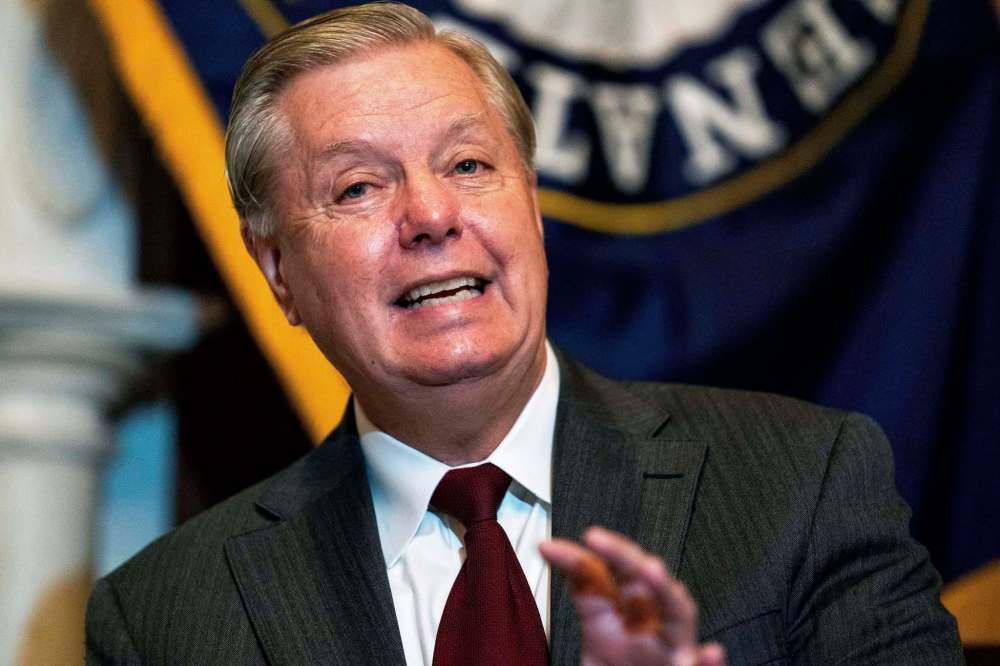
Trump’s loss to Biden, particularly in such (until recently) solid Republican states as Arizona and Georgia, seemed impossible to those like South Carolina Sen. Lindsey Graham. Predictably, in his view the alleged culprit was mail-in voting because it supposedly enabled too many people to vote under questionable circumstances. Soon after the election, Graham commented, “If we don’t do something about voting by mail, we are going to lose the ability to elect a Republican in this country.”
Graham conveniently ignored that in a democracy, elections sometimes work like that: the party that is “supposed” to win occasionally does not. Nonetheless, Republicans have determined the way to guarantee future success at the polls is not to alter their policies or disavow their cultish loyalty to Trump; rather it is to make it more difficult for people to vote.
According to the Brennan Center for Justice, a non-partisan law and policy institute based in New York City, in the past few months state governments across the U.S. have introduced more than 250 bills in 43 states to restrict voting; almost all are in states in which Republicans control the legislatures. The greatest number of bills are in Georgia, which recently passed a comprehensive bill, and Arizona and Pennsylvania — all states where Trump was defeated.
These state Republican leaders claim they are merely attempting to make elections more secure — “election integrity” is the term they favour— in light of the fraud that was allegedly perpetrated during the presidential election.
These various bills, which aim to limit mail-in voting access, impose stricter voter ID requirements, slash voter registration opportunities and enable more aggressive voter roll purges, have one aim and one aim only: to suppress the vote in mainly Democratic constituencies and to make it difficult for young and poor voters and African-Americans to cast their ballots.
As an example, the new Georgia voting law — which is being challenged in court as unconstitutional — decreases the number of drop boxes for mail-in votes and limits the number of Sundays in which early voting can take place — a blatant attempt to halt the “souls to the polls” campaign in which large numbers of African-Americans voted after Sunday church services.
Even more absurd is that under this law it is a crime to offer food or water to someone waiting in line to vote.
Republicans are fooling no one but themselves with these anti-democratic measures. Raphael G. Warnock, Georgia’s first African-American senator, rightly stated in his inaugural speech on March 17 that the U.S. is witnessing “a massive and unabashed assault on voting rights unlike anything we’ve ever seen since the Jim Crow era (of the late 19th century).” These actions, he added, amount to “Jim Crow in new clothes.”
The 14th and 15th amendments to the U.S. constitution — ratified in 1868 and 1870, respectively — guaranteed male citizens equal protection under the law and the right to vote. No man over the age of 21, white or Black, could be denied the right to vote “on account of race, colour, or previous condition of servitude.”
Yet such legal principles made little difference to white supremacist governments of the former southern states of the Confederacy, which did everything in their power to prevent their former slaves from voting. They instituted Black Codes — poll taxes of two and three dollars; literacy tests, with exceptions for white citizens who could not read or write; and grandfather clauses that stipulated a person could only vote if their grandfather was allowed to vote in 1867 or earlier — which no Black southerners were permitted to do.

These were enforced with violence, lynchings and Ku Klux Klan terror. Legalized “Jim Crow” segregation followed in the 1890s, discriminatory practices which stood until the 1950s and ‘60s.
The unwarranted attempts of today’s Republicans to suppress the vote do bring back the bitter memories of Jim Crow, as Warnock suggests. Proposed federal legislation — the “For the People Act”, known as H.R. 1, which seeks to broaden electoral laws rather than restrict them — could stop the states’ suppression efforts, though the legislation faces strong opposition in the senate from Republicans.
The sad truth of the current situation was predicted by Canadian journalist David Frum, who writes for The Atlantic, back in January 2018. “If conservatives become convinced that they cannot win democratically,” he wrote,” they will not abandon conservatism. They will reject democracy.”
And so they have.
Now & Then is a column in which historian Allan Levine puts the events of today in a historical context. His most recent book is Details are Unprintable: Wayne Lonergan and the Sensational Café Society Murder.
Related Articles
Corporations gave over $50M to voting restriction backers
Advertisement Advertise With Us
Advertisement Advertise With Us