

Policing on trial on both sides of border
Advertisement
Read this article for free:
or
Already have an account? Log in here »
To continue reading, please subscribe:

Digital Subscription
One year of digital access for only $205*
- Enjoy unlimited reading on winnipegfreepress.com
- Read the E-Edition, our digital replica newspaper
- Access News Break, our award-winning app
- Play interactive puzzles
*First annual payment billed as $205.00 + GST for one year. This annual subscription will automatically renew at $233.00 + GST every 52 weeks (10% off the regular annual price of $259.35). Offer available to new and qualified returning subscribers only. Cancel any time.
To continue reading, please subscribe:
Add Free Press access to your Brandon Sun subscription for only an additional
$1 for the first 4 weeks*
- Enjoy unlimited reading on winnipegfreepress.com
- Read the E-Edition, our digital replica newspaper
- Access News Break, our award-winning app
- Play interactive puzzles
*Your next Brandon Sun subscription payment will increase by $1.00 and you will be charged $17.95 plus GST for four weeks. After four weeks, your payment will increase to $24.95 plus GST every four weeks.
Read unlimited articles for free today:
or
Already have an account? Log in here »
Hey there, time traveller!
This article was published 17/04/2021 (1988 days ago), so information in it may no longer be current.
The way Minnesota is handling allegations against police may be a revelation to people in Winnipeg.
We’re not used to seeing police on trial. Here, when officers are accused of crimes, many avoid prosecution through a variety of creative methods.
As we follow news accounts of the Minneapolis trial of former officer Derek Chauvin in the death of George Floyd, what seems even more unusual is that officers are testifying against their former colleague. Even the police chief took the stand in full uniform to condemn him.
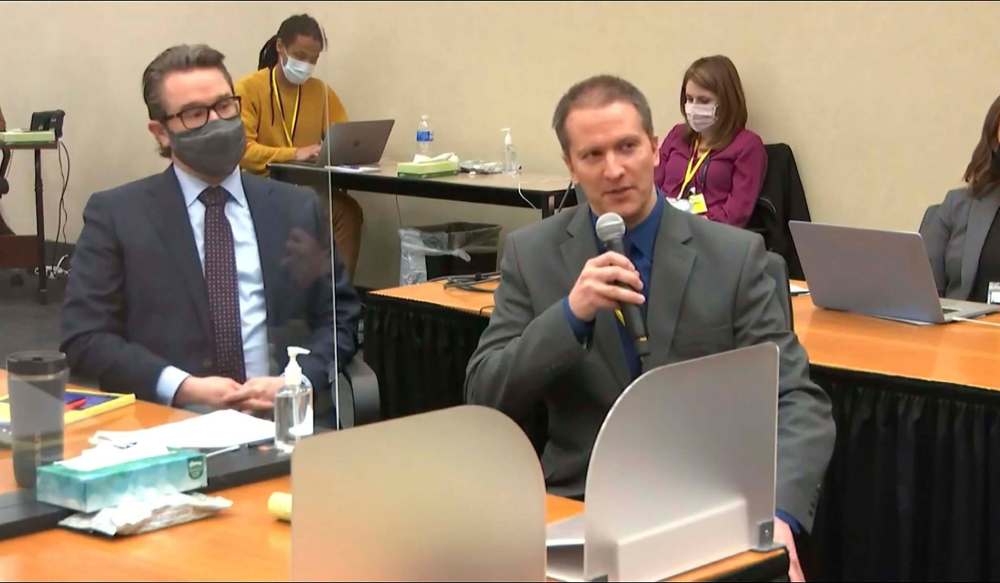
And while Chauvin’s high-profile trial is still in progress, another Minnesota police officer, Kim Potter, was charged with killing a Black motorist. What’s noteworthy — and unprecedented by Winnipeg standards — is how swiftly and publicly her prosecution is proceeding. On Sunday, she allegedly killed Daunte Wright in a routine traffic stop. On Tuesday, she and her police chief both resigned. On Wednesday, she was jailed briefly and charged with second-degree manslaughter.
That’s not how things are done in Winnipeg. When police officers here are accused of wrongdoing, the so-called “blue wall of silence” is erected and the justice system often becomes woefully inefficient at investigating and prosecuting the alleged offences. This has happened so frequently that it seems there’s a separate standard of justice — one that seems particularly lenient — when Winnipeg Police Service officers are themselves accused.
The breach of the blue wall in Minneapolis is perhaps not surprising, given the widely shared video of Chauvin kneeling for nine minutes on the neck of Floyd, who was pinned on the pavement. The horrifying video prompted public outrage of a level that made it impossible to deny the impact of Chauvin’s actions.
The 2020 death of Floyd, a Black man, under the knee of Chauvin, a white officer, gave impetus to the Black Lives Matter movement, which has also contributed to a groundswell to transform policing in Winnipeg. Protests against WPS brutality attracted thousands of people last June, and 63,000 people signed a petition to defund police in this city.
A commentator observing the Minneapolis trial said, “Policing is on trial here,” referring to the justice system’s ability to police its own. That same could be said about policing in Winnipeg.
Investigative journalism by the Free Press, particularly by reporter Ryan Thorpe, has shown a pattern of ways in which allegations against Winnipeg police are stymied.
Sometimes, it’s colleagues who are slow to investigate a fellow officer. Const. Justin Holz was off duty and had been drinking with fellow officers before he killed a pedestrian in a hit-and-run on Main Street; his breathalyzer test was delayed so his blood-alcohol reading at the time of the crash remains unknown, which may have led to a more lenient sentence.
Sometimes, the Crown won’t go to trial when the accusations involve a police officer. That was the case with accusations of perjury against Const. James William Macumber, one of four officers who unlawfully entered a family’s room at the Clarion Hotel, assaulted multiple people, seized recording devices without cause and falsely imprisoned two suspects.
The Independent Investigation Unit recommended a charge of perjury because Macumber lied on a police report to cover up his unlawful actions, but the Crown opted not to proceed.
Often, investigations of officers by the IIU police watchdog are thwarted by WPS managers, who refuse to hand over requested documents, block interview requests and deny the IIU has the right to even look into certain cases.
It boggles the mind how the police department can continue to provide employment for officers such as Patrol Sgt. Jeffrey Norman, who still wears the uniform even though he has been sued eight times over allegations including wrongful arrests, beating and threatening suspects.
If Winnipeg officers are paying attention to the new age of police accountability emerging in Minnesota, the astute among them will endorse the crumbling of the blue wall. Winnipeg’s upstanding officers, and there are many, will see change is necessary to restore honour to the badge.
There was hope remedies would come from the Manitoba government, which promised improvements to the Police Services Act. The changes were expected to be revealed last month, but Justice Minister Cameron Friesen postponed their unveiling until later this year, partly in order to consult with First Nations leaders.

It’s anticipated that adjustments to the act will provide more oversight and transparency to help pierce the tightly-knit culture within policing and legal circles that seems to often protect Winnipeg officers who break the law.
Police supporters argue it’s wrong to use a wide brush to disparage all Winnipeg officers because of the misdeeds of a few. That’s fair; the “bad-apple” argument is understandable. But the WPS must commit to discarding its bad apples.
Look to Minnesota to see how it’s done.
carl.degurse@freepress.mb.ca
Carl DeGurse is a member of the Free Press editorial board.
History
Updated on Sunday, April 18, 2021 9:32 AM CDT: Corrects criminal charge.