J.D. Power says Canadians ‘unimpressed’ with their wireless service

Advertisement

Advertise with us

TORONTO - J.D. Power's latest annual study of Canadian wireless network performance found consumers were even hungrier for data than last year, but a significant portion were unimpressed with the quality they got.

Read this article for free:


or

Already have an account? Log in here »

To continue reading, please subscribe:

Subscribe and receive a limited-edition Free Press branded hat or tote.

Digital Subscription

One year of digital access for only $205*

  • Enjoy unlimited reading on winnipegfreepress.com
  • Read the E-Edition, our digital replica newspaper
  • Access News Break, our award-winning app
  • Play interactive puzzles

*First annual payment billed as $205.00 + GST for one year. This annual subscription will automatically renew at $233.00 + GST every 52 weeks (10% off the regular annual price of $259.35). Offer available to new and qualified returning subscribers only. Cancel any time.

To continue reading, please subscribe:

Add Free Press access to your Brandon Sun subscription for only an additional

$1 for the first 4 weeks*

  • Enjoy unlimited reading on winnipegfreepress.com
  • Read the E-Edition, our digital replica newspaper
  • Access News Break, our award-winning app
  • Play interactive puzzles
Start now

*Your next Brandon Sun subscription payment will increase by $1.00 and you will be charged $17.95 plus GST for four weeks. After four weeks, your payment will increase to $24.95 plus GST every four weeks.

Hey there, time traveller!
This article was published 22/04/2021 (1977 days ago), so information in it may no longer be current.

TORONTO – J.D. Power’s latest annual study of Canadian wireless network performance found consumers were even hungrier for data than last year, but a significant portion were unimpressed with the quality they got.

It found 24 per cent of about 9,500 people contacted said they have at least 10 gigabytes of data in their monthly plan, up from 20 per cent in 2020.

Another 17 per cent had unlimited data plans, up from 11 per cent in 2020.

A cell tower is pictured in rural Ontario on Wednesday, July 15, 2020. THE CANADIAN PRESS/Sean Kilpatrick

About 14 per cent said they exceeded their plan’s data allowance in the past six months.

The biggest use of the data was browsing (an average of 57 minutes over the previous 48 hours) followed by video and music streaming (46 minutes)

Only 67 per cent of the wireless customers agreed that their carrier’s network was reliable when streaming music and video — a finding that J.D. Power said is a red flag for carriers because of how much data is used for that.

“Despite massive investments in infrastructure and technology, customers remain relatively unimpressed by their carriers’ wireless networks,” said Adrian Chung, director of the technology, media and telecom practice at J.D. Power Canada.

This year’s J.D. Power study of Canadian wireless network quality was conducted in February and March, about a year after wireless and internet usage patterns changed dramatically because of the COVID-19 pandemic.

Industry observers, including some of the major carriers, have noted that wireless phones were used less by some customers while they worked from home because they relied more on their internet and in-home Wi-Fi wireless connections.

In other cases, there have been anecdotal reports of some customers increasing their wireless data packages because of slow or inaccessible internet connections outside of urban areas.

The federal budget included an additional $1 billion for the Universal Broadband Fund, bringing the projected total to $2.7 billion by 2026. It’s just one of many public and privately funded efforts to build high-speed internet and wireless networks in rural and remote regions.

The J.D. Power study of Canada’s wireless services provided a regional analysis of customer experience in different parts of Canada and ranked the carriers in those areas.

It found that BCE’s Bell Mobility and Telus Mobility tied for first place in Ontario, with eight problems per 100 connections (8 PP100).

In the east region, which includes Quebec and the four Atlantic provinces, Quebecor’s Videotron had best ranking at 5 PP100, just ahead of Rogers Wireless and Telus Mobility at 6 PP100.

In the West region, which includes five provinces and three northern territories, Telus Mobility had the best ranking (8 PP100) followed by Rogers (9 PP100) and SaskTel (10 PP100).

Telus said in a statement that J.D. Power has ranked it as No. 1 in Ontario for seven consecutive years, including this year’s shared top spot.

This report by The Canadian Press was first published March 22, 2021.

Companies in this story: (TSX:BCE, TSX:RCI. B, TSX:SJR. B, TSX:T, TSX:QBR. B)

Report Error Submit a Tip

More Stories

Desperate Poilievre wants Canadians to believe the sky is falling when it’s just cloudy outside

Tom Brodbeck 5 minute read Preview

Desperate Poilievre wants Canadians to believe the sky is falling when it’s just cloudy outside

Tom Brodbeck 5 minute read Friday, Sep. 18, 2026

Pierre Poilievre has a problem.

Canadians just don’t seem to be paying much attention to him anymore.

So, naturally, the Conservative Opposition leader has decided to turn up the volume.

At a recent party caucus retreat in Penticton, B.C., Poilievre delivered the familiar message: Canada is in trouble, Canadians are hurting and the Liberal government is making everything worse.

Read
Friday, Sep. 18, 2026

Wireless customers 'unimpressed': study

David Paddon, The Canadian Press 3 minute read Preview

Wireless customers 'unimpressed': study

David Paddon, The Canadian Press 3 minute read Thursday, Apr. 22, 2021

A collection of breaking news briefs filed on April 27, 2021

• Southbound lane of Arlington Bridge closing for day

• RCMP arrest three drunk drivers in eight hours

• Missing young adults, infant boy may be in city: police

• Residents asked to search yards for missing man

• 218 new COVID-19 cases and no new deaths in Manitoba Tuesday

• Police looking for suspects connected to Winnipeg Beach break-in

• Man arrested after shotgun fired

• City could explore added cleaning for park washrooms

• Multiple Tuesday morning fires being investigated

• Refugee workers locked out at Welcome Place

• Crews respond to apartment complex fire on Kennedy Street

Read
Thursday, Apr. 22, 2021

A quick look at where provinces and territories stand on time changes

The Canadian Press 2 minute read Preview

A quick look at where provinces and territories stand on time changes

The Canadian Press 2 minute read Friday, Sep. 18, 2026

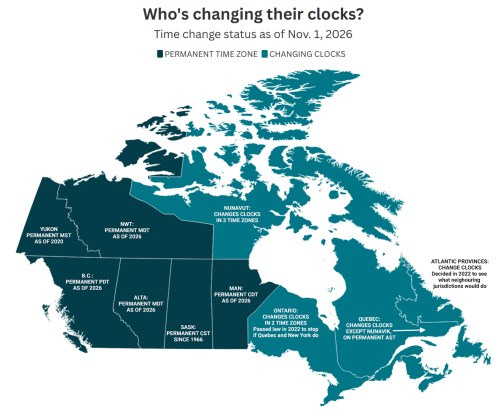
WINNIPEG - Manitoba's government said Thursday the province will be sticking with daylight time year-round, making it the latest jurisdiction to move away from twice-annual time changes. Here's a look at where things stand across Canada:

British Columbia said in March that it was moving to permanent Pacific daylight time. The change also means that parts of northeastern B.C., which have been on mountain standard time year round, are now in alignment with the rest of the province.

Alberta also switched to permanent daylight time this year in what it calls Alberta time. The change means it now has the same time as Saskatchewan year round.

Saskatchewan has been on permanent central standard time since 1966.

Read
Friday, Sep. 18, 2026

Klein has burned bridges with PM, Gillingham says

Joyanne Pursaga 3 minute read Preview

Klein has burned bridges with PM, Gillingham says

Joyanne Pursaga 3 minute read Friday, Sep. 18, 2026

One mayoral candidate accused another of writing a column so critical it could compromise his ability to work with the federal government.

Read
Friday, Sep. 18, 2026

Family account spiced with magic realism, geopolitical intrigue and a ghost story

Reviewed by Zilla Jones 4 minute read Preview

Family account spiced with magic realism, geopolitical intrigue and a ghost story

Reviewed by Zilla Jones 4 minute read Yesterday at 2:01 AM CDT

Tom Lin’s second novel Babylon, South Dakota moves beyond a historical account of an immigrant family’s struggle, delightfully blending and bending genres.

Lin is a Chinese-born novelist whose family emigrated to the U.S. when he was four years old. His debut novel, The Thousand Crimes of Ming Tsu, won the 2022 Andrew Carnegie Medal for Excellence in Fiction, making him the youngest ever recipient of that award. He earned a PhD in English from the University of California Davis and is currently an assistant professor of English and creative writing at the University of Iowa.

Babylon, South Dakota takes place in an unspecified time period that can be understood to be during the Mao era — likely the 1950s or ’60s. A young Chinese couple, the Hsuis, immigrate to the rural community that gives the book its title. They take the names Saul and Mei and settle on a 160-acre homestead left to them by a distant relative.

Saul’s dream is to breed and sell chrysanthemums from seeds he brought from China, while Mei wants to raise livestock. They speak no English, know nothing of life in the United States, are unprepared for the harshness of winter and the isolation of the farm and bring nothing with them except some gold, which Mei hides around the house for emergencies. Their only link to the outside world is a discarded and marginally functioning TV set, which Saul rescues and rigs up.

Read
Yesterday at 2:01 AM CDT

Today’s horoscope

Georgia Nicols 4 minute read Preview

Today’s horoscope

Georgia Nicols 4 minute read Yesterday at 2:01 AM CDT

MOON ALERT: After 12:15 a.m., there are no restrictions to shopping or important decisions today. The moon is in Capricorn.

ARIES (March 21-April 19)

This is a tricky day. Don’t be too ambitious. It’s totally OK to kick back and relax. But be aware that communications with parents and authority figures might be confused, vague or subject to misunderstandings. Nevertheless, romance is sweet and cosy!

TAURUS (April 20-May 20)

Read
Yesterday at 2:01 AM CDT