Glaciers getting smaller, faster — especially in North America, study finds

Advertisement

Advertise with us

A new study has used millions of satellite images to generate the clearest picture yet of the world's glaciers and concludes they're getting smaller, faster.

Read this article for free:


or

Already have an account? Log in here »

To continue reading, please subscribe:

Subscribe and receive a limited-edition Free Press branded hat or tote.

Digital Subscription

One year of digital access for only $205*

  • Enjoy unlimited reading on winnipegfreepress.com
  • Read the E-Edition, our digital replica newspaper
  • Access News Break, our award-winning app
  • Play interactive puzzles

*First annual payment billed as $205.00 + GST for one year. This annual subscription will automatically renew at $233.00 + GST every 52 weeks (10% off the regular annual price of $259.35). Offer available to new and qualified returning subscribers only. Cancel any time.

To continue reading, please subscribe:

Add Free Press access to your Brandon Sun subscription for only an additional

$1 for the first 4 weeks*

  • Enjoy unlimited reading on winnipegfreepress.com
  • Read the E-Edition, our digital replica newspaper
  • Access News Break, our award-winning app
  • Play interactive puzzles
Start now

*Your next Brandon Sun subscription payment will increase by $1.00 and you will be charged $17.95 plus GST for four weeks. After four weeks, your payment will increase to $24.95 plus GST every four weeks.

Hey there, time traveller!
This article was published 28/04/2021 (1938 days ago), so information in it may no longer be current.

A new study has used millions of satellite images to generate the clearest picture yet of the world’s glaciers and concludes they’re getting smaller, faster.

And glaciers along the western edge of North America are thinning faster than almost anywhere else in the world, said co-author Brian Menounos of the University of Northern British Columbia, whose paper was published Wednesday in the journal Nature.

“I don’t think humans need more evidence the climate is changing,” Menounos said.
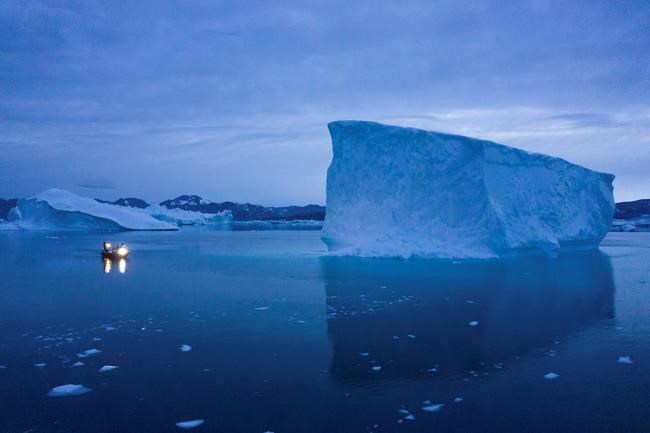
In this Aug. 15, 2019, photo, a boat navigates at night next to large icebergs in eastern Greenland. Greenland's ice has been melting for more than 20 years. THE CANADIAN PRESS/AP-Felipe Dana

“But I also think we can’t throw up our hands and say, ‘Oh, we can’t do anything.’ We have to understand the implications of climate change.”

Scientists have long known that the world’s 217,000 glaciers are in retreat.

That knowledge, however, was based on relatively infrequent satellite images and field monitoring that didn’t include all glaciers. Menounos and his colleagues turned to a previously unused trove of images that allowed them to estimate the falling elevation of precise spots with unprecedented accuracy.

“We had (a supercomputer) running for a solid year of compute time,” he said.

Once they knew how far the surface of the glaciers had fallen, they could calculate how much ice was lost. The results boggle the mind.

They found glaciers are now losing 267 billion tonnes of ice every year. Just one billion tonnes of ice — a gigatonne — is equal in mass to 10,000 fully loaded aircraft carriers.

Put another way, that’s enough ice melting every year to cover Canada’s entire land mass to a depth of 30 centimetres.

The pace is picking up. Between 2000 and 2004, when the study begins, glaciers “only” lost 227 gigatonnes per year.

But glaciers up the mountainous western spine of North America — including Canada — are melting even faster. Their thawing rate increased fourfold between 2000 and 2019.

Glaciers are now responsible for about 21 per cent of the roughly 22 centimetres that sea levels have risen since 1880.

That won’t stop. By the end of the century, about 200 million people will live on land likely to be submerged at high tide.

Glaciers are also a crucial source of fresh water, as they are in Western Canada. The paper quotes research suggesting more than one billion people could face water shortages by 2050.

That doesn’t include other benefits humans rely on glaciers for. They keep headwaters streams cool, for example.

“If you take that thermal buffering capacity of glaciers away, you’re left with a situation where these aquatic ecosystems are going to change,” Menounos said.

By far the biggest driver of glacial melt is rising temperatures caused by climate change, said Menounos. There are enough greenhouse gases in the air that some melting will continue even if the taps were turned off tomorrow.

But he said his study shows that while humans are causing the problem, they can also curb it.

“We just need the power and the gumption and the willpower to make some hard, difficult decisions,” Menounos said.

“You can’t really engineer your way out of this problem. You have to mitigate and reduce greenhouse gas emissions.”

This report by The Canadian Press was first published April 28, 2021.

— Follow Bob Weber on Twitter at @row1960

Report Error Submit a Tip

More Stories

Take advantage of hydroelectric potential

Jerry Storie 5 minute read Preview

Take advantage of hydroelectric potential

Jerry Storie 5 minute read Yesterday at 2:00 AM CDT

Manitoba Hydro tells us that we are going to need significant new electricity generation over the coming decades.

Read
Yesterday at 2:00 AM CDT

Trustees call for e-scooter safety education

Maggie Macintosh 4 minute read Preview

Trustees call for e-scooter safety education

Maggie Macintosh 4 minute read Yesterday at 6:00 AM CDT

School trustees are calling on the province to bolster public education around e-bike and e-scooter safety ahead of back-to-school season.

The Manitoba School Boards Association brought members’ concerns about a growing number of students using electronic devices to get to and from classes to the education minister’s office this month.

“There’s a concerning lack of safety knowledge on the part of Manitoba youth,” executive director Alan Campbell said.

Campbell, a long-time trustee in the Interlake School Division, resigned from elected office this summer to run the association that mobilizes school boards and provides them with labour relations support.

Read
Yesterday at 6:00 AM CDT

Manitoba man lied about abduction: N.D. police

Scott Billeck 2 minute read Yesterday at 3:17 PM CDT

U.S. authorities say a Manitoba man falsely claimed he had been kidnapped and taken across the Canada-U.S. border over the weekend.

Roderick Garson, 37, is being held in a county jail near Alexandria, Minn., after he was arrested and charged with falsely reporting a crime.

The arrest stems from a report police received Saturday that a man had been abducted with a weapon in Manitoba and taken across the border into the United States.

The investigation led U.S. authorities to Alexandria, about two hours northwest of Minneapolis, where police located the reported victim and suspect after the latter ran into a local store claiming he had escaped from his 31-year-old unnamed captor.

Shelters overwhelmed as rising vet costs forcing some owners to surrender pets

Tiago Resko 4 minute read Preview

Shelters overwhelmed as rising vet costs forcing some owners to surrender pets

Tiago Resko 4 minute read Yesterday at 6:00 AM CDT

In the fall of 2022, Tara Miller was faced with a difficult decision: keep her car or sell it to pay for a second knee surgery for her dog.

Ultimately, she needed her car to commute during the winter and decided to manage her dog Corby’s arthritis with medication and home therapy.

“Mentally it probably broke me,” said the 54-year-old.

While insurance covered two-thirds of the dog’s initial $6,000 surgery, Miller had to pay the remaining $2,000. That was on top of the $500 checkup before the surgery and the monthly $175 pet insurance premium.

Read
Yesterday at 6:00 AM CDT

The moral courage of public dissent

Judith Dueck 5 minute read 2:00 AM CDT

As a non-Jewish Canadian, I have watched our public conversation about Israel and Palestine become increasingly polarized. One feature of that debate has particularly caught my attention—not the disagreements themselves, but the moral courage required of Jewish Canadians who publicly dissent from influential voices within their own community.

Ironically, many non-Jewish Canadians who may have little familiarity with Jewish history assume that disagreement is somehow un-Jewish. The opposite is true. Debate has been central to Jewish intellectual life for centuries. The Talmud itself preserves arguments rather than erasing them.

To outsiders, minority communities can easily appear to speak with one voice. In Canada, organizations such as the Centre for Israel and Jewish Affairs (CIJA), Jewish Federations of Canada (UIA) and B’nai Brith are often perceived as representing the Jewish perspective on Israel and antisemitism. They undoubtedly represent many Canadian Jews. But they do not represent them all.

There are also Jewish organizations and individuals — including Independent Jewish Voices Canada, the United Jewish People’s Order, the recently formed Jewish Faculty Network and others — who reject the notion that any single institution or political perspective can define what it means to speak as a Jew in Canada. They frequently offer perspectives that differ from those advanced by many established Jewish organizations about Israel; defend the importance of free expression on university campuses; and argue that criticism of the actions of the Israeli government should not automatically be equated with antisemitism.

Indigenous peoples are deeply invested in Canada

Niigaan Sinclair 5 minute read Preview

Indigenous peoples are deeply invested in Canada

Niigaan Sinclair 5 minute read Yesterday at 6:00 AM CDT

Elections Canada released a report this week that stated that, in the 2025 federal election, approximately 41 per cent of eligible First Nations, Inuit and Métis voters cast a ballot and contributed significantly to the federal Liberals and Prime Minister Mark Carney making a political comeback.

For anyone curious about how Manitoba fared, the numbers in this province were slightly lower — but still very strong, with 34 per cent participation.

This is a far cry from the highest rate of Indigenous participation in a federal election — that would be the 60 per cent who cast a ballot in 2015, when Justin Trudeau’s Liberals defeated Stephen Harper’s Conservatives — but it’s still higher than the abysmal numbers seen in decades previous.

First Nations voters have only been allowed the legal right to cast a ballot in Canadian elections since 1960, but many in the past — perhaps rightly — felt a sense of complicity in the country’s colonization or, worse, that voting didn’t make a difference.

Read
Yesterday at 6:00 AM CDT