

Pandemic challenges remain daunting
Advertisement
Read this article for free:
or
Already have an account? Log in here »
To continue reading, please subscribe:
Monthly Digital Subscription
$1 per week for 24 weeks*
- Enjoy unlimited reading on winnipegfreepress.com
- Read the E-Edition, our digital replica newspaper
- Access News Break, our award-winning app
- Play interactive puzzles
*Billed as $4.00 plus GST every four weeks. After 24 weeks, price increases to the regular rate of $19.95 plus GST every four weeks. Offer available to new and qualified returning subscribers only. Cancel any time.
Monthly Digital Subscription
$4.99/week*
- Enjoy unlimited reading on winnipegfreepress.com
- Read the E-Edition, our digital replica newspaper
- Access News Break, our award-winning app
- Play interactive puzzles
*Billed as $19.95 plus GST every four weeks. Cancel any time.
To continue reading, please subscribe:
Add Free Press access to your Brandon Sun subscription for only an additional
$1 for the first 4 weeks*
*Your next subscription payment will increase by $1.00 and you will be charged $16.99 plus GST for four weeks. After four weeks, your payment will increase to $23.99 plus GST every four weeks.
Read unlimited articles for free today:
or
Already have an account? Log in here »
Hey there, time traveller!
This article was published 01/05/2021 (1786 days ago), so information in it may no longer be current.
Whatever your particular viewpoint, it is indisputable that Dr. Brent Roussin, Manitoba’s chief public health officer, has had an impossibly tough job the past year. In combatting the COVID-19 pandemic, he has not only had to manage the province’s public-health regulations, but also heed Brian Pallister, a micro-managing premier, who has his own agenda when it comes to balancing health and economics.
Throughout this ordeal, Roussin’s public profile has exponentially increased. Frequently appearing on television news shows and the subject of intense media scrutiny, his efforts to mitigate the pandemic have been frequently challenged.
His latest dictum — in place until the end of May — forbidding indoor gatherings, among other restrictions, will infuriate some Manitobans for not going far enough and others for going too far. Occasionally defensive, like other public officials, Roussin remains steadfast that the approach he has taken has been and remains the correct one.
More than a 100 years ago, the dynamics were much different. During the influenza pandemic of 1918-19, Dr. M. Stuart Fraser, Manitoba’s first provincial health officer, did not have to deal with an interfering premier; the affable Liberal party premier Tobias Norris, in office from 1915 to 1922, was the exact opposite of Pallister in style and temperament.
Nor did Fraser have to worry about sharp daily comments on social media, or regular criticism and second-guessing from newspaper columnists; opinion articles in this era (most were unsigned) were more polite and less personal. Yet given the inadequacies of scientific and medical knowledge at the time, the challenges Fraser faced were arguably more difficult.
Born in White Lake, Ont., west of Ottawa in 1860, Fraser later moved with his family to Manitoba. He received a BA in 1887 from the University of Manitoba and his medical degree three years later from the Manitoba Medical College. He furthered his medical training in Toronto and Edinburgh. The first two and a half decades of his career as a physician were spent in Brandon before he relocated to Winnipeg to take up his new position with the government in 1916 — a job he held until his retirement in 1931.
In mid-October 1918, when the pandemic was in its second and most deadly phase, Fraser had no choice but to designate it “a contagious infectious disease.” The proclamation gave him wide powers to quarantine individuals who were ill and temporarily halt all public gatherings — including closing schools, university theatres, and churches and other religious institutions.
Curiously, he did not shut down department stores and restaurants. Streetcars were also permitted to operate. Neither was there a compulsory mask mandate. Alberta did institute one for a brief time and other provinces encouraged their use. So, too, did the Town of Minnedosa, which required that masks be worn at stores and other businesses.
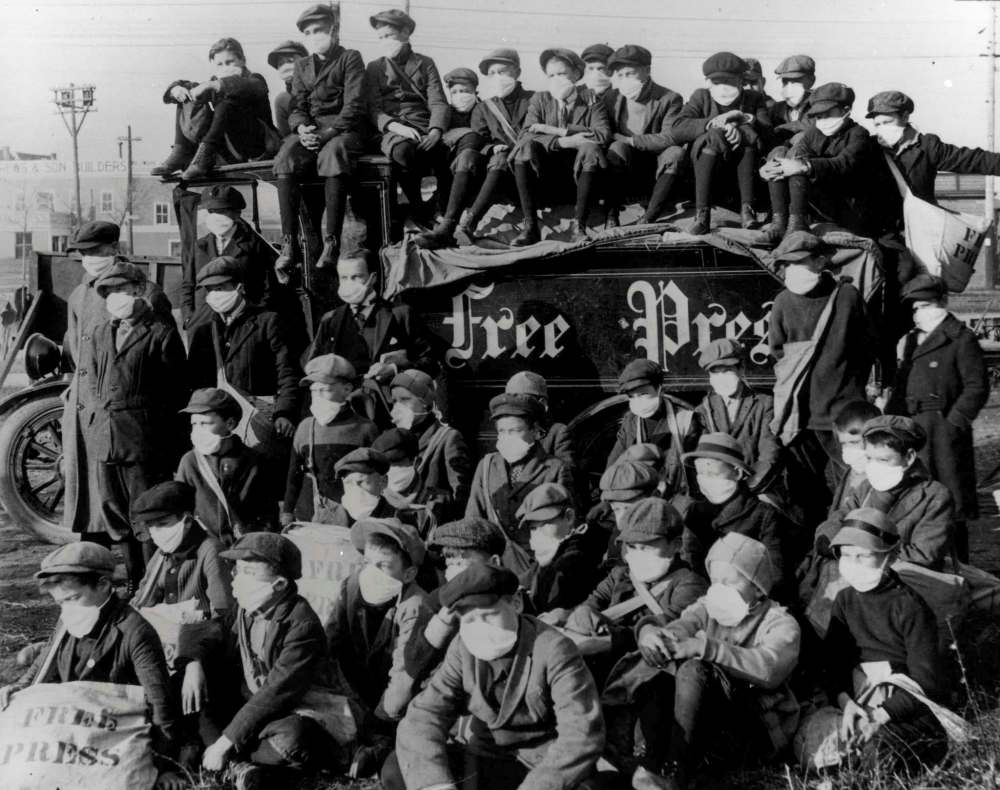
But there were legitimate health concerns about keeping the cloth masks — no disposable ones in those days — properly sanitized and germ-free. Still, many Winnipeggers did wear them including a group of young Free Press carriers photographed by Lewis Foote in an iconic picture of the 1918 pandemic.
Even as the situation grew dire, Fraser remained optimistic. “Things are looking very satisfactory,” he reported on Oct. 18, even though there had been 72 new cases and two deaths. Ten days later, there were 171 new cases, bringing the total to 330. Fraser conceded that the “disease is undoubtedly widespread,” but he insisted “it is being kept within bounds.” A week after that, he was predicting that the ban on public gathering could be lifted in the near future.
The flu, however, continued to spread “at an alarming rate,” as the Free Press described it, and take lives. By the end of the month, Fraser and his official were forced to echo today’s refrain and admit that “prevention is up to the public.” Soon, city health officials began putting up placards on the homes of people who were ill, and Fraser adopted a firmer stand that quarantining and health rules had to be followed or prosecutions would follow.

It was not sufficient. As Esyllt Jones notes in her 2007 book on the influenza in Winnipeg, “Fraser’s threat of prosecution for violation of quarantine was undermined by the increasing sense of disruption in the community.” Like Roussin a century later, health officials in 1918, adds Jones, “faced a difficult balancing act between generating enough public concern to guarantee compliance with public health measures, and generating so much concern that fear evolved into panic.”
In 1918, various attempts were made to develop vaccines that could counteract influenza — most notably by Dr. Edward Rosenow of the Mayo Clinic. But, alas, Rosenow’s vaccine and the others failed to provide adequate protection.
Roussin does not have this problem; incredible advancements in science have given him and other health officials across the world vaccines that are effective. Securing a sufficient supply and figuring out how to deliver these vaccines quickly enough to combat the COVID-19 variants is the real problem.
The federal government is looking after the supply, as dicey as that has been during the past few months. Still, regular deliveries of several vaccines have been underway for some time now. The same cannot be said for getting vaccines into the arms of Manitobans as quickly as possible. Despite official assertions to the contrary, that continues to be a work in progress, with much room for improvement.
Now & Then is a column in which historian Allan Levine puts the events of today in a historical context. His most recent book is Details are Unprintable: Wayne Lonergan and the Sensational Café Society Murder.