Cuba rolls out mass vaccines while awaiting study results

Advertisement

Advertise with us

HAVANA (AP) — The jab didn't even hurt, and Mabel Aguilera figures it may finally let her see granddaughters on the other side of Cuba who she hasn't glimpsed during many months of pandemic restrictions.

Read this article for free:


or

Already have an account? Log in here »

To continue reading, please subscribe:

Subscribe and receive a limited-edition Free Press branded hat or tote.

Digital Subscription

One year of digital access for only $205*

  • Enjoy unlimited reading on winnipegfreepress.com
  • Read the E-Edition, our digital replica newspaper
  • Access News Break, our award-winning app
  • Play interactive puzzles

*First annual payment billed as $205.00 + GST for one year. This annual subscription will automatically renew at $233.00 + GST every 52 weeks (10% off the regular annual price of $259.35). Offer available to new and qualified returning subscribers only. Cancel any time.

To continue reading, please subscribe:

Add Free Press access to your Brandon Sun subscription for only an additional

$1 for the first 4 weeks*

  • Enjoy unlimited reading on winnipegfreepress.com
  • Read the E-Edition, our digital replica newspaper
  • Access News Break, our award-winning app
  • Play interactive puzzles
Start now

*Your next Brandon Sun subscription payment will increase by $1.00 and you will be charged $17.95 plus GST for four weeks. After four weeks, your payment will increase to $24.95 plus GST every four weeks.

Hey there, time traveller!
This article was published 14/05/2021 (1912 days ago), so information in it may no longer be current.

HAVANA (AP) — The jab didn’t even hurt, and Mabel Aguilera figures it may finally let her see granddaughters on the other side of Cuba who she hasn’t glimpsed during many months of pandemic restrictions.

“Sometimes I thought I wouldn’t be able to stand not seeing my granddaughters,” said the 75-year-old woman, who got the shot at a clinic near her Havana home and has had to make do with phone calls and social media to keep in contact with relatives in the island’s far east.

“Talking is not like touching them,” she said Friday while in a post-inoculation observation area. They send me photos on Facebook but that’s not enough,” she added on the verge of tears.
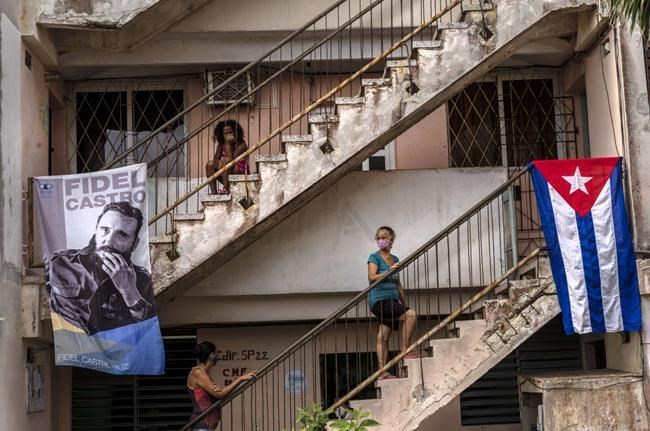
People wait to be vaccinated with the Cuban Abdala vaccine for COVID-19 at a doctors' office, decorated with an image of Fidel Castro and a Cuban flag, in the Alamar neighborhood of Havana, Cuba, Friday, May 14, 2021. Cuba began immunizing people this week with its own vaccines, Abdala and Soberana 02, the only ones developed by a Latin American country. (AP Photo/Ramon Espinosa)

Aguilera is among hundreds of thousands of Cubans who have begun receiving new, locally produced vaccines against COVID-19 in the past few days as the socialist government has ramped up an inoculation campaign — even before releasing formal Phase III data on the vaccines’ effectiveness and safety.

The campaign is being closely watched by many across Latin America and the world who see Cuba’s vaccines as a possible way to ease global shortages.

The island’s health minister, José Angel Portal Miranda, announced on May 7 that officials are still processing information from the unusually large Phase III trials of the two vaccine candidates, which covered 400,000 people overall. But he said that beginning mass vaccines now “has more benefits than risks. … The number of sick and deceased is going to decrease.”

Officials also have not given data on results from trials in other countries, such as Iran, that were reportedly testing the Cuban candidates.

The vaccines are a point of pride for a small and relatively poor nation of 11 million people that has prioritized its medical sector and has long boasted of exporting its own pharmaceuticals across the globe. While other Latin American nations are producing foreign vaccines under license, only Cuba so far has developed its own.

Officials say they pushed forward wide-scale inoculations due to early evidence that the vaccines are safe and work and because of a recent upsurge in coronavirus infections.

The clinic that served Aguilera in the Habana del Este neighborhood is using the Abdala vaccine, while some others are offering Soberana 02. Three other domestic vaccine candidates are also under study on the island.

“We have had very few adverse events. Some patients experience a little tiredness,” said Dr. Naicy Guzmán, director of the clinic, who lives nearby with her parents and children.

“All this is moving for me,” she said. “My people, my brothers, my community will be vaccinated against this disease that has really shaken us. It has been a long and intense fight.”

While most other vaccines have relied upon a two-dose regime, Guzmán indicated that three doses will be applied at 14-day intervals to each person.

She said it will take little more than a month to vaccinate 20,490 of the 32,000 people served by her neighborhood clinic. Those under 18 and those infected with COVID-19 so far are excluded.

Portal said the government plans to start mass vaccines with some 700,000 people in seven Havana districts hardest hit by COVID-19 such as Habana del Este. From June through August, they plan to vaccinate another 1 million people in the capital.

Officials say inoculations are taking place as well in the provinces, with plans to cover 70% of the adult population by the end of August.

Cuba is experiencing an outbreak of infections that began last December after months in which some localities went weeks without cases. Since the pandemic began in March 2020, Cuba has reported 121,838 cases and 785 deaths. But 31,346 of those cases came last month.

The pandemic has devastated Cuba’s tourism-dependent economy, with shrank by 11% last year.
Report Error Submit a Tip

More Stories

City puts Osborne Village lot up for sale third time

Joyanne Pursaga 5 minute read Preview

City puts Osborne Village lot up for sale third time

Joyanne Pursaga 5 minute read Thursday, Aug. 6, 2026

The city is making a third attempt to sell a seemingly prime Osborne Street property, after an offer for the surface parking lot fell through earlier this year.

The 772-square-metre space at 145 Osborne St., which formerly operated as an official paid city parking lot, has been posted for sale once again.

It may puzzle some Winnipeggers to see the site in the heart of Osborne Village remain empty so long after the city declared it surplus in 2020.

However, a few different challenges may limit its appeal to potential buyers, alocal real estate agent said.

Read
Thursday, Aug. 6, 2026

Watching while we work

Tory McNally 7 minute read Preview

Watching while we work

Tory McNally 7 minute read 2:01 AM CDT

For many employees, the idea that their employer might be tracking how long they spend at their keyboard, how often they move their mouse, or whether they are actively working throughout the day feels unsettling. For many employers, however, workplace surveillance is increasingly viewed as another management tool, particularly as hybrid and remote work become more common. The recent news that TD plans to monitor certain employees’ activity during the workday has reignited a conversation that has been quietly growing for several years: where is the line between legitimate oversight and excessive monitoring?

The reality is that workplace surveillance is nothing new. Employers have long monitored attendance, reviewed security camera footage, tracked company vehicles using GPS, audited expense reports, and reviewed internet usage on company-owned devices. What has changed is the sophistication of the technology. Today’s software can record login times, monitor application usage, track keystrokes, capture screenshots, analyze email activity, and even generate reports ranking employees based on their perceived productivity.

This naturally raises an important question. Does increased surveillance actually make people work harder?

The answer is not nearly as straightforward as many organizations hope.

Read
2:01 AM CDT

Mayoral race lineup grows to 10 candidates

Joyanne Pursaga 2 minute read Preview

Mayoral race lineup grows to 10 candidates

Joyanne Pursaga 2 minute read Thursday, Aug. 6, 2026

An electrical contractor has become the 10th candidate to register for the race to become Winnipeg’s next mayor.

Zac Uminski has thrown his name into the competition, after Scott Gillingham signed up to seek re-election as mayor and eight other candidates previously registered.

The father of four said concern about homelessness and addictions sparked his interest in politics.

“My campaign will focus on practical solutions to improve public safety, support families and strengthen the city services,” Uminski said. “We need safer communities.”

Read
Thursday, Aug. 6, 2026

Survival guide offers a frightening perspective on life in U.S. prisons

Reviewed by Bill Rambo 4 minute read Preview

Survival guide offers a frightening perspective on life in U.S. prisons

Reviewed by Bill Rambo 4 minute read 2:01 AM CDT

Canadian criminal sentencing guidelines identify “three traditional utilitarian goals — deterrence … incapacitation and rehabilitation.”

In spite of lofty intentions, fiction and film have identified North American incarceration in general as largely negative, incapacitating most inmates only while they are actually behind bars. Prison often leads to more crime, teaching criminal behaviour.

Tom Nelson spent more than 17 years in medium and maximum security facilities in the U.S. for such pasttimes as auto theft, armed robbery and drug dealing. Then he turned that life of crime around and became a successful physical trainer and gym owner in Los Angeles.

Nelson met and formed a friendship with Taylor Sheridan, creator and writer of such series as Yellowstone, Landman and the prequels 1883 and 1923. When COVID devastated the gym business and Nelson’s health was failing, Sheridan suggested turning Nelson’s attempt at a screenplay about prison life into a book.

Read
2:01 AM CDT

The view from here: Phyllis Green. Boob Tree, 1975

2 minute read Preview

The view from here: Phyllis Green. Boob Tree, 1975

2 minute read 2:01 AM CDT

Staycation: The Art of Being Here feautres more than 100 Manitoba-related artworks from the Winnipeg Art Gallery-Qaumajuq collection, spanning the past 50 years. These pieces reveal how the places around us are layered with memory, story and lived experience. Over the coming weeks, the Free Press will spotlight works from this eclectic exhibition, each one offering a new way of seeing home. Experience it in person and enjoy some staycation time at the gallery, on view until December.

Phyllis Green. Boob Tree, 1975

(Yarn, wood. Collection of the Winnipeg Art Gallery; Acquired with funds from the Estate of Mr. and Mrs. Bernard Naylor, funds administered by The Winnipeg Foundation, 2014-128. Photo: Ernest Mayer.)

The year 1975 was designated International Women’s Year by the United Nations, and in celebration, the WAG staged the show Images of Women, which explored how women had historically been depicted, an impressive selection but by mostly male artists. Amid pushback from the community, Sharron Zenith Corne and Marian Yeo organized a second exhibition, Woman as Viewer, which challenged those portrayals by only featuring works by women. It was called the first Canadian exhibition of feminist art. American artist Phyllis Green’s Boob Tree, a four-foot-tall crochet sculpture of a cluster of breasts, adorned the exhibit posters, which were so popular they were snatched by passersby! The sculpture is playful and unsettling, re-appropriating the objectification of women’s bodies.

Read
2:01 AM CDT

$60M, six-storey Harbourview Terrace due to open in June 2028

Aaron Epp 3 minute read Preview

$60M, six-storey Harbourview Terrace due to open in June 2028

Aaron Epp 3 minute read Yesterday at 7:24 PM CDT

They donned high-vis vests and brandished shovels with gold-coloured blades Friday morning at the ceremonial groundbreaking for a multi-family residential development in northeast Winnipeg.

Concord Projects has started construction of Harbourview Terrace, the inaugural development by two-year-old real estate company Foxhill Properties. Located in North Kildonan at 1820 De Vries Ave., the $60-million, six-storey apartment building will contain 179 units.

Founder and president Frank Koch-Schulte, who runs the company with his wife Alisha, said Foxhill wants to develop and manage properties with integrity.

“This is kind of like my opportunity to try to do things our way, which I feel is a way that keeps tenants in mind,” Koch-Schulte said. “We live in this neighbourhood. We’re very much invested in seeing quality housing go here.”

Read
Yesterday at 7:24 PM CDT