Saskatchewan preparing for first step in its provincial reopening plan this weekend

Advertisement

Advertise with us

REGINA - The government of Saskatchewan is preparing to start easing restrictions Sunday as the first step in its reopening plan.

Read this article for free:


or

Already have an account? Log in here »

To continue reading, please subscribe:

Subscribe and receive a limited-edition Free Press branded hat or tote.

Digital Subscription

One year of digital access for only $205*

  • Enjoy unlimited reading on winnipegfreepress.com
  • Read the E-Edition, our digital replica newspaper
  • Access News Break, our award-winning app
  • Play interactive puzzles

*First annual payment billed as $205.00 + GST for one year. This annual subscription will automatically renew at $233.00 + GST every 52 weeks (10% off the regular annual price of $259.35). Offer available to new and qualified returning subscribers only. Cancel any time.

To continue reading, please subscribe:

Add Free Press access to your Brandon Sun subscription for only an additional

$1 for the first 4 weeks*

  • Enjoy unlimited reading on winnipegfreepress.com
  • Read the E-Edition, our digital replica newspaper
  • Access News Break, our award-winning app
  • Play interactive puzzles
Start now

*Your next Brandon Sun subscription payment will increase by $1.00 and you will be charged $17.95 plus GST for four weeks. After four weeks, your payment will increase to $24.95 plus GST every four weeks.

Hey there, time traveller!
This article was published 25/05/2021 (1943 days ago), so information in it may no longer be current.

REGINA – The government of Saskatchewan is preparing to start easing restrictions Sunday as the first step in its reopening plan.

It comes three weeks after 70 per cent of the province’s residents aged 40 and older received their first dose of COVID-19 vaccine.

Beginning Sunday, gathering sizes will increase, restaurants and bars can open with limited capacity, and group fitness classes can resume.

Saskatchewan chief medical health officer, Dr. Saqib Shahab, speaks at a COVID-19 media update at the Legislative Building in Regina on Wednesday Dec. 9, 2020. THE CANADIAN PRESS/Michael Bell

Officials also announced that they will be relaxing restrictions on outdoor sports during the first step.

That was not originally included, but the province made the decision to move it forward in the reopening plan.

“Outdoor sports are safe,” Premier Scott Moe said Tuesday. “Safer, certainly, than indoors. (And) our children and youth … have really sacrificed a lot throughout this pandemic.

“They haven’t had the opportunity for going into the second year now to play competitive sports, whether that be softball, soccer, football — whatever that might be.”

The province has also reached the vaccination threshold for its second step of reopening — more than 70 per cent of Saskatchewan residents 30 and older have received their first COVID-19 vaccine.

As a result, the next phase of easing restrictions is to begin June 20.

Moe urged people to get a COVID-19 vaccine during his Tuesday afternoon news conference.

“We’re not asking you to storm the beaches of Normandy,” he said. “All we’re asking you to do is go in and get a tiny needle in your arm.”

Moe had particularly sharp words for people who may be encouraging others not to get vaccinated under “some misguided notion of defending your personal freedoms.”
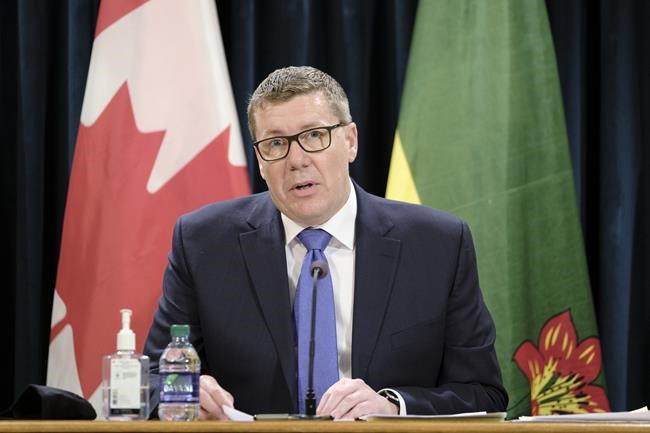
Saskatchewan Premier Scott Moe speaks at a press conference at the Legislative Building in Regina, Thursday, March 25, 2021. The government of Saskatchewan is preparing to start easing restrictions Sunday as part of its reopening roadmap. THE CANADIAN PRESS/Michael Bell

He said he hates imposing the restrictions.

“There is this bizarre misconception that politicians like myself and others, we love imposing these restrictions on others and the general population,” he said. “And I can tell you today, nothing — nothing — could be further from the truth. I hate it. I hate it. And I look forward to the day that it all ends, but that day can only come when enough of us are vaccinated.

“So if you really want all your freedoms back, go get in line and get vaccinated,” added Moe.

This report by The Canadian Press was first published May 25, 2021.

— By Julia Peterson in Saskatoon

Report Error Submit a Tip

More Stories

Day 1 of Jets training camp in the books with pairings essentially cemented

Ken Wiebe 7 minute read Preview

Day 1 of Jets training camp in the books with pairings essentially cemented

Ken Wiebe 7 minute read Thursday, Sep. 17, 2026

Nearly six minutes into his question-and-answer session, Scott Arniel took a welcome detour from the news of the day.

After exhausting the discussion around the goalie who wasn’t in training camp, the head coach of the Winnipeg Jets finally got a query about the line combinations and defensive pairings that were unveiled in training camp.

And unlike past years, when exhibition games were more frequent and the training camp wasn’t this condensed, Arniel conceded these groupings were intentional and were likely staying together for some time.

The expansion to an 84-game regular season brings with it a reduction to four pre-season games and a much shorter training camp, which could limit the amount of experimentation that Arniel can do during the next two weeks.

Read
Thursday, Sep. 17, 2026

Family account spiced with magic realism, geopolitical intrigue and a ghost story

Reviewed by Zilla Jones 4 minute read Preview

Family account spiced with magic realism, geopolitical intrigue and a ghost story

Reviewed by Zilla Jones 4 minute read 2:01 AM CDT

Tom Lin’s second novel Babylon, South Dakota moves beyond a historical account of an immigrant family’s struggle, delightfully blending and bending genres.

Lin is a Chinese-born novelist whose family emigrated to the U.S. when he was four years old. His debut novel, The Thousand Crimes of Ming Tsu, won the 2022 Andrew Carnegie Medal for Excellence in Fiction, making him the youngest ever recipient of that award. He earned a PhD in English from the University of California Davis and is currently an assistant professor of English and creative writing at the University of Iowa.

Babylon, South Dakota takes place in an unspecified time period that can be understood to be during the Mao era — likely the 1950s or ’60s. A young Chinese couple, the Hsuis, immigrate to the rural community that gives the book its title. They take the names Saul and Mei and settle on a 160-acre homestead left to them by a distant relative.

Saul’s dream is to breed and sell chrysanthemums from seeds he brought from China, while Mei wants to raise livestock. They speak no English, know nothing of life in the United States, are unprepared for the harshness of winter and the isolation of the farm and bring nothing with them except some gold, which Mei hides around the house for emergencies. Their only link to the outside world is a discarded and marginally functioning TV set, which Saul rescues and rigs up.

Read
2:01 AM CDT

Puzzles Palace

1 minute read Monday, Jul. 27, 2026

To solve our puzzles, please subscribe with this special offer: |

Klein has burned bridges with PM, Gillingham says

Joyanne Pursaga 3 minute read Preview

Klein has burned bridges with PM, Gillingham says

Joyanne Pursaga 3 minute read Yesterday at 5:51 PM CDT

One mayoral candidate accused another of writing a column so critical it could compromise his ability to work with the federal government.

Read
Yesterday at 5:51 PM CDT

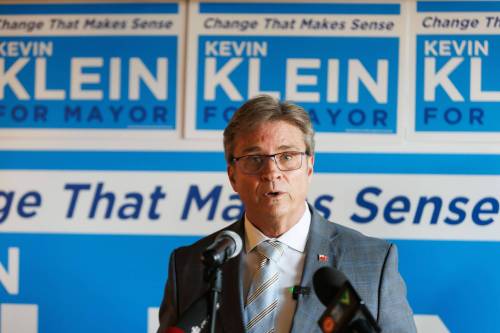
Klein launches mayoral campaign with pledge to make Winnipeg safest city in Canada

Joyanne Pursaga 5 minute read Preview

Klein launches mayoral campaign with pledge to make Winnipeg safest city in Canada

Joyanne Pursaga 5 minute read Updated: Yesterday at 7:48 PM CDT

Mayoral candidate Kevin Klein says he would make Winnipeg the safest city in Canada by the end of his four-year term, if elected.

“Crime is happening all over the city and we have to take steps to address it,” Klein said at his first campaign announcement Friday morning.

The candidate said crime is “getting out of control,” noting his grandchild’s car seat was recently stolen from a vehicle parked in a typically quiet neighbourhood.

He promised to hire 100 to 110 more police officers, which he believes would cost between $9 million and $11 million.

Read
Updated: Yesterday at 7:48 PM CDT

United Way, other charities fight for dollars as donor base shrinks

Scott Billeck 8 minute read Preview

United Way, other charities fight for dollars as donor base shrinks

Scott Billeck 8 minute read Yesterday at 2:00 AM CDT

Winnipeg’s charitable sector is being squeezed from both sides: demand for help is growing while the pool of donors to meet that need is shrinking.

The imbalance is increasingly being carried by a relatively small group of deep-pocketed donors. Last year, 600 people — about three per cent of United Way Winnipeg’s individual donors — accounted for roughly $8 million, or 55 per cent of individual donations.

The fundraising pitch isn’t getting any easier.

Homelessness and public drug use have become increasingly visible, household budgets remain strained and the problems charities are trying to address can seem so entrenched that donors may reasonably wonder what difference another contribution can make.

Read
Yesterday at 2:00 AM CDT