A timeline of the controversial Keystone XL pipeline project
Advertisement
Read this article for free:
or
Already have an account? Log in here »
To continue reading, please subscribe:

Digital Subscription
One year of digital access for only $205*
- Enjoy unlimited reading on winnipegfreepress.com
- Read the E-Edition, our digital replica newspaper
- Access News Break, our award-winning app
- Play interactive puzzles
*First annual payment billed as $205.00 + GST for one year. This annual subscription will automatically renew at $233.00 + GST every 52 weeks (10% off the regular annual price of $259.35). Offer available to new and qualified returning subscribers only. Cancel any time.
To continue reading, please subscribe:
Add Free Press access to your Brandon Sun subscription for only an additional
$1 for the first 4 weeks*
- Enjoy unlimited reading on winnipegfreepress.com
- Read the E-Edition, our digital replica newspaper
- Access News Break, our award-winning app
- Play interactive puzzles
*Your next Brandon Sun subscription payment will increase by $1.00 and you will be charged $17.95 plus GST for four weeks. After four weeks, your payment will increase to $24.95 plus GST every four weeks.
Read unlimited articles for free today:
or
Already have an account? Log in here »
Hey there, time traveller!
This article was published 09/06/2021 (1937 days ago), so information in it may no longer be current.
July 2008: TC Energy Corp. — then called TransCanada Corp. — and ConocoPhillips, joint owners of the Keystone Pipeline, propose a major extension to the network. The expansion, dubbed Keystone XL, would carry hundreds of thousands of barrels of oilsands bitumen from Alberta to Texas.
2009: As the U.S. State Department wades through comments based on an environmental assessment of the project, TransCanada starts visiting landowners potentially affected by the pipeline. Opposition emerges in Nebraska.
June 2009: TransCanada announces it will buy ConocoPhillips’s stake in Keystone.
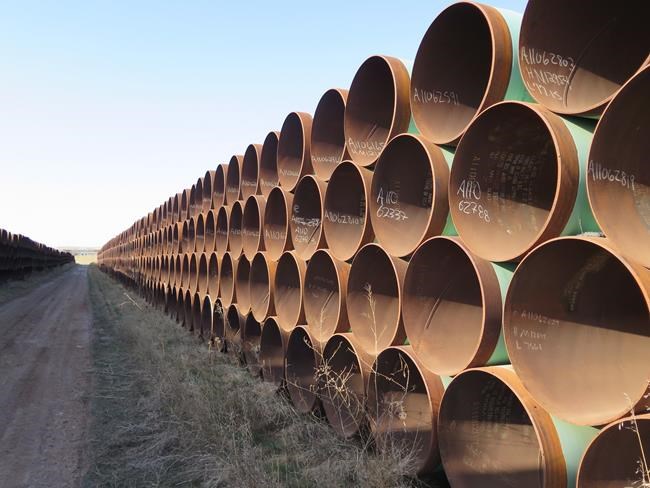
March 2010: The National Energy Board approves TransCanada’s application for Keystone XL, though the OK comes with 22 conditions regarding safety, environmental protection and landowner rights.
April 2010: The U.S. State Department releases a draft environmental impact statement saying Keystone XL would have a limited effect on the environment.
June-July 2010: Opposition to Keystone XL begins mounting in the United States. Legislators write to then-secretary of state Hillary Clinton calling for greater environmental oversight; scientists begin speaking out against the project; and the Environmental Protection Agency questions the need for the pipeline extension.
July 2010: The State Department extends its review of Keystone, saying federal agencies need more time to weigh in before a final environmental impact assessment can be released.
March 2011: The State Department announces a further delay in its environmental assessment.
Aug. 26, 2011: The State Department releases its final environmental assessment, which reiterates that the pipeline would have a limited environmental impact.
August-September 2011: Protesters stage a two-week campaign of civil disobedience at the White House to speak out against Keystone XL. Police arrest approximately 1,000 people, including actors Margot Kidder and Daryl Hannah as well as Canadian activist Naomi Klein.
Sept. 26, 2011: At a demonstration on Parliament Hill, police arrest 117 of 400 protesters.
Nov. 10, 2011: The State Department says TransCanada must reroute Keystone XL to avoid an ecologically sensitive region of Nebraska.
Nov. 14, 2011: TransCanada agrees to reroute the line.
December 2011: U.S. legislators pass a bill with a provision saying President Barack Obama must make a decision on the pipeline’s future in the next 60 days.
Jan. 18, 2012: Obama rejects Keystone, saying the timeline imposed by the December bill did not leave enough time to review the new route. Obama said TransCanada was free to submit another application.
Feb. 27, 2012: TransCanada says it will build the southern leg of Keystone XL, from Cushing, Okla., to the Gulf Coast, as a separate project with a price tag of $2.3 billion. This is not subject to presidential permission, since it did not cross an international border.
April 18, 2012: TransCanada submits a new route to officials in Nebraska for approval.
May 4, 2012: TransCanada files a new application with the State Department for the northern part of Keystone XL.
Jan. 22, 2013: Nebraska Gov. Dave Heineman approves TransCanada’s proposed new route for Keystone XL, sending the project back to the State Department for review.
January 2013: Pipeline opponents file a lawsuit against the Nebraska government claiming the state law used to review the new route is unconstitutional.
Jan. 31, 2014: The State Department says in a report that Keystone XL would produce fewer greenhouse gas emissions than transporting oil to the Gulf of Mexico by rail.
Feb. 19, 2014: A Nebraska judge rules that the law that allowed the governor to approve Keystone XL over the objections of landowners was unconstitutional. Nebraska said it would appeal.
April 18, 2014: The State Department suspends the regulatory process indefinitely, citing uncertainty about the court case in Nebraska.
Nov. 4, 2014: TransCanada says the costs of Keystone XL have grown to US$8 billion from US$5.4 billion.
November-December 2014: Midterm elections turn control of the U.S. Congress over to Republicans, who say they’ll make acceptance of Keystone XL a top priority. But Obama adopts an increasingly negative tone.
Jan. 9, 2015: At the Nebraska Supreme Court, by the narrowest of margins, a panel of seven judges strikes down the lower-court decision.
Jan. 29, 2015: The U.S. Senate approves a bill to build Keystone XL, but the White House says Obama would veto it.
Feb. 24, 2015: Obama vetoes the bill.
June 30, 2015: TransCanada writes to then-secretary of state John Kerry and other U.S. officials saying the State Department should include recent climate change policy announcements by the Alberta and federal governments in its review of Keystone XL.
Nov. 2, 2015: TransCanada asks the U.S. government to temporarily suspend its application.
Nov. 4, 2015: The U.S. government rejects that request.
Nov. 6, 2015: The Obama administration rejects TransCanada’s application to build the Keystone XL pipeline. TransCanada CEO Russ Girling says he is disappointed, but continues to believe the project is in the best interests of both Canada and the U.S.
Jan. 6, 2016: TransCanada files notice to launch a claim under Chapter 11 of the North American Free Trade Agreement, alleging the U.S. government breached its legal commitments under NAFTA. The company also files a lawsuit in U.S. Federal Court in Texas arguing that Obama exceeded his powers by denying construction of the project.
May 26, 2016: Republican presidential contender Donald Trump says he would approve Keystone XL if elected, a pledge he repeats several times during the campaign.
Nov. 8, 2016: Trump is elected president.
Jan. 24, 2017: Trump signs an executive order that he says approves Keystone XL, but suggests the United States intends to renegotiate the terms of the project. He also signs an order requiring American pipelines to be built with U.S. steel.
Nov. 9, 2018: A U.S. federal judge blocks the pipeline’s construction to allow more time to study the potential environmental impact.
March 29, 2019: Trump issues a new presidential permit in an effort to speed up development of the pipeline
May 3, 2019: TransCanada changes its name to TC Energy.
March 31, 2020: Alberta agrees to invest $1.5 billion in Keystone XL, followed by a $6 billion loan guarantee in 2021.
April 7, 2020: Construction begins, despite calls from Indigenous groups and environmentalists to pause their efforts.
May 18, 2020: Joe Biden, then the presumptive Democratic presidential nominee, vows to scrap Keystone XL if elected, but doesn’t set out a timeline for doing so.
Nov. 3, 2020: Biden is elected president.
Jan. 17, 2021: TC Energy announces a plan for Keystone XL to achieve net-zero emissions.
Jan. 20, 2021: Biden revokes Keystone XL’s presidential permit on his first day in office, hours after TC Energy said it would halt work on the project.
May 7, 2021: In reporting quarterly earnings results, TC Energy says it is taking a $2.2-billion writedown on the cancelled project. Shippers including Cenovus Energy Inc., Suncor Energy Inc. and Imperial Oil Ltd. had previously reported non-cash writedowns on earnings related to their commitments to Keystone XL.
June 9, 2021: TC Energy announces termination of the project.
This report by The Canadian Press was first published June 9, 2021.
Companies in this story: (TSX: TRP)