

The beauty of Torrey Pines might lie in how tough it can be
Advertisement
Read this article for free:
or
Already have an account? Log in here »
To continue reading, please subscribe:

Digital Subscription
One year of digital access for only $205*
- Enjoy unlimited reading on winnipegfreepress.com
- Read the E-Edition, our digital replica newspaper
- Access News Break, our award-winning app
- Play interactive puzzles
*First annual payment billed as $205.00 + GST for one year. This annual subscription will automatically renew at $233.00 + GST every 52 weeks (10% off the regular annual price of $259.35). Offer available to new and qualified returning subscribers only. Cancel any time.
To continue reading, please subscribe:
Add Free Press access to your Brandon Sun subscription for only an additional
$1 for the first 4 weeks*
- Enjoy unlimited reading on winnipegfreepress.com
- Read the E-Edition, our digital replica newspaper
- Access News Break, our award-winning app
- Play interactive puzzles
*Your next Brandon Sun subscription payment will increase by $1.00 and you will be charged $17.95 plus GST for four weeks. After four weeks, your payment will increase to $24.95 plus GST every four weeks.
Read unlimited articles for free today:
or
Already have an account? Log in here »
Hey there, time traveller!
This article was published 16/06/2021 (1899 days ago), so information in it may no longer be current.
Of the 53 golf courses that have hosted the men’s U.S. Open through the years, this week’s venue, the South Course at Torrey Pines near San Diego, ranks near the bottom of most every list that assesses golf course architecture.
It is no Pebble Beach. No Oakmont. No Winged Foot. No Pinehurst No. 2. No Merion.
When I played there 14 years ago, I was underwhelmed. The annual home of the Farmers Insurance Open, as well as the 2008 U.S. Open, has some fantastic holes to be sure, but by and large I found it disappointing that a golf course on the Pacific Ocean has very few holes on the water. And most of its inland holes lack creativity and quirkiness, two traits of which I’m quite fond of when playing the game. It is a long, tough slog of a course with brutal rough penalizing astray shots. A bit of a snore overall, I think.
Tour players do not agree.
“I love the place,” said Graham DeLaet. “It’s as strong of a golf course as you’ll ever play.”
I knew DeLaet, a runner-up at the 2014 Famers Insurance Open, and his fellow Canadian Brad Fritsch, 10th that year, were fans of Torrey Pines so I called them both and asked them to tell me why I’m wrong about the place. I opined to DeLaet that Torrey Pines does not compare favourably to other tour venues that he likes, such as L.A.’s Riviera Country Club (Genesis Invitational) and Hilton Head, S.C.’s Harbour Town Golf Links (RBC Heritage).
“I would defend (Torrey) until I went down,” responded DeLaet, never one to mince his words. “You can’t fake it around there. You have to be in control. You have to drive it really well. It’s such a good, strong golf course. I think it’s a perfect championship golf course.”
DeLaet had no problem telling me I’m wrong.
“I agree when people say they could have used the ocean more for the views, or whatever, I get that part, but I’m there to play, not sightsee,” stated Fritsch. “I just think it’s demanding but fair. There are no hidden shots. It’s all right in front of you. But you still have trouble with it because there is just a lot that you have to do.”
Fair enough, Mr. Fritsch.
Still, nobody is going to confuse Torrey Pines with Augusta National or Shinnecock Hills. But DeLaet and Fritsch’s points are valid in that the South Course offers a stern but equitable test of golf. It’s an open-book exam, explained Fritsch, that’s nonetheless very difficult to pass. No secrets, no surprises, and not a lot of decisions off the tee. It’s an oval, not a street course, and let’s see who can floor it and go the fastest.
Who might that be? A strong driver of the golf ball for sure. That can be said at most every event with such a premium now placed on that part of the game. Advanced statistics have proven that the big stick is the most important club in a golfer’s bag, which is why you see aggressive major championship game plans like that of Bryson DeChambeau at the U.S. Open at Winged Foot last September. Hit it far, find it, and wedge it. By and large tour players want a venue where if they hit driver well they will be rewarded, and that is Torrey Pines in a nutshell.
Jon Rahm certainly fits the bill. Coming off a forced withdrawal because of a positive COVID-19 test at the Memorial two weeks ago, a tournament he was leading by six shots through three rounds, Rahm may be owed one from the golfing gods. He doesn’t necessarily need the good fortune, however. The world’s No. 3-ranked golfer scored his first PGA Tour win at Torrey Pines in 2017 and he was a runner-up there in 2020. Like DeLaet and Fritsch, he absolutely loves the place. The man proposed to his wife on a hiking trail just north of the course.

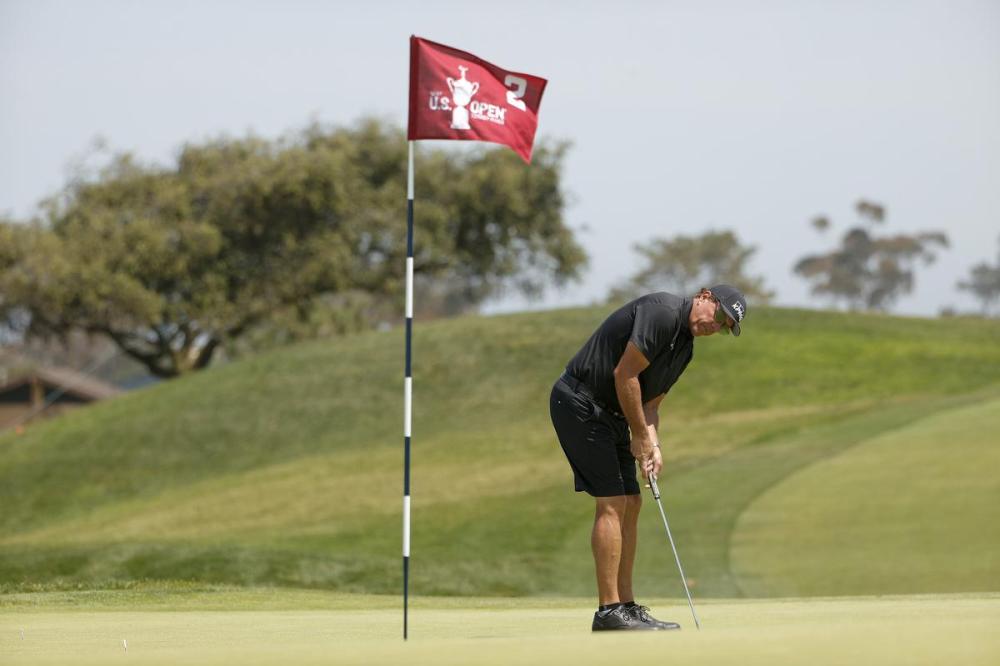
Phil Mickelson adores Torrey too. The PGA Championship winner turned 51 Wednesday and needs only the U.S. Open to complete the career grand slam. He’s finished second six times in his national championship and isn’t it crazy to consider that this week might be as legitimate of a shot as he’s had in the tournament given the game he displayed at Kiawah Island last month and his history at Torrey Pines? The San Diego native has three wins and a runner-up on the course and he tied for 18th at the 2008 U.S. Open there.
Dustin Johnson and Brooks Koepka figure to factor too, as does the defending champion DeChambeau, the tour’s top-ranked player in Strokes Gained: Off the Tee. But maybe, despite the premium on driving the ball well, Torrey’s poa annua greens will ultimately decide the outcome. They require extreme patience given they get bumpier as the day goes on. Remember that putt Tiger Woods made at the 2008 U.S. Open to qualify for a playoff with Rocco Mediate? It hopped its way to the hole like the green was a Plinko board.
“The one thing that always got me about courses like Torrey and Pebble, out on the West Coast, is that as the day goes on you start to see footprints and it’s very discouraging. It’s difficult to putt,” explained Fritsch. “It’s not like perfect Bermuda or perfect Bentgrass where if you hit a good putt it’s likely to go in. Out there that’s not how it works. It’s the mindset of that and accepting it and knowing that the scores aren’t going to be super low.”
No they are not. This is the U.S. Open after all. The toughest of tests. Maybe not being contested on a classic golf course this time around, but certainly one up to the job of identifying the week’s best player.
Jason Logan is the editor of SCOREGolf Magazine and is based in Toronto. He is a contributor to the Star’s Sports section. Follow him on Twitter: @jasonSCOREGolf
Related Articles
Ryder Cup: Kaymer, McDowell picked as Europe's vice captains





Advertisement Advertise With Us
Advertisement Advertise With Us