This MVP’s a shocker
After footballer Christian Eriksen's frightening on-field collapse, a look back on other athletes who've needed a life-saving jolt
Advertisement
Read this article for free:
or
Already have an account? Log in here »
To continue reading, please subscribe:

Digital Subscription
One year of digital access for only $205*
- Enjoy unlimited reading on winnipegfreepress.com
- Read the E-Edition, our digital replica newspaper
- Access News Break, our award-winning app
- Play interactive puzzles
*First annual payment billed as $205.00 + GST for one year. This annual subscription will automatically renew at $233.00 + GST every 52 weeks (10% off the regular annual price of $259.35). Offer available to new and qualified returning subscribers only. Cancel any time.
To continue reading, please subscribe:
Add Free Press access to your Brandon Sun subscription for only an additional
$1 for the first 4 weeks*
- Enjoy unlimited reading on winnipegfreepress.com
- Read the E-Edition, our digital replica newspaper
- Access News Break, our award-winning app
- Play interactive puzzles
*Your next Brandon Sun subscription payment will increase by $1.00 and you will be charged $17.95 plus GST for four weeks. After four weeks, your payment will increase to $24.95 plus GST every four weeks.
Read unlimited articles for free today:
or
Already have an account? Log in here »
Hey there, time traveller!
This article was published 19/06/2021 (1937 days ago), so information in it may no longer be current.
It was one of the most miraculous saves in the history of soccer. It came after Denmark’s Christian Eriksen’s heart stopped last Saturday during the first half of his team’s game against Finland at the European Championship in Copenhagen.
As 15,000 people in the stands and millions of TV viewers looked on, Eriksen’s teammates formed a protective wall around their fallen star when he collapsed on the pitch after suffering cardiac arrest.
Players from both teams, as well as fans in the stadium were visibly distressed as medics raced to restart the heart of the man considered Denmark’s finest player.
He was brought back to life through a combination of CPR — the manual cardiopulmonary resuscitation that involves repeated pushing down on the chest — and an electric shock from an automated defibrillator.
Denmark’s team doctor, Morton Boesen, told reporters Eriksen “was gone” before he was resuscitated. “Well, what should I say? He was gone. And we did cardiac resuscitation and it was cardiac arrest. How close were we? I don’t know,” Boesen said. “We got him back after one ‘de-fib,’ so that is quite fast.”
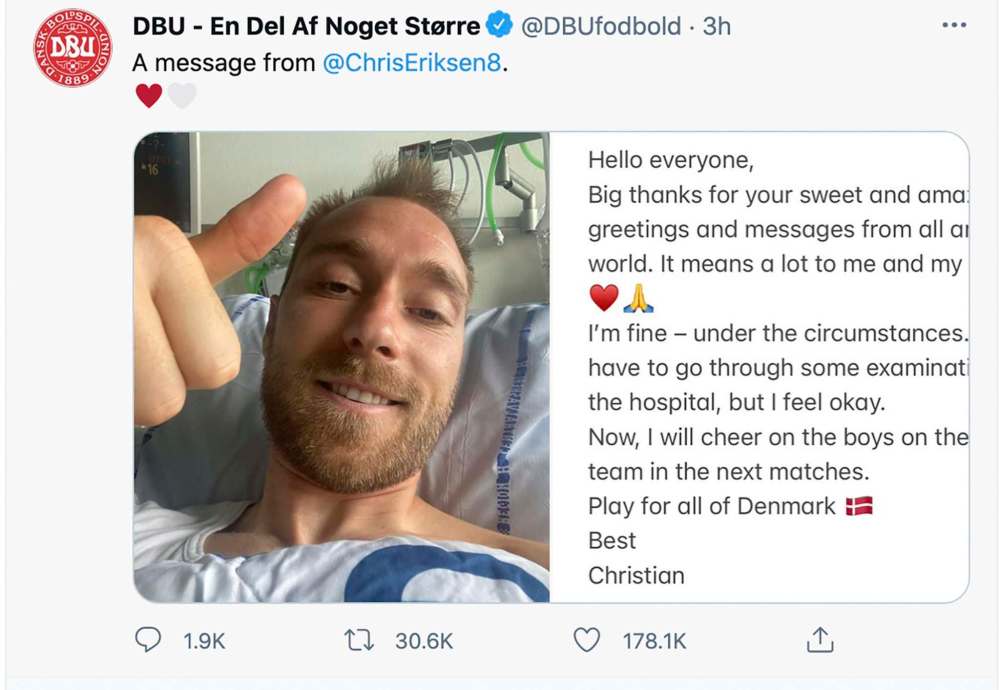
On Tuesday, the 29-year-old soccer star thanked supporters for their well-wishes in message that was accompanied by a photo of him giving a thumbs-up from his hospital bed.
Eriksen’s terrifying experience puts him in excellent company, as we see from today’s heart-tugging list of Five Athletes Brought Back to Life by Automatic Defibrillators:
5) The stricken athlete: Swimmer Paul Andaloro
The heart-starting rescue: Paul Andaloro had been swimming at the Gus Ryder Pool and Health Club in Toronto for 25 years, but in the early morning of Jan. 18, 2013, something happened that had never happened before. Andaloro, a fit 65-year-old who swam at the pool three times a week and rode his bike 100 kilometres a week, suffered a cardiac arrest.
“My cool-down lap, I swim on my back. And on that lap, I was looking at the ceiling and it started to spin,” Andaloro recalled. “That’s the last thing I remember.” The three lifeguards on duty noticed he was in distress, pulled him from the water and started CPR. And with the help of an automatic external defibrillator (AED) — available in every city pool — they saved his life. Once the lifeguards applied the AED to Andaloro’s chest, it gave a shock. Lifeguard Kristy Blair continued CPR for two minutes, but the defibrillator indicated no further shock was required. It was the first time Blair had used an AED. “It gave me butterflies at first,” Blair said later.
“Feels really good to know he has more time with his family and he can live his life.” Andaloro underwent emergency surgery and went back to the pool to thank those who rescued him. “Can you imagine being able to save someone’s life?” he said. “And that’s what they did. They saved my life… These people’s training and dedication really pays off — it paid off for me.” Gayle Pollock, commander of the Toronto EMS Safe City Program, said seven lives were saved the previous year with the automated defibrillators.
“This is the third save this year using an AED installed in a public space as part of the City’s program,” she said. “When someone like Mr. Andaloro is in cardiac arrest, seconds count. Without CPR and defibrillation, fewer than five per cent of people who have a cardiac arrest outside of a hospital survive.”
4) The stricken athlete: Rec basketball player Kevin Marcus Miller
The heart-starting rescue: It was 2019 and Kevin Marcus Miller had just joined a recreational basketball league in Seattle, Wash. The idea, according to a story this month by the American Heart Association News, was to get more exercise, meet new people and give balance to a life that had become dominated by work.
“Minutes into his second game, the 25-year-old was dribbling up the court when he went down on one knee,” the association reports. “Then he collapsed, unconscious.” Tim Kerns, who runs the adult basketball league, had just walked into the gym and thought Miller might have turned an ankle or maybe even had a seizure. But when he checked Miller’s wrist and neck area for a pulse, there was none. “We’ve got to start CPR pronto,” Kerns told everyone in the gym. While one man went to call 911, Kerns began chest compressions.
“Once it got to the four- or five-minute mark, I think all of us there were super concerned,” Kerns recalled. When paramedics arrived, they set up a defibrillator to try jolting Miller’s heart back into rhythm. The first two shocks did nothing, so they tried a third, then wheeled the fallen man out to the ambulance. “I thought he passed away,” Kerns told the heart association. “But the fireman said, ‘No, we got a pulse.’” At the hospital, Miller was put into an induced coma. Three days later, he awoke, confused. His brother and the doctors explained what happened. The problem turned out to be an electrical issue that caused an odd rhythm.
A subcutaneous implantable cardioverter defibrillator was placed in his side in case his heart stopped again, which was when the doctors gave him the OK to go back to the rec league. So Miller returned to play, and, yes, his heart stopped again. Kerns was there to see it. “I screamed bloody murder to call 911,” Kerns said. “And he popped back up. He was only down a second or two. He’s like, ‘No, I’m OK.’ “ Said Miller of that second heart-stopping moment: “The defibrillator kicked right in.”
3) The stricken athlete: Nova Scotia baseball player Sean Ferguson
The heart-starting rescue: All-around athlete Sean Ferguson of Cape Breton, N.S., knows one thing for sure — he probably wouldn’t be alive if it weren’t for a few good friends and a handy defibrillator. Ferguson will never forget the day in June 2016 when he collapsed while playing a pickup game of basketball in the gym at Cape Breton University’s Sullivan Field House.
At the age of 23, he suffered cardiac arrest. He was well-known in the local sports community as a member of the Sydney Sooners senior baseball club and a former player with the Glace Bay Miners junior hockey team, and on this day some of his Sooners teammates were on the court when he collapsed. “The first thing was panic, but then the next thing (we thought) was, ‘We gotta do what we gotta do to keep our friend going until the paramedics get here,’” teammate Kenny Long told CTV at the time. Taylor Slade ran to a nearby sports complex to grab an automated defibrillator while others at the scene performed CPR on Ferguson.
Slade returned and began pumping electric pulses into his friend’s chest, but Ferguson still didn’t wake up. “He did not respond, he was having trouble breathing, and I realized this is very real. I was terrified,” Slade recalled. Ferguson was rushed to Cape Breton Regional Hospital in Sydney, where he spent several days in a medically induced coma. Two weeks after the incident, he had surgery to get a subcutaneous cardioverter defibrillator put in. It shocks his heart back to the proper rhythm when the organ goes awry. The man they call “Fergie” credits his friends with saving his life. “I think it is safe to say that without them I wouldn’t be here today,” he told saltwire.com. “It was their quick actions to locate and get the defibrillator, do the CPR and call it in. Everything worked out the way I needed it to in order for it to turn out like it did.”
Today, at 28, he’s committed to raising awareness about defibrillator access. “If you put one of those in a facility and it never saves anybody’s life it is still not a waste of money or time because you can never say never,” he said.
2) The stricken athlete: St. Louis Blues defenceman Jay Bouwmeester
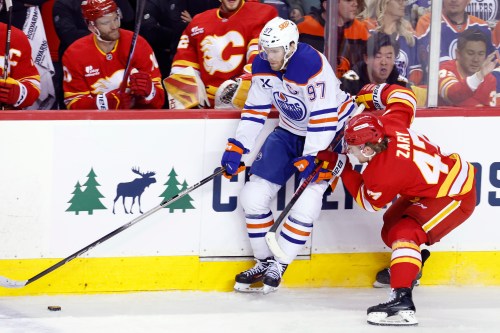
The heart-starting rescue: If you’re going to go into cardiac arrest, a professional hockey team’s arena is a pretty good place to do it. Just ask now-retired St. Louis Blues defenceman Jay Bouwmeester, whose career was cut short when he became unresponsive on the bench on Feb. 11, 2020, and needed to be revived by a defibrillator after completing a lengthy shift against the Ducks in Anaheim.
“It happened in the absolute best place that it could happen because of all the protocols they have in place and how people responded so quickly,” Bouwmeester said days after the drama unfolded on the bench. “No. 1, they saved my life and No. 2, the fact that they could get on it so fast was very helpful.” Chaos erupted when, after a long shift, Bouwmeester returned to the bench, reached for a water bottle, then collapsed next to teammate Vince Dunn, who immediately flagged medical staff to attend to his stricken teammate.
“It all just came pretty suddenly,” Bouwmeester said later. “Everything up to that point was normal. I hadn’t been sick or had much going on. It was completely out of the blue.” With the hockey world looking on, first responders used a defibrillator to help the 36-year-old regain consciousness before he was taken to hospital. The game was postponed and finished on March 11, the day before the season was cut short by COVID-19. In a video, Bouwmeester can be seen slumped over on the bench before he falls forward and his teammates call for help. Opposing players were seen consoling Blues players as the incident unfolded. It was also father’s week for the Blues so Bouwmeester’s dad was in the stands when the incident occurred.
On Feb. 14, Valentine’s Day, Bouwmeester had an implantable cardioverter defibrillator placed in his chest to restore his heart’s normal rhythm. Eleven months later, he told TSN he’d decided to retire from the NHL, where he was a star for 17 seasons. He won a Stanley Cup with the St. Louis Blues in 2019, won an Olympic gold medal with Canada in 2014 and was named to two all-star games. “Oh yeah,’’ Bouwmeester said when TSN’s Pierre LeBrun asked if he was done playing in the NHL. “I knew I was done essentially when it happened, to be quite honest.’’
1) The stricken athlete: Former soccer star Fabrice Muamba
The heart-starting rescue: If anyone understands the agony Denmark’s Christian Eriksen is experiencing, it’s Fabrice Muamba. The former Bolton Wanderers midfielder famously suffered a cardiac arrest on the pitch during an FA cup quarterfinal on March 17, 2012.
Then 23, Muamba’s heart stopped for a stunning 78 minutes, but he miraculously recovered after medics administered a reported 26 defibrillator shocks on the field and in the ambulance rushing him to hospital. Muamba told reporters he has an idea of how Eriksen must be feeling and said the fact the incident happened on a field with medics nearby likely saved the Danish star’s life.

“If this was going to happen anywhere, it was better for it to happen on a football pitch,” Muamba said in an interview with Britain’s The Telegraph newspaper. “My experience taught me that. The speed and expertise of the medical staff on the scene rescued me from a cardiac arrest in 2012. As did the skill of all those who rushed me to the London Chest Hospital. All I could say when watching the television was ‘please Christian, pull through.’”
He confided he has never really gotten over the incident that led to his retiring from the game he loved. Muamba was discharged from hospital after receiving an implantable cardioverter-defibrillator. In the wake of Eriksen’s cardiac incident, Muamba is now calling for the government to make defibrillators a legal requirement in public places, including schools, sports facilities and other public buildings.
He told the Mirror newspaper: “No one realizes how important a defibrillator is until they are in a situation where they need one — the difference of having one could be life or death. I was extremely fortunate to be surrounded by the best medics with the right equipment when I suffered my cardiac arrest. But I know that others are not as lucky because they don’t have access to a defibrillator quickly enough.”
When CPR is combined with the use of an AED in the first few minutes, an individual’s chance of surviving a cardiac arrest increases by up to 75 per cent.
doug.speirs@freepress.mb.ca
Related Articles
Eriksen released from hospital after 'successful' operation


Advertisement Advertise With Us
Advertisement Advertise With Us