Hong Kong freedoms fade as security law muzzles dissent
Advertisement
Read this article for free:
or
Already have an account? Log in here »
To continue reading, please subscribe:

Digital Subscription
One year of digital access for only $205*
- Enjoy unlimited reading on winnipegfreepress.com
- Read the E-Edition, our digital replica newspaper
- Access News Break, our award-winning app
- Play interactive puzzles
*First annual payment billed as $205.00 + GST for one year. This annual subscription will automatically renew at $233.00 + GST every 52 weeks (10% off the regular annual price of $259.35). Offer available to new and qualified returning subscribers only. Cancel any time.
To continue reading, please subscribe:
Add Free Press access to your Brandon Sun subscription for only an additional
$1 for the first 4 weeks*
- Enjoy unlimited reading on winnipegfreepress.com
- Read the E-Edition, our digital replica newspaper
- Access News Break, our award-winning app
- Play interactive puzzles
*Your next Brandon Sun subscription payment will increase by $1.00 and you will be charged $17.95 plus GST for four weeks. After four weeks, your payment will increase to $24.95 plus GST every four weeks.
Read unlimited articles for free today:
or
Already have an account? Log in here »
Hey there, time traveller!
This article was published 30/06/2021 (1861 days ago), so information in it may no longer be current.
HONG KONG (AP) — Hong Kong is still China’s wealthiest, most capitalist city. Its vistas of skyscrapers and sea framed by dragon-backed emerald peaks are as stunning as ever. But a year after Beijing imposed a harsh national security law on the former British colony, the civil liberties that raised hopes for more democracy among many of its 7 million people are fading.
The June 30, 2020, introduction of the law accelerated a rolling back of freedoms promised to Hong Kong when China took over in 1997.
Already, authorities have banned an annual June 4 candlelight vigil commemorating the bloody 1989 crackdown on pro-democracy demonstrators in Beijing’s Tiananmen Square, and a yearly July 1 pro-democracy protest, citing pandemic social distancing restrictions.
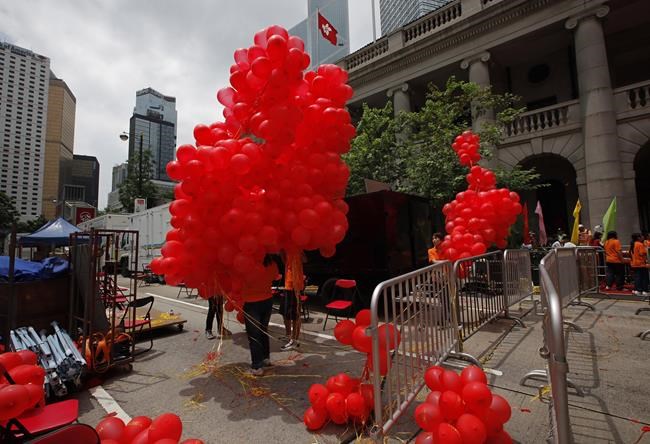
On Wednesday, police rearrested pro-democracy activist Chow Hang-tung on suspicion of inciting others to participate in an unauthorized assembly. Chow, a key organizer of the June 4 Tiananmen candlelight vigils, is one of many pro-democracy figures who have been detained over the past year.
Most of the city’s outspoken pro-democracy activists are currently behind bars or have fled overseas.
The rollback of freedoms was punctuated earlier this month with the shutdown of the city’s last pro-democracy newspaper, Apple Daily.
The authorities first came for Apple Daily’s outspoken billionaire founder Jimmy Lai. He’s in jail serving a 20-month sentence and facing charges of foreign collusion to endanger national security.
Last week, some 500 police officers raided the newspaper’s headquarters. At least seven of its journalists and executives have been arrested and $2.3 million worth of assets linked to the paper frozen, preventing it from paying salaries and other costs. For its final edition, Apple Daily printed a million copies — more than 12 times its usual print run. It sold out to crowds who lined up at newsstands for hours.
Apple Daily’s coverage was often “sensationalist,” but it also uncovered corruption and won awards for its investigative reporting, Yuen Chan, a journalism lecturer at the City University of London, said in a commentary republished by Hong Kong online news portal Citizen News.
It also was a “barometer of Hong Kong’s press freedom and freedom of expression,” she wrote.
The newspaper’s closure comes as the Chinese Communist Party celebrates the 100th anniversary of its founding in Shanghai in 1921 by Mao Zedong and others. Over the last year the Chinese government has tightened its grip over semi-autonomous Hong Kong following months of anti-government protests that brought hundreds of thousands of people into the streets.
The demonstrations against proposed extradition legislation that would have allowed suspects to face trial in mainland Chinese courts sometimes turned violent, and encompassed other demands, including calls for greater democracy and investigation into police tactics. Now, protesting or publishing anything that might be construed as a violation of the security law can land them in jail in Hong Kong.
Traditionally, the city has been considered one of the most attractive places for expatriates, thanks to its low tax rates and ease of doing business. It’s still a major business and financial hub. But some multinational companies have begun relocating their operations and staff. The American Chamber of Commerce says 2 out of 5 expats it surveyed in May were considering leaving the city. The top concern was the national security law.
In private conversations, many in Hong Kong lament the loss of their freedoms, but life goes on. On the weekends, shopping malls are still crowded. People still line up for hours to get seats in popular dim sum and noodle restaurants or take weekend strolls on scenic Victoria Peak. On the surface, daily life hasn’t changed much.
What has changed are the special privileges that Hong Kong was promised for a half-century after control of the territory was handed to Beijing on July 1, 1997 — the autonomy of its courts and legal system, civil liberties that included a free press, freedom of speech and the leeway to take to the streets and other public spaces in protest.
With the space for dissent shrinking, the online news platform Stand News said it would remove commentaries published on its site before June, stop its fundraising efforts and stop accepting new subscribers.
With the handover 24 years ago, Hong Kong became a semi-autonomous territory, promised independent economic and legal status under a “one country, two systems” arrangement that led many in the city to expect more, not less democracy despite the Communist Party’s lack of tolerance for dissent across the border in the Chinese mainland.
Like millions of others who left the mainland seeking more opportunity in Hong Kong in past decades, 40-something Wang Wai says she migrated there because wages were “in the thousands but in China still in the hundreds.”
“The health care system, education and work to be found in Hong Kong is much better than in China,” said Wang, who is married with two children.
Ever since its days as a hub in Britain’s trading of opium from India for silk, tea and porcelain from China, Hong Kong has mainly been about moneymaking. The city flourished in the years after the 1949 Communist Revolution, as industrialists from Shanghai relocated to the colony, bringing what they could of their salvaged fortunes.
After the city’s garment and electronics manufacturing moved across the border, back into China, Hong Kong’s colonial legacy left it well placed to thrive as a financial center for what has become the world’s No. 2 economy. For many in the city, the handover to Beijing was just a welcome switch of flags.
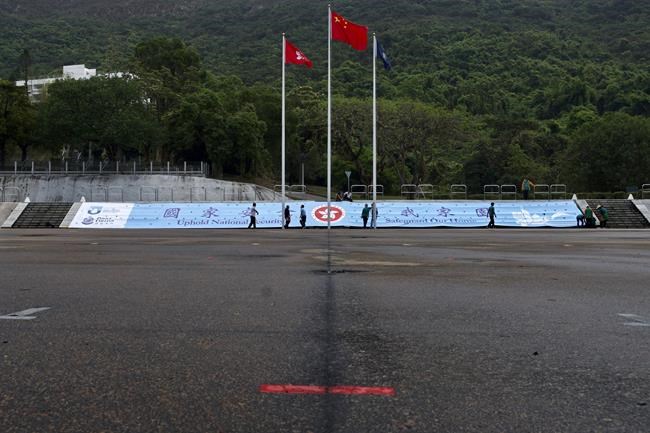
Hong Kong was meant to help lead China’s ascent as an economic power, enjoying the best of both East and West, as its first chief executive, shipping tycoon Tung Chee-hwa, often would say. It remains home for scores of billionaire business people and many other wealthy Chinese who have invested in choice property after prospering on the mainland.
Despite the massive pro-democracy protests that paralyzed parts of the city in 2019 and the blows to tourism and trade from the pandemic, the city’s stratospheric property market has surged still higher.
Even modest apartments under 100 square meters (1,100 square feet) have more than doubled in price since 1997, said Derek Chan, head of research at real estate firm Ricacorp Properties.
“Even though prices have soared, the wealthy in Hong Kong are still willing to buy property at these prices, making it increasingly inaccessible for regular residents to buy homes,” Chan said.
Such costs have made the city unaffordable for many: the share of Hong Kongers living in poverty has doubled to 1 in 5 since the handover.
Such pressures have added to frustrations as Beijing has tightened the screws.
Even before the handover, China and Britain quarreled over how much democracy Hong Kong should have. When election results made it clear that the public preferred more, Beijing moved to ensure it would stay in control, mandating less.
Hong Kong’s last colonial governor, Chris Patten, left the territory declaring that, “Now Hong Kong people are to run Hong Kong.″
“That is the promise — and that is the unshakeable destiny,″ he said as he boarded the Royal Yacht Britannia and sailed away after the handover.
A city of Chinese people accustomed to a free press, rule of law, freedom of assembly had hoped in time to gain more say over how they were governed. Instead, one distant ruler has replaced another.

The weakening of the city’s civil liberties is “not a good thing,” said Wang, who moved to Hong Kong from her hometown in southeastern China’s Fujian province. “I came to Hong Kong also because it had freedom, and there is rule of law and more democracy. Now it is looking more and more like a city in China.”
___
This story corrects Chan’s job description.
___
Kurtenbach, who has lived and worked in Hong Kong and China at times since 1981, contributed to this report from Bangkok.