Monster wildfire tests years of forest management efforts

Advertisement

Advertise with us

PORTLAND, Ore. (AP) — Ecologists in a vast region of wetlands and forest in remote Oregon have spent the past decade thinning young trees and using planned fires to try to restore the thick stands of ponderosa to a less fire-prone state.

Read this article for free:


or

Already have an account? Log in here »

To continue reading, please subscribe:

Subscribe and receive a limited-edition Free Press branded hat or tote.

Digital Subscription

One year of digital access for only $205*

  • Enjoy unlimited reading on winnipegfreepress.com
  • Read the E-Edition, our digital replica newspaper
  • Access News Break, our award-winning app
  • Play interactive puzzles

*First annual payment billed as $205.00 + GST for one year. This annual subscription will automatically renew at $233.00 + GST every 52 weeks (10% off the regular annual price of $259.35). Offer available to new and qualified returning subscribers only. Cancel any time.

To continue reading, please subscribe:

Add Free Press access to your Brandon Sun subscription for only an additional

$1 for the first 4 weeks*

  • Enjoy unlimited reading on winnipegfreepress.com
  • Read the E-Edition, our digital replica newspaper
  • Access News Break, our award-winning app
  • Play interactive puzzles
Start now

*Your next Brandon Sun subscription payment will increase by $1.00 and you will be charged $17.95 plus GST for four weeks. After four weeks, your payment will increase to $24.95 plus GST every four weeks.

Hey there, time traveller!
This article was published 20/07/2021 (1853 days ago), so information in it may no longer be current.

PORTLAND, Ore. (AP) — Ecologists in a vast region of wetlands and forest in remote Oregon have spent the past decade thinning young trees and using planned fires to try to restore the thick stands of ponderosa to a less fire-prone state.

This week, the nation’s biggest burning wildfire provided them with an unexpected, real-world experiment. As the massive inferno half the size of Rhode Island roared into the Sycan Marsh Preserve, firefighters said the flames jumped less from treetop to treetop and instead returned to the ground, where they were easier to fight, moved more slowly and did less damage to the overall forest.

The initial assessment suggests that the many years of forest treatments worked, said Pete Caligiuri, Oregon forest program director for The Nature Conservancy, which runs the research at the preserve.
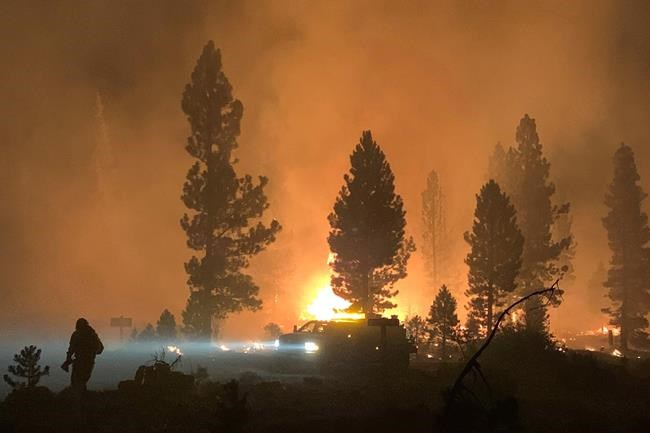
In this photo provided by the Bootleg Fire Incident Command, the Bootleg Fire burns at night in southern Oregon on Saturday, July 17, 2021. The destructive Bootleg Fire, one of the largest in modern Oregon history, has already burned more than 476 square miles (1,210 square kilometers), an area about the size of Los Angeles. The Bootleg Fire is among dozens burning in the parched West. (Bootleg Fire Incident Command via AP)

“Generally speaking, what firefighters were reporting on the ground is that when the fire came into those areas that had been thinned … it had significantly less impact.”

The reports were bittersweet for researchers, who still saw nearly 20 square miles of the preserve burn, but the findings add to a growing body of research about how to make wildfires less explosive by thinning undergrowth and allowing forests to burn periodically — as they naturally would do — instead of snuffing out every flame.

The Bootleg Fire, now 606 square miles (1,569 square kilometers) in size, has ravaged southern Oregon and is the fourth-largest fire in the state’s modern history. It’s been expanding by up to 4 miles (6 kilometers) a day, pushed by gusting winds and critically dry weather that’s turned trees and undergrowth into a tinderbox.

Fire crews have had to retreat from the flames for 10 consecutive days as fireballs jump from treetop to treetop, trees explode, embers fly ahead of the fire to start new blazes and, in some cases, the inferno’s heat creates its own weather of shifting winds and dry lightning. Monstrous clouds of smoke and ash have risen up to 6 miles into the sky and are visible for more than 100 air miles.

The fire in the Fremont-Winema National Forest merged with a smaller nearby blaze Tuesday, and it has repeatedly breached a perimeter of treeless dirt and fire retardant meant to stop its advance.

More evacuations were ordered Monday night, and a red flag weather warning signifying dangerous fire conditions was in effect through Tuesday. The fire is 30% contained.

“We’re in this for as long as it takes to safely confine this monster,” Incident Commander Rob Allen said Tuesday.

At least 2,000 homes have been evacuated at some point during the fire and another 5,000 threatened. At least 70 homes and more than 100 outbuildings have gone up in flames. Thick smoke chokes the area where residents and wildlife alike have already been dealing with months of drought and extreme heat. No one has died.

The Bootleg Fire was one of many fires burning in a dozen states, most of them in the West. Sixteen large uncontained fires burned in Oregon and Washington state alone on Monday.

On Tuesday, officials temporarily closed all recreational and public access to state-managed lands in eastern Washington due to fire danger, starting Friday.

Historically, wildfires in Oregon and elsewhere in the West burned an area as big or bigger than the current blaze more frequently but much less explosively. Periodic, naturally occurring fire cleared out the undergrowth and smaller trees that cause today’s fires to burn so dangerously.
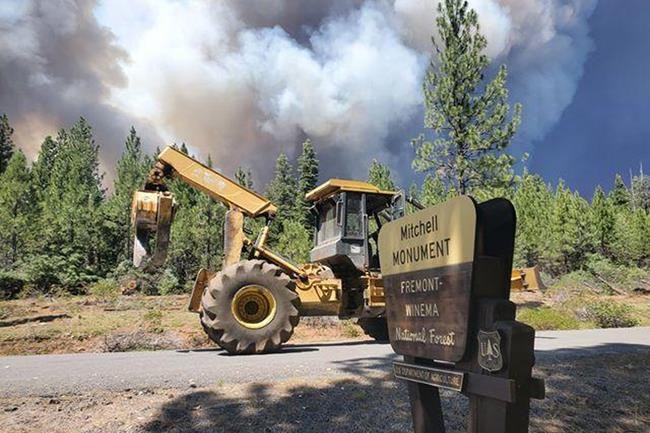
In this photo provided by the Bootleg Fire Incident Command, the Bootleg Fire burns behind heavy equipment at the Mitchell Monument in southern Oregon on Saturday, July 17, 2021. The 569-square-mile (1,474 square kilometers) Bootleg Fire is burning 300 miles (483 kilometers) southeast of Portland in and around the Fremont-Winema National Forest, a vast expanse of old-growth forest, lakes and wildlife refuges. (Bootleg Fire Incident Command via AP)

Those fires have not been allowed to burn for the past 120 years, said James Johnston, a researcher with Oregon State University’s College of Forestry who studies historical wildfires.

The area on the northeastern flank of the Bootleg Fire is in the ancestral homeland of the Klamath Tribes, which have used intentional, managed fire to keep the fuel load low and prevent such explosive blazes. Scientists at the Sycan Marsh research station now work with the tribe and draw on that knowledge.

Climate change is the catalyst for the worsening wildfire seasons in the West, Johnston said, but poor forest management and a policy of decades of fire suppression have made a bad situation even worse.

“My colleagues and I have been predicting a massive fire in that area for years. It’s an area that’s exceptionally prone to catastrophic fire,” said Johnston, who is not affiliated with Sycan Marsh. “It’s dry. It’s fire-prone and always has been. But what’s changed over the past 100 years is an extraordinary amount of fuel buildup.”

Elsewhere, fire crews were engaged in other daunting battles.

In Northern California, authorities expanded evacuations for the Tamarack Fire in Alpine County in the Sierra Nevada to include the mountain town of Mesa Vista late Monday. That fire, which exploded over the weekend was 61 square miles (158 square kilometers) with no containment.

Tony Galvez fled with his daughter at the last minute and found out the family’s home is gone.

“I lost my whole life, everything I’ve ever had. The kids are what’s going to matter,” he said as he fielded calls from relatives. “I got three teenagers. They’re going to go home to a moonscape.”

On the western side of the Sierra, the Dixie Fire has scorched more than 90 square miles (163 square kilometers), threatening tiny communities in the Feather River Valley region.

Meteorologist Julia Ruthford told a briefing that a surge of monsoonal moisture from the Southwest had created plumes topping 6 miles — so big that the fire generated a thunderstorm over itself with lightning and gusty winds.
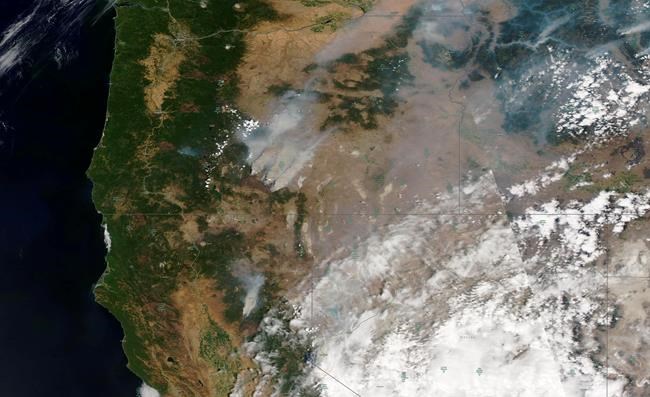
This satellite image provided by Satellite image ©2021 Maxar Technologies shows overview of wildfires from Oregon, Idaho, and Northern California on Sunday, July 18, 2021. Extremely dry conditions and heat waves tied to climate change have made wildfires harder to fight. Climate change has made the West much warmer and drier in the past 30 years and will continue to make weather more extreme and wildfires more frequent and destructive. (Satellite image ©2021 Maxar Technologies via AP)

For the past two days in Oregon, the fire has danced around Sycan Marsh, where researchers raced to protect buildings with sprinklers and fire lines. The 47-square-mile habitat attracts migrating and nesting birds and offers a unique location to research forest and fire ecology.

The nonprofit operates its own fire engines and now has three engines and seven firefighters on the blaze and more people are arriving.

“It’s an amazing place,” Caligiuri said. “It’s very hard to watch it all happening, and seeing all of that work being threatened by this fire is a lot to process.”

___

Associated Press Writer John Antczak in Los Angeles and AP Video Journalist Haven Daley in Alpine County, California, contributed to this report.

___

Follow Flaccus on Twitter at http://www.twitter.com/gflaccus

Report Error Submit a Tip

More Stories

A Life's Story: Woman fought for better outcomes for others amid cancer fight

Janine LeGal 7 minute read Preview

A Life's Story: Woman fought for better outcomes for others amid cancer fight

Janine LeGal 7 minute read Yesterday at 3:00 AM CDT

Catherine Mary Burke was strong and motivated in ways many of us could never imagine.

She was known for fighting the good fight, and she fought as hard as she could for as long as she could. But something set her apart. Even when it was too late for her, she insisted cancer survival rates had to be better for other women. And they are today because of her fierce determination.

Burke died on Nov. 29, 2025, at age 67 after courageously facing breast cancer for more than a decade.

“Cathy was born happy,” said her husband, Patrick Burke. “She was a glass-half-full person. What a gift this attitude was to me and the boys. She never once said ‘Why me?’ or complained. She was just so happy to be alive.

Read
Yesterday at 3:00 AM CDT

Rainbow Stage’s Legally Blonde a lovely legal musical

Holly Harris 6 minute read Preview

Rainbow Stage’s Legally Blonde a lovely legal musical

Holly Harris 6 minute read Friday, Aug. 14, 2026

Omigod, you guys! Rainbow Stage kicked off its penultimate summer production Thursday with a high-octane joy machine bathed in a sea of pink.

Inspired by the 2001 Hollywood film starring Reese Witherspoon, and Amanda Brown’s same-titled novel, the award-winning Legally Blonde: The Musical — featuring a book by Heather Hach, with music/lyrics by Laurence O’Keefe and Nell Benjamin — opened on Broadway in April 2007, followed by a subsequent West End run.

The tale — equal parts cheesy rom-com and potent siren call for female autonomy and empowerment — focuses on quintessential Cali-girl Elle Woods (a pitch-perfect Claire Mac Master). A proud daughter and president of Delta Nu sorority house, she enrols at Harvard Law School to win back her upwardly mobile ex-boyfriend, Warner Huntington III (Duncan Cox).

Laser-focused on marrying a “Jackie, not a Marilyn,” Warner dreams of becoming an American senator, latching onto uber-preppy fellow pupil Vivienne Kensington (Julie Davis), who becomes Elle’s arch nemesis.

Read
Friday, Aug. 14, 2026

Proposed Transcona development — which could add 20,000 people — gets thumbs down from residents

Joyanne Pursaga 5 minute read Preview

Proposed Transcona development — which could add 20,000 people — gets thumbs down from residents

Joyanne Pursaga 5 minute read Friday, Aug. 14, 2026

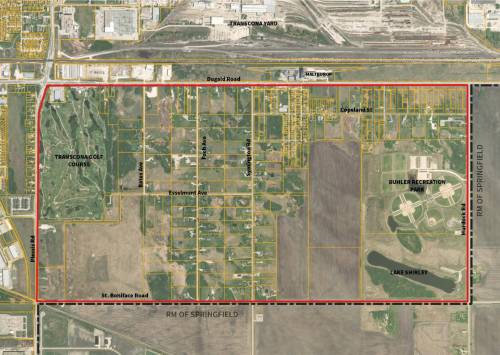
Dozens of Winnipeggers fear plans to make way for up to 20,000 more people to live in south Transcona would dramatically alter their neighbourhood and tie hefty fees for new services to their property titles.

If city council adopts the proposed South Transcona secondary plan, all future development applications would need to conform to its goals. The affected area is located south of Dugald Road, north of St. Boniface Road, east of Plessis Road and west of Murdock Road.

Homeowner Virginia Page Jähne fears the plan could add a massive tab to the title of her 4.3-acre property to cover services required for the development.

“My main concern is that they are wanting to put $1.4 million onto my title to pay for this. Now, they say that I will not have to pay it unless I subdivide. But if a person comes by and wants to buy from me … and they see that $1.4 million … what’s the first thing (they’re) going to do?” said Page Jähne, in an interview.

Read
Friday, Aug. 14, 2026

Bombers manage to hand Redblacks another loss

Taylor Allen 7 minute read Preview

Bombers manage to hand Redblacks another loss

Taylor Allen 7 minute read Updated: Yesterday at 8:35 AM CDT

It looked bad. Real bad.

Winnipeg Blue Bombers quarterback Zach Collaros made his return to the lineup on Friday night against the Ottawa Redblacks, and he was once again the victim of a blindside hit.

The one he suffered in Hamilton on July 5 appeared relatively modest in comparison and yet, it sidelined him for a month with a neck injury.

So when Redblacks linebacker Lucas Cormier came around the edge unblocked and hammered Collaros from behind in the second quarter, you could hear a pin drop inside Princess Auto Stadium.

Read
Updated: Yesterday at 8:35 AM CDT

Manitoba family finalist for cattle producers environmental award

Aaron Epp 4 minute read Preview

Manitoba family finalist for cattle producers environmental award

Aaron Epp 4 minute read Yesterday at 2:00 AM CDT

A family in western Manitoba is one of seven finalists for a national environmental award honouring beef cattle producers.

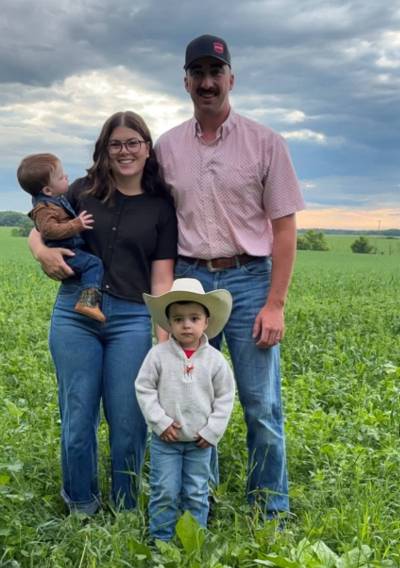
Connor and Kyla English, alongside Connor’s parents, Brian and Leanne English, are nominated for the Canadian Cattle Association’s Environmental Stewardship Award. The 30-year-old award is presented to beef farmers and ranchers who explore innovative ways to protect, preserve and enhance their operations and the environment simultaneously.

This year’s recipient will be announced on Wednesday during a banquet at the Canadian Beef Industry Conference in Winnipeg.

The English family’s roots near Bradwardine — about 265 kilometres west of Winnipeg — date back to 1898. Today, Connor, Kyla, Brian and Leanne manage a herd of about 320 breeding cows on nearly 445 hectares (1,100 acres) of owned and rented pasture and forage land.

Read
Yesterday at 2:00 AM CDT

Men’s recovery home dedicated to ‘homeless hero’ Faron Hall’s memory

Scott Billeck 14 minute read Preview

Men’s recovery home dedicated to ‘homeless hero’ Faron Hall’s memory

Scott Billeck 14 minute read Friday, Aug. 14, 2026

Faron Hall never got the chance to begin recovery. Once heralded as Winnipeg’s “homeless hero” after twice plunging into the Red River to save strangers from drowning, Hall told St. Boniface Street Links executive director Marion Willis shortly before his death in 2014 that he wanted help for his alcoholism.

Read
Friday, Aug. 14, 2026