Merkel prepares to step down with legacy of tackling crises

Advertisement

Advertise with us

BERLIN (AP) — Angela Merkel will leave office as one of modern Germany's longest-serving leaders and a global diplomatic heavyweight, with a legacy defined by her management of a succession of crises that shook a fragile Europe rather than any grand visions for her own country.

Read this article for free:


or

Already have an account? Log in here »

To continue reading, please subscribe:

Subscribe and receive a limited-edition Free Press branded hat or tote.

Digital Subscription

One year of digital access for only $205*

  • Enjoy unlimited reading on winnipegfreepress.com
  • Read the E-Edition, our digital replica newspaper
  • Access News Break, our award-winning app
  • Play interactive puzzles

*First annual payment billed as $205.00 + GST for one year. This annual subscription will automatically renew at $233.00 + GST every 52 weeks (10% off the regular annual price of $259.35). Offer available to new and qualified returning subscribers only. Cancel any time.

To continue reading, please subscribe:

Add Free Press access to your Brandon Sun subscription for only an additional

$1 for the first 4 weeks*

  • Enjoy unlimited reading on winnipegfreepress.com
  • Read the E-Edition, our digital replica newspaper
  • Access News Break, our award-winning app
  • Play interactive puzzles
Start now

*Your next Brandon Sun subscription payment will increase by $1.00 and you will be charged $17.95 plus GST for four weeks. After four weeks, your payment will increase to $24.95 plus GST every four weeks.

Hey there, time traveller!
This article was published 02/09/2021 (1813 days ago), so information in it may no longer be current.

BERLIN (AP) — Angela Merkel will leave office as one of modern Germany’s longest-serving leaders and a global diplomatic heavyweight, with a legacy defined by her management of a succession of crises that shook a fragile Europe rather than any grand visions for her own country.

In 16 years at the helm of Europe’s biggest economy, Merkel did end military conscription, set Germany on course for a future without nuclear and fossil-fueled power, enable the legalization of same-sex marriage, introduce a national minimum wage and benefits encouraging fathers to look after young children, among other things.

But a senior ally recently summed up what many view as her main service: as an anchor of stability in stormy times. He told Merkel: “You protected our country well.”
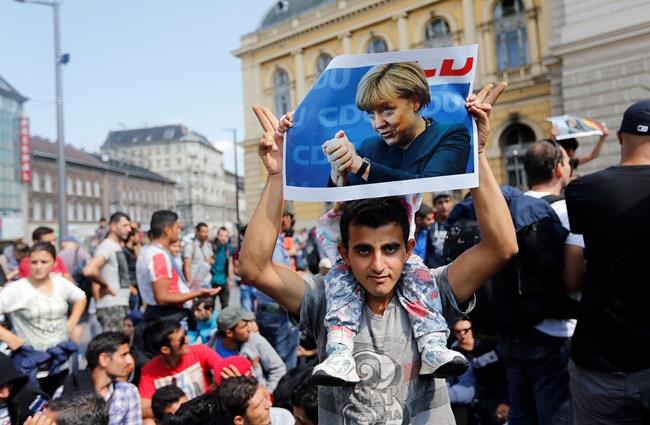
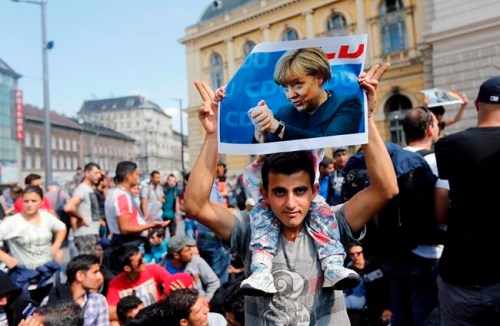
In this Sept. 4, 2015 file photo a migrant holds up a poster of German Chancellor Angela Merkel before starting a march out of Budapest, Hungary, towards Austria. In 2015, Merkel was the face of a welcoming approach to migrants as people fleeing conflicts in Syria and elsewhere trekked across the Balkans, allowing in hundreds of thousands and insisting that
In this Sept. 4, 2015 file photo a migrant holds up a poster of German Chancellor Angela Merkel before starting a march out of Budapest, Hungary, towards Austria. In 2015, Merkel was the face of a welcoming approach to migrants as people fleeing conflicts in Syria and elsewhere trekked across the Balkans, allowing in hundreds of thousands and insisting that "we will manage" the influx, but running into resistance both at home and among European partners. (AP Photo/Frank Augstein, file)

“All the major crossroads you had to navigate … we never mapped out in any election program — they came overnight and you had to govern well,” Bavarian governor Markus Soeder said.

Merkel passed her first test in 2008, pledging at the height of the global financial crisis that Germans’ savings were safe. Over the following years, she was a leading figure in the effort to save the euro currency from the debt crisis that engulfed several members, agreeing to bailouts but insisting on painful spending cuts.

In 2015, Merkel was the face of a welcoming approach to migrants as people fleeing conflicts in Syria and elsewhere trekked across the Balkans. She allowed in hundreds of thousands and insisted that “we will manage” the influx, but ran into resistance both at home and among European partners.

And in the twilight of her career — she announced in 2018 that she wouldn’t seek a fifth term — she led a COVID-19 response that saw Germany fare better than some of its peers.

On the international stage, Merkel insisted on seeking compromises and pursuing a multilateral approach to the world’s problems through years of turbulence that saw the U.S. drift apart from European allies under President Donald Trump and Britain leave the European Union.

“I think Ms. Merkel’s most important legacy is simply that, in such a time of worldwide crises, she provided for stability,” said Ralph Bollmann, a biographer of Merkel and a journalist with the Frankfurter Allgemeine Sonntagszeitung newspaper.

There was “a constant succession of crises that were really existential threats and raised questions over the world order we are used to, and her achievement is that she led Germany, Europe and perhaps to some extent the world fairly safely through that, for all that you can criticize details,” Bollmann said.

Before winning the top job in 2005, he noted, Merkel campaigned as “a chancellor of change, who wanted to make Germany more modern,” seeking deeper economic reforms and a more socially liberal approach than her center-right party had previously taken.

But she ditched much of her economic agenda after almost blowing a huge poll lead by turning off voters with talk of far-reaching reforms, instead embracing what she called an approach of “many small steps.” Along with a pragmatic willingness to jettison conservative orthodoxy such as conscription when opportune, it enabled her to dominate the center ground of German politics.

Crises consumed so much energy that “not much time was left to deal with other issues,” Bollmann said. There is plenty of unfinished business: Merkel has conceded that “the lack of digitization in our society” is a problem, ranging from notoriously patchy cell phone reception to many health offices using faxes to transmit data during the pandemic.

Merkel’s political longevity is already historic. Among democratic Germany’s post-World War II leaders, she lags only Helmut Kohl, who led the country to reunification during his 1982-98 tenure. She could overtake even him if she is still in office on Dec. 17. That’s feasible if parties are slow to form a new government after the Sept. 26 election.

Merkel, 67, insists that others must judge her record. Still, she highlighted a few achievements at a rare campaign appearance last month, starting with the reduction of the number of unemployed in Germany from over 5 million in 2005 to under 2.6 million now.
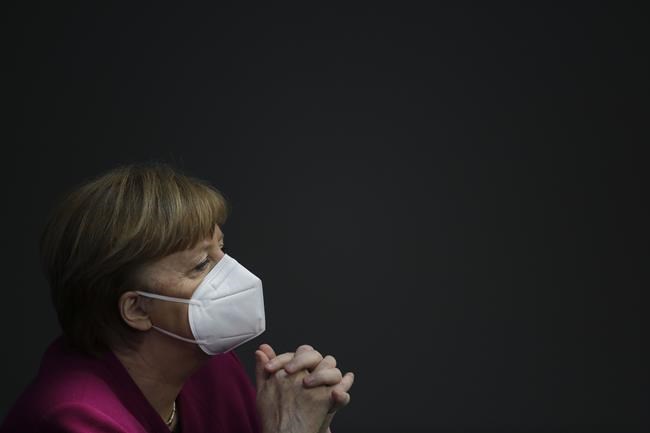
In this Thursday, March 25, 2021 file photo, German Chancellor Angela Merkel attends a session of the German parliament Bundestag ahead of an European Union summit at the Reichstag building in Berlin, Germany. Merkel pointed to her government's drive to improve Germany's public finances, which enabled it to stop running up new debt from 2014 until the coronavirus pandemic pushed it into huge rescue packages. (AP Photo/Markus Schreiber, file)

Predecessor Gerhard Schroeder, whose welfare-state trims and economic reforms were beginning to kick in when he left office, arguably deserves part of the credit.

Merkel also inherited a plan to exit nuclear power from Schroeder, but abruptly accelerated it following the meltdowns at Japan’s Fukushima plant in 2011. More recently, she set in motion Germany’s exit from coal-fueled power.

The chancellor pointed to progress on renewable energy, saying its share of the German energy mix has risen from 10% to well over 40%. Merkel was often referred to as the “climate chancellor” in her early years, but also has drawn criticism for moving too slowly; her government this year moved forward the date for reducing German greenhouse gas emissions to “net zero” to 2045, after the country’s top court ruled that previous plans place too much of the burden on young people.

Merkel praised her government’s drive to improve Germany’s public finances, which enabled it to stop running up new debt from 2014 until the coronavirus pandemic pushed it into huge rescue packages. Opponents argue that it skimped on necessary investments in infrastructure.

“I could talk about how we saved the euro,” she said, adding that “our principle of combining the affected countries’ own responsibility with solidarity was exactly the right method to give the euro a future.” Merkel’s austerity-heavy approach was resented deeply in parts of Europe and controversial among economists, but allowed her to overcome reluctance at home to bail out strugglers.

Whatever the ultimate verdict, Merkel can celebrate a unique end to her tenure: she is set to become the first German chancellor to leave power when she chooses.

___

Kerstin Sopke in Berlin contributed to this report.

Report Error Submit a Tip

More Stories

City rescinds Balmoral Street property owner’s order to clean up encampment

Scott Billeck 3 minute read Preview

City rescinds Balmoral Street property owner’s order to clean up encampment

Scott Billeck 3 minute read Tuesday, Aug. 18, 2026

A West Broadway landlord is off the hook for clearing a large riverbank encampment after the City of Winnipeg rescinded an order threatening to stick him with the cleanup bill.

Marvin Sharp, CEO of Astroid Management Ltd., which operates the Pen-Eve Apartments at 35 Balmoral St., said he received a call from the city Tuesday letting him know the order has been cancelled.

In a statement from the city, an official said the order was shelved due to an existing and active easement on the property.

“We have been communicating with the property owner throughout this process and they have been informed of this development,” a spokesperson said.

Read
Tuesday, Aug. 18, 2026

Merkel prepares to step down with legacy of tackling crises

Geir Moulson, The Associated Press 6 minute read Preview

Merkel prepares to step down with legacy of tackling crises

Geir Moulson, The Associated Press 6 minute read Thursday, Sep. 2, 2021

BERLIN (AP) — Angela Merkel will leave office as one of modern Germany's longest-serving leaders and a global diplomatic heavyweight, with a legacy defined by her management of a succession of crises that shook a fragile Europe rather than any grand visions for her own country.

In 16 years at the helm of Europe's biggest economy, Merkel did end military conscription, set Germany on course for a future without nuclear and fossil-fueled power, enable the legalization of same-sex marriage, introduce a national minimum wage and benefits encouraging fathers to look after young children, among other things.

But a senior ally recently summed up what many view as her main service: as an anchor of stability in stormy times. He told Merkel: “You protected our country well.”

“All the major crossroads you had to navigate ... we never mapped out in any election program — they came overnight and you had to govern well,” Bavarian governor Markus Soeder said.

Read
Thursday, Sep. 2, 2021

Canada, U.S. both say they made gains in new trade deal that averted tariffs

Kelly Geraldine Malone, The Canadian Press 6 minute read Preview

Canada, U.S. both say they made gains in new trade deal that averted tariffs

Kelly Geraldine Malone, The Canadian Press 6 minute read Updated: Yesterday at 5:55 PM CDT

Canada-U.S. Minister Dominic LeBlanc smiled widely beside U.S. President Donald Trump's trade czar in Washington on Wednesday as they touted a draft deal which appears to have averted a new round of punishing tariffs on Canada.

Read
Updated: Yesterday at 5:55 PM CDT

Rural Manitoba homeowner charged with shooting at accused thieves

Nicole Buffie 4 minute read Preview

Rural Manitoba homeowner charged with shooting at accused thieves

Nicole Buffie 4 minute read Tuesday, Aug. 18, 2026

A homeowner in southern Manitoba has been charged after he fired shots at a group of people accused of stealing from his property, police say.

Officers were sent to the Rural Municipality of Dufferin Saturday after a report of a theft in progress. RCMP said four people went to the property, located about 95 kilometres southwest of Winnipeg, and returned later the same day driving two vehicles stolen from Watrous, Sask.

The owner of the property, a 66-year-old man, saw the suspects on a motion-activated camera and saw someone transferring fuel from a portable container into one of the stolen vehicles. The man confronted the group and fired shots towards the vehicles, police said.

Three people stayed at the scene until officers arrived and took them into custody, RCMP said. Various items believed to have been stolen from the property were found in the back of a truck. A fourth suspect fled in the other vehicle.

Read
Tuesday, Aug. 18, 2026

Letters, Aug. 20

7 minute read 2:00 AM CDT

Old-fashioned news

I scrolled through the comment section of the online news story, my eyes darting through differing opinions until I landed on one that caught my attention. I felt my shoulders tense and my breath quicken as I read the fiery thoughts of a stranger.

Surely, there must be a better way to read the news?

I thought back to the ’90s. Every morning, my mother would open the front door to retrieve the Winnipeg Free Press. I would jump at the Arts section until I found the comics and giggle while I ate my cereal. My parents absorbed the news while getting ready for their day, and eventually the newspaper found its way to the top of the paper pile in the garage. The next morning, the cycle would repeat itself.

Build the resources to help children with speech

Britney Morrish and Bonnie Bricker 6 minute read 2:00 AM CDT

Imagine your daughter says her first word later than her friends do. You wait, hoping she will catch up. By age three, she still is not putting words together the way other kids her age are. Your doctor refers you to a speech-language pathologist. You expect a call within a few weeks.

Instead, you wait. Six months. A year. Two years.

By the time your daughter is finally seen, she is heading into kindergarten. She still struggles to tell her teacher she needs the bathroom. She still cannot explain when something hurts. She still cannot join in the games her classmates play, because those games need more words than she has.

As a parent, your anxiety grows, the frustration leading to sleepless nights worrying about how your child’s life will be impacted by this lack of support. The rest of your family and circle of friends is deeply affected by this potential crisis, they can see you struggling, you feel the stain of stigma attaching itself to your precious daughter. Where can you turn to help your child?