Merkel prepares to step down with legacy of tackling crises

Advertisement

Advertise with us

BERLIN (AP) — Angela Merkel will leave office as one of modern Germany's longest-serving leaders and a global diplomatic heavyweight, with a legacy defined by her management of a succession of crises that shook a fragile Europe rather than any grand visions for her own country.

Read this article for free:


or

Already have an account? Log in here »

To continue reading, please subscribe:

Subscribe and receive a limited-edition Free Press branded hat or tote.

Digital Subscription

One year of digital access for only $205*

  • Enjoy unlimited reading on winnipegfreepress.com
  • Read the E-Edition, our digital replica newspaper
  • Access News Break, our award-winning app
  • Play interactive puzzles

*First annual payment billed as $205.00 + GST for one year. This annual subscription will automatically renew at $233.00 + GST every 52 weeks (10% off the regular annual price of $259.35). Offer available to new and qualified returning subscribers only. Cancel any time.

To continue reading, please subscribe:

Add Free Press access to your Brandon Sun subscription for only an additional

$1 for the first 4 weeks*

  • Enjoy unlimited reading on winnipegfreepress.com
  • Read the E-Edition, our digital replica newspaper
  • Access News Break, our award-winning app
  • Play interactive puzzles
Start now

*Your next Brandon Sun subscription payment will increase by $1.00 and you will be charged $17.95 plus GST for four weeks. After four weeks, your payment will increase to $24.95 plus GST every four weeks.

Hey there, time traveller!
This article was published 02/09/2021 (1816 days ago), so information in it may no longer be current.

BERLIN (AP) — Angela Merkel will leave office as one of modern Germany’s longest-serving leaders and a global diplomatic heavyweight, with a legacy defined by her management of a succession of crises that shook a fragile Europe rather than any grand visions for her own country.

In 16 years at the helm of Europe’s biggest economy, Merkel did end military conscription, set Germany on course for a future without nuclear and fossil-fueled power, enable the legalization of same-sex marriage, introduce a national minimum wage and benefits encouraging fathers to look after young children, among other things.

But a senior ally recently summed up what many view as her main service: as an anchor of stability in stormy times. He told Merkel: “You protected our country well.”
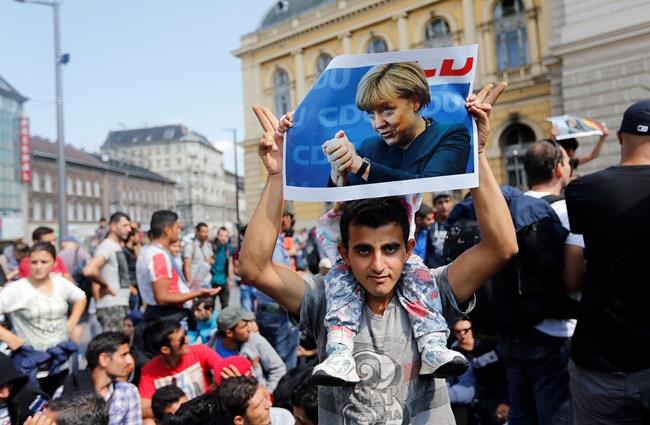
In this Sept. 4, 2015 file photo a migrant holds up a poster of German Chancellor Angela Merkel before starting a march out of Budapest, Hungary, towards Austria. In 2015, Merkel was the face of a welcoming approach to migrants as people fleeing conflicts in Syria and elsewhere trekked across the Balkans, allowing in hundreds of thousands and insisting that
In this Sept. 4, 2015 file photo a migrant holds up a poster of German Chancellor Angela Merkel before starting a march out of Budapest, Hungary, towards Austria. In 2015, Merkel was the face of a welcoming approach to migrants as people fleeing conflicts in Syria and elsewhere trekked across the Balkans, allowing in hundreds of thousands and insisting that "we will manage" the influx, but running into resistance both at home and among European partners. (AP Photo/Frank Augstein, file)

“All the major crossroads you had to navigate … we never mapped out in any election program — they came overnight and you had to govern well,” Bavarian governor Markus Soeder said.

Merkel passed her first test in 2008, pledging at the height of the global financial crisis that Germans’ savings were safe. Over the following years, she was a leading figure in the effort to save the euro currency from the debt crisis that engulfed several members, agreeing to bailouts but insisting on painful spending cuts.

In 2015, Merkel was the face of a welcoming approach to migrants as people fleeing conflicts in Syria and elsewhere trekked across the Balkans. She allowed in hundreds of thousands and insisted that “we will manage” the influx, but ran into resistance both at home and among European partners.

And in the twilight of her career — she announced in 2018 that she wouldn’t seek a fifth term — she led a COVID-19 response that saw Germany fare better than some of its peers.

On the international stage, Merkel insisted on seeking compromises and pursuing a multilateral approach to the world’s problems through years of turbulence that saw the U.S. drift apart from European allies under President Donald Trump and Britain leave the European Union.

“I think Ms. Merkel’s most important legacy is simply that, in such a time of worldwide crises, she provided for stability,” said Ralph Bollmann, a biographer of Merkel and a journalist with the Frankfurter Allgemeine Sonntagszeitung newspaper.

There was “a constant succession of crises that were really existential threats and raised questions over the world order we are used to, and her achievement is that she led Germany, Europe and perhaps to some extent the world fairly safely through that, for all that you can criticize details,” Bollmann said.

Before winning the top job in 2005, he noted, Merkel campaigned as “a chancellor of change, who wanted to make Germany more modern,” seeking deeper economic reforms and a more socially liberal approach than her center-right party had previously taken.

But she ditched much of her economic agenda after almost blowing a huge poll lead by turning off voters with talk of far-reaching reforms, instead embracing what she called an approach of “many small steps.” Along with a pragmatic willingness to jettison conservative orthodoxy such as conscription when opportune, it enabled her to dominate the center ground of German politics.

Crises consumed so much energy that “not much time was left to deal with other issues,” Bollmann said. There is plenty of unfinished business: Merkel has conceded that “the lack of digitization in our society” is a problem, ranging from notoriously patchy cell phone reception to many health offices using faxes to transmit data during the pandemic.

Merkel’s political longevity is already historic. Among democratic Germany’s post-World War II leaders, she lags only Helmut Kohl, who led the country to reunification during his 1982-98 tenure. She could overtake even him if she is still in office on Dec. 17. That’s feasible if parties are slow to form a new government after the Sept. 26 election.

Merkel, 67, insists that others must judge her record. Still, she highlighted a few achievements at a rare campaign appearance last month, starting with the reduction of the number of unemployed in Germany from over 5 million in 2005 to under 2.6 million now.
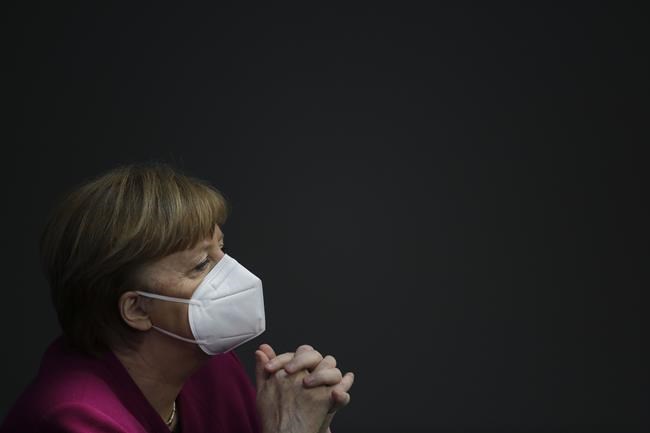
In this Thursday, March 25, 2021 file photo, German Chancellor Angela Merkel attends a session of the German parliament Bundestag ahead of an European Union summit at the Reichstag building in Berlin, Germany. Merkel pointed to her government's drive to improve Germany's public finances, which enabled it to stop running up new debt from 2014 until the coronavirus pandemic pushed it into huge rescue packages. (AP Photo/Markus Schreiber, file)

Predecessor Gerhard Schroeder, whose welfare-state trims and economic reforms were beginning to kick in when he left office, arguably deserves part of the credit.

Merkel also inherited a plan to exit nuclear power from Schroeder, but abruptly accelerated it following the meltdowns at Japan’s Fukushima plant in 2011. More recently, she set in motion Germany’s exit from coal-fueled power.

The chancellor pointed to progress on renewable energy, saying its share of the German energy mix has risen from 10% to well over 40%. Merkel was often referred to as the “climate chancellor” in her early years, but also has drawn criticism for moving too slowly; her government this year moved forward the date for reducing German greenhouse gas emissions to “net zero” to 2045, after the country’s top court ruled that previous plans place too much of the burden on young people.

Merkel praised her government’s drive to improve Germany’s public finances, which enabled it to stop running up new debt from 2014 until the coronavirus pandemic pushed it into huge rescue packages. Opponents argue that it skimped on necessary investments in infrastructure.

“I could talk about how we saved the euro,” she said, adding that “our principle of combining the affected countries’ own responsibility with solidarity was exactly the right method to give the euro a future.” Merkel’s austerity-heavy approach was resented deeply in parts of Europe and controversial among economists, but allowed her to overcome reluctance at home to bail out strugglers.

Whatever the ultimate verdict, Merkel can celebrate a unique end to her tenure: she is set to become the first German chancellor to leave power when she chooses.

___

Kerstin Sopke in Berlin contributed to this report.

Report Error Submit a Tip

More Stories

Wait times for MRIs getting worse in Brandon, Dauphin

Rylee Gerrard 4 minute read Yesterday at 2:01 AM CDT

BRANDON — Wait times for MRI scans have surged in the Prairie Mountain Health region during the last two years.

Despite a campaign promise by the NDP in September 2023 to increase the number of allied health professionals capable of administering diagnostic imaging in northern and rural areas, wait times for MRIs have increased dramatically in Brandon and Dauphin.

Median imaging wait times tripled at Dauphin Regional Health Centre between 2024 and 2026, increasing from eight to 24 weeks, according to the province’s wait time dashboard.

The Brandon Regional Health Centre median wait times for MRI scans more than doubled during the same period, from nine to 23 weeks.

Free Press literary editor picks noteworthy Canadian fiction and non-fiction titles to watch for this fall

Ben Sigurdson 8 minute read Preview

Free Press literary editor picks noteworthy Canadian fiction and non-fiction titles to watch for this fall

Ben Sigurdson 8 minute read Yesterday at 6:00 AM CDT

For many book lovers, summer means relaxing at the beach, in the backyard or at the cottage with fun, warm-weather page-turners — easy-going romance novels, gripping thrillers or even a dishy biography.

And some may long for the summer months to slow down, fall books season always offers up some of the most compelling reads for bookworms.

Here are 10 works of fiction and 10 non-fiction titles from Canadian authors slated to be published in the coming months — from Olympians to separatists, draft dodgers, plutocrats, prime ministers, bird-men and beyond, the characters in these forthcoming titles run the gamut.

FICTIONEliza Sunshine

Read
Yesterday at 6:00 AM CDT

Kinew’s message for PM: don’t back down

Niigaan Sinclair 5 minute read Preview

Kinew’s message for PM: don’t back down

Niigaan Sinclair 5 minute read Friday, Aug. 21, 2026

Let it be known that when Canada’s provinces and alcohol industries needed a defender, Canada’s first First Nations provincial premier was their greatest warrior.

This is, admittedly, a provocative opening line — referencing historical and cultural intersections and relying on a stereotype or two.

It’s impossible, however, not to see how important the nearly Canada-wide provincial-led ban on the sale of U.S. alcohol is to Manitoba Premier Wab Kinew.

It’s due to his stand on national matters like these that he’s become very popular — according to polls, the most popular premier in Canada — and has been empowered to take on the mantle of one of the captains of “Team Canada” on economic, political and domestic issues.

Read
Friday, Aug. 21, 2026

Plenty of alternatives to U.S. wines on the shelves

Ben Sigurdson 5 minute read Preview

Plenty of alternatives to U.S. wines on the shelves

Ben Sigurdson 5 minute read Yesterday at 6:00 AM CDT

In February 2025, Manitoba (and most other provinces) pulled American liquor from store shelves as part of the ongoing trade dispute with the United States.

Then in December, the province followed a similar course to others and put American booze that was already on hand back on shelves, selling off inventory that had been wasting away in warehouses for months, and directing proceeds from those sales to charities.

Lineups sprung up at numerous stores as consumers snapped up bestselling American products — think Maker’s Mark, Jack Daniel’s, Apothic Red and the like. After that initial rush, what was left has been languishing on shelves ever since, with many products eventually being drastically discounted for a quick sale, lest they become too long in the tooth.

I decided early on not to write about/review U.S. products in this space until things were well and truly sorted. But a few months back, I found myself in the mood for a big, oaky red wine and — in a moment of weakness, or nostalgia, or maybe just curiosity — I picked up a $30-ish California Cabernet Sauvignon.

Read
Yesterday at 6:00 AM CDT

Unresolved issues leave little space for you

Maureen Scurfield 5 minute read Yesterday at 2:00 AM CDT

DEAR MISS LONELYHEARTS: My boyfriend — who is newly divorced — has two great children from his marriage. Although he and I have been together since Christmas, it’s obvious he loves his kids much more than he loves me! For instance, he lavishes affection on the kids when they’re over and completely leaves me out. I’m just the cook and dish-washer for the night.

When I brought this up recently, he said, “My girlfriends don’t last, because if I’m openly affectionate with them, the kids tell their mother we’re making out in front of them! They want all my affection and attention when I’m with them.” Then he added, “Stick around, and the kids will probably loosen up.”

Stick around? The explanation and his “advice” totally turned me off. What do you think?

— Not Second-Best to Anyone, St. Vital

Five Things: PM Carney explains why Canada left the U.S. negotiating table

David Baxter, The Canadian Press 5 minute read Preview

Five Things: PM Carney explains why Canada left the U.S. negotiating table

David Baxter, The Canadian Press 5 minute read Updated: Yesterday at 1:58 PM CDT

OTTAWA - Canada is preparing to hit the U.S. with dollar-for-dollar tariffs in response to new 50 per cent duties on $28 billion worth of Canadian products that took effect when talks between the two nations collapsed as negotiations neared the finish line. 

Prime Minister Mark Carney was quiet publicly during the final days of negotiations, but now has now explained his rationale for telling the Canadian negotiating team, led by Canada-U.S. Trade Minister Dominic LeBlanc and chief negotiator Janice Charette, to leave the table.

Restrictions on further trade deals

"The U.S. Introduced at the last hours, in the last hours, efforts to restrict our ability to have other trade deals. You heard me say a moment ago, what we've accomplished in the past year, 20 new deals, economic and security partnerships, the prospect of doubling our market access because we believe in free trade. We're the partner of choice in many respects for countries around the world and the Americans wanted to restrict that. They had language that what they wanted to restrict that, unacceptable," Carney said during a press conference on Parliament Hill.

Read
Updated: Yesterday at 1:58 PM CDT