Alberta’s ‘Open For Summer’ plan was premature: chief medical officer of health
Advertisement
Read this article for free:
or
Already have an account? Log in here »
To continue reading, please subscribe:

Digital Subscription
One year of digital access for only $205*
- Enjoy unlimited reading on winnipegfreepress.com
- Read the E-Edition, our digital replica newspaper
- Access News Break, our award-winning app
- Play interactive puzzles
*First annual payment billed as $205.00 + GST for one year. This annual subscription will automatically renew at $233.00 + GST every 52 weeks (10% off the regular annual price of $259.35). Offer available to new and qualified returning subscribers only. Cancel any time.
To continue reading, please subscribe:
Add Free Press access to your Brandon Sun subscription for only an additional
$1 for the first 4 weeks*
- Enjoy unlimited reading on winnipegfreepress.com
- Read the E-Edition, our digital replica newspaper
- Access News Break, our award-winning app
- Play interactive puzzles
*Your next Brandon Sun subscription payment will increase by $1.00 and you will be charged $17.95 plus GST for four weeks. After four weeks, your payment will increase to $24.95 plus GST every four weeks.
Read unlimited articles for free today:
or
Already have an account? Log in here »
Hey there, time traveller!
This article was published 14/09/2021 (1813 days ago), so information in it may no longer be current.
Alberta’s top doctor says the province’s “Open For Summer” plan set the trajectory for a crushing fourth wave of COVID-19, which her predecessor warns is leading to an “acute care system breakdown.”
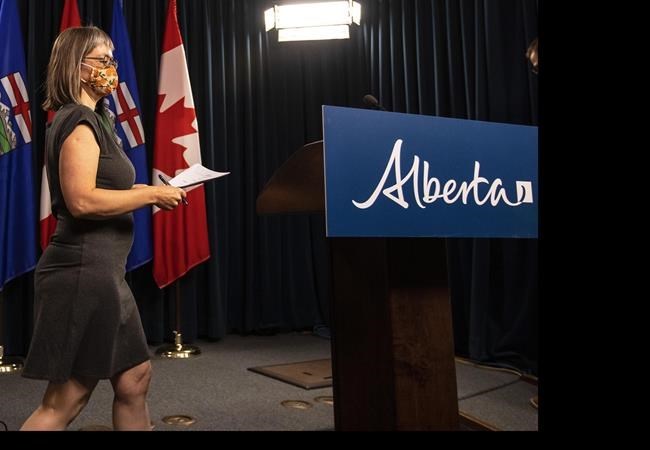
Chief medical officer of health, Dr. Deena Hinshaw, told a conference call with doctors Monday that lifting all public health restrictions in July was the wrong move. She said other provinces that kept base-level restrictions to manage the spread of the virus are faring better than Alberta is now.
“Obviously, Alberta is in a significant crisis state right now,” Hinshaw said. “Delta has spread much more quickly and has had more severe outcomes than we anticipated.”
She said available data in July on COVID-19 spread and outcomes, together with vaccine uptake, led her to believe it was an appropriate time to open the province.
“The expectations did not match the reality,” said Hinshaw, who added there was not the expected decoupling of case rates compared to hospitalizations. “(We) really had to shift and walk back about, ‘OK, we’re not ready yet, need to take more time.’”
Dr. James Talbot, a former chief medical health officer for Alberta, said the worsening fourth wave is increasing the likelihood that physicians will have to decide who lives and dies as the health system collapses.
“We’re looking at a situation in which an entire cohort of health-care workers, doctors, nurses and anesthetists, administrators are going to live with long-term consequences of having to make life or death decisions for a situation that was completely preventable,” Talbot said in an interview Tuesday.
He said Alberta’s United Conservative government has failed to address the crisis.
Without vaccine passports and reinstated public health measures to curb spread, the situation will continue to spiral, Talbot predicted.
“If the triage protocol has to be invoked, there are going to be people who would have otherwise survived a heart attack, pregnancy complication or motor vehicle collision who are not going to, because the bed is filled with someone who decided not to get vaccinated.”
Federal Liberal leader Justin Trudeau criticized Alberta and Saskatchewan’s opposition to vaccine passports during a campaign stop in Richmond, B.C., on Tuesday.
“I feel bad, really bad for those people in Alberta and Saskatchewan who stepped up to do the right thing,” said Trudeau of the millions who have been vaccinated.
“Because of leadership that will not commit to keeping them safe in the right way, or even protecting the economy the right way, they are facing greater risks because of cancelled surgeries. They are facing emergency public health restrictions that may have to be brought in.”
During the call with doctors, Hinshaw said it’s clear from other jurisdictions that vaccine requirements for discretionary activities can increase uptake among younger populations.
Premier Jason Kenney has repeatedly rejected calls for a proof of vaccination policy in Alberta. However, beginning Thursday, Albertans will be able to print their vaccine status on a card or show it electronically.
Hinshaw also said she “deeply regrets” how comments she made in July led some Albertans to believe COVID-19 was over. She acknowledged frustrations by health-care workers with the government’s handling of the pandemic.
A record-setting 212 Albertans were in intensive care as of Tuesday. Overall, 822 people were hospitalized with COVID-19. Alberta had the highest active case count in Canada at 18,265.
Government spokesman Harrison Fleming said the COVID-19 committee was meeting Tuesday and a caucus meeting was to follow.
In Edmonton, NDP Opposition Leader Rachel Notley said video of Hinshaw’s conference call, which circulated online, was concerning given there was no plan mentioned to solve the crisis.
“The defeatist attitude was disturbing,” Notley said outside the legislature.
“The lack of an answer was concerning, (as were) the admissions that this whole crisis that we are in can be traced back to the decisions taken by this government as a whole in July.”
Notley renewed a call for Kenney’s government to act, particularly with a vaccine passport.
“Forecasts prepared by Alberta Health Services say that the number of Albertans who need intensive care in order to save their lives is going to almost double in the coming weeks. We are slipping off the edge of a great cliff.”
This report by The Canadian Press was first published Sept. 14, 2021.