

Slower speed limits directly ahead
School zones return Tuesday as lead-footed drivers risk steep fines

Advertisement
Read this article for free:
or
Already have an account? Log in here »
To continue reading, please subscribe:

Digital Subscription
One year of digital access for only $205*
- Enjoy unlimited reading on winnipegfreepress.com
- Read the E-Edition, our digital replica newspaper
- Access News Break, our award-winning app
- Play interactive puzzles
*First annual payment billed as $205.00 + GST for one year. This annual subscription will automatically renew at $233.00 + GST every 52 weeks (10% off the regular annual price of $259.35). Offer available to new and qualified returning subscribers only. Cancel any time.
To continue reading, please subscribe:
Add Free Press access to your Brandon Sun subscription for only an additional
$1 for the first 4 weeks*
- Enjoy unlimited reading on winnipegfreepress.com
- Read the E-Edition, our digital replica newspaper
- Access News Break, our award-winning app
- Play interactive puzzles
*Your next Brandon Sun subscription payment will increase by $1.00 and you will be charged $17.95 plus GST for four weeks. After four weeks, your payment will increase to $24.95 plus GST every four weeks.
Read unlimited articles for free today:
or
Already have an account? Log in here »
School crossing guards are preparing to resume their posts on busy corners across the Winnipeg School Division, but Luna Zúñiga isn’t one of them.
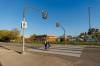
Zúñiga hung up her high-visibility vest about 30 months ago after she was struck by a motorist while escorting a child through a pedestrian crosswalk on Grant Avenue at Lanark Street.
Zúñiga protected the child, who wasn’t hurt, but the educational assistant at nearby J.B. Mitchell School suffered life-altering injuries, including nerve damage that limits her stamina, range of motion and makes her left leg “feel like it’s burning all the time.”
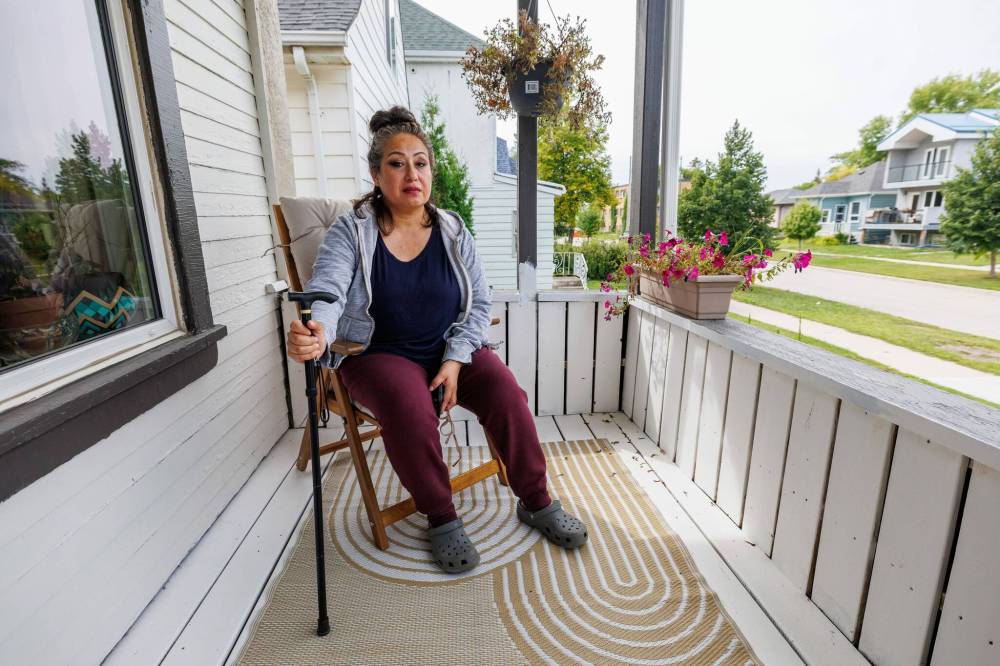
“I don’t know what needs to be done (to improve school-zone safety),” she said. “But I do know that when a six-year-old is crossing the street, a car needs to be fully stopped.”
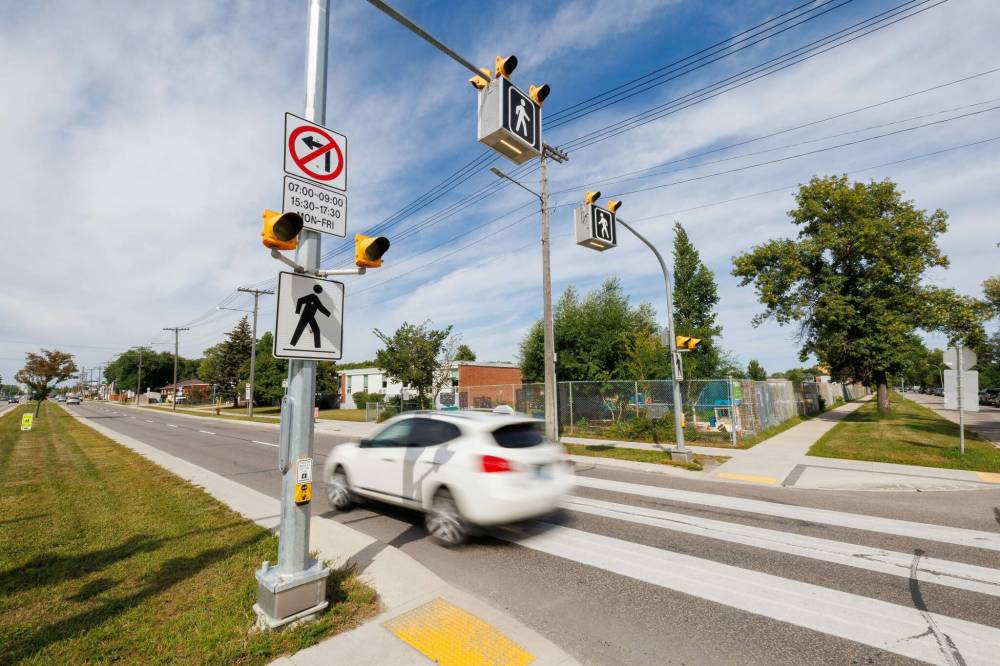
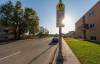
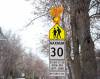
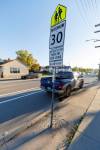
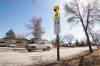
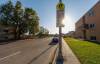
Winnipeg’s 30 km/h school zones return on Tuesday — a full week before the 2026-27 school year starts — following a summer hiatus. They are in effect every weekday, from 7 a.m. to 5:30 p.m., from Sept. 1 until July 1.
The WSD board was unsuccessful last year in making an appeal to city council to permanently reduce speeds around its elementary school buildings.
The city’s road-safety unit is focusing on piloting traffic-calming measures, such as in-street crosswalk signage, and reviewing whether any regional roads should be designated as 30 km/h school zones.
Grant Avenue, where Zúñiga was injured during a morning shift in February 2024, is currently classified as a regional road.
Zúñiga said she supports lowering the limit and doing so on a year-round basis, but she said that alone won’t fix the chronic safety issues at the site.
Historic speeding-ticket records suggest Tuesday will be one of the most profitable days of 2026 for the city, said Curtis Pankratz, a traffic-safety researcher at the University of Winnipeg.
“September days before school starts are immensely profitable. There’s nothing going on and it still feels like holidays and those are streets that are normally 50,” Pankratz said.
The associate professor estimates photo-radar tickets in Winnipeg generate, on an average month, about $4 million. That figure is higher when drivers are adjusting to new routines during back-to-school season, he said.
Pankratz recently analyzed time stamps of more than 260,000 infraction records from reduced-speed school zones between September 2014 and September 2019.
“There’s a rule of thumb — when there’s no kids (visible), there’s a lot of tickets,” he said.
His team’s latest research project shows overall infractions on instructional days drop, as well as average speeds, within 15 minutes of the first bell and final bell, Pankratz said.
“There’s a rule of thumb… when there’s no kids (visible), there’s a lot of tickets.”
The review included nearly 24,400 photo-radar tickets outside River Elm School on eastbound Talbot Avenue east of Watt Street.
There were 103 infractions in that 30 km/h zone between 8:50 a.m. — which is when the first bell rings at the elementary school — and 8:55 a.m.
Between 9:15 a.m. and 9:20 a.m., that number spiked to 386.
“It reinforces what we already knew,” said Chris Sweryda, an independent researcher who regularly collaborates with Pankratz, after becoming obsessed with photo radar-related corruption about 13 years ago.
“People don’t speed when kids are present… and it shows that people will drive accordingly, to the conditions of the road, which is the system we need to depend on.”
Sweryda, who was a candidate in the 2025 city council byelection in the Elmwood-East Kildonan ward, said he’s in favour of proactive interventions, such as the widespread use of flashing lights at eye-level, rather than punitive ones.
There are dozens of missing school-zone signs that need to be replaced or installed to make motorists aware they’re entering them, he added.
Over the summer, in preparation for a new school year, the city installed traffic-calming curbs at several school crosswalks “with vehicle speeding issues, long crossing distances and poor visibility,” spokesperson Julie Dooley said.
New in-street signage is also being set up at 10 pedestrian crossings — near Elwick, Acadia Junior High, Victor H L Wyatt, Harold Hatcher, HC Avery, Frontenac, St. Germain, Princess Margaret, South Pointe and Wellington schools — before classes start.
“People think it’s a right to drive… but it’s actually a privilege.”
“We are also piloting a new school-area pavement marking as a way to increase driver awareness when entering a school zone,” Dooley said in a statement.
She said these markings are being tested, starting in late September, at five schools with wide streets that are speeding hot spots.
Sargent Park resident Jeff Rupert said he wants speed bumps installed on Clifton Street, where there is one of the city’s roughly 170 30 km/h zones.
“Cars still rip by here during the school day,” Rupert said, sitting on his front porch — the senior’s usual hangout spot — facing Clifton School.
Neighbour Emmalee Mosher echoed his concerns about speeding near the elementary school. Mosher regularly walks her two huskies and recently experienced a near-miss there.
“People think it’s a right to drive,” she said, “but it’s actually a privilege.”
She is “pro community-based solutions,” such as expanding school-patrol programs.
Clifton was among 270 schools in Manitoba that participated in the CAA School Safety Patrol last year. The program gives young students the opportunity to don their own high-visibility vests alongside paid adult crossing guards to help kids get to and from school during peak commuter times.
maggie.macintosh@freepress.mb.ca
Maggie Macintosh
Education reporter
Maggie Macintosh reports on education for the Free Press. Originally from Hamilton, Ont., she first reported for the Free Press in 2017. Read more about Maggie.
Funding for the Free Press education reporter comes from the Government of Canada through the Local Journalism Initiative.
Every piece of reporting Maggie produces is reviewed by an editing team before it is posted online or published in print — part of the Free Press‘s tradition, since 1872, of producing reliable independent journalism. Read more about Free Press’s history and mandate, and learn how our newsroom operates.
Our newsroom depends on a growing audience of readers to power our journalism. If you are not a paid reader, please consider becoming a subscriber.
Our newsroom depends on its audience of readers to power our journalism. Thank you for your support.
Maggie Macintosh
Education reporter
Maggie Macintosh reports on education for the Free Press. Originally from Hamilton, Ont., she first reported for the Free Press in 2017. Read more about Maggie.
Funding for the Free Press education reporter comes from the Government of Canada through the Local Journalism Initiative.
Every piece of reporting Maggie produces is reviewed by an editing team before it is posted online or published in print — part of the Free Press‘s tradition, since 1872, of producing reliable independent journalism. Read more about Free Press’s history and mandate, and learn how our newsroom operates.
Our newsroom depends on a growing audience of readers to power our journalism. If you are not a paid reader, please consider becoming a subscriber.
Our newsroom depends on its audience of readers to power our journalism. Thank you for your support.
Related Articles
Speed reduction proposed for River Road after child hit


Advertisement Advertise With Us
Advertisement Advertise With Us